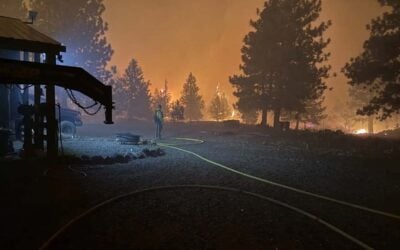

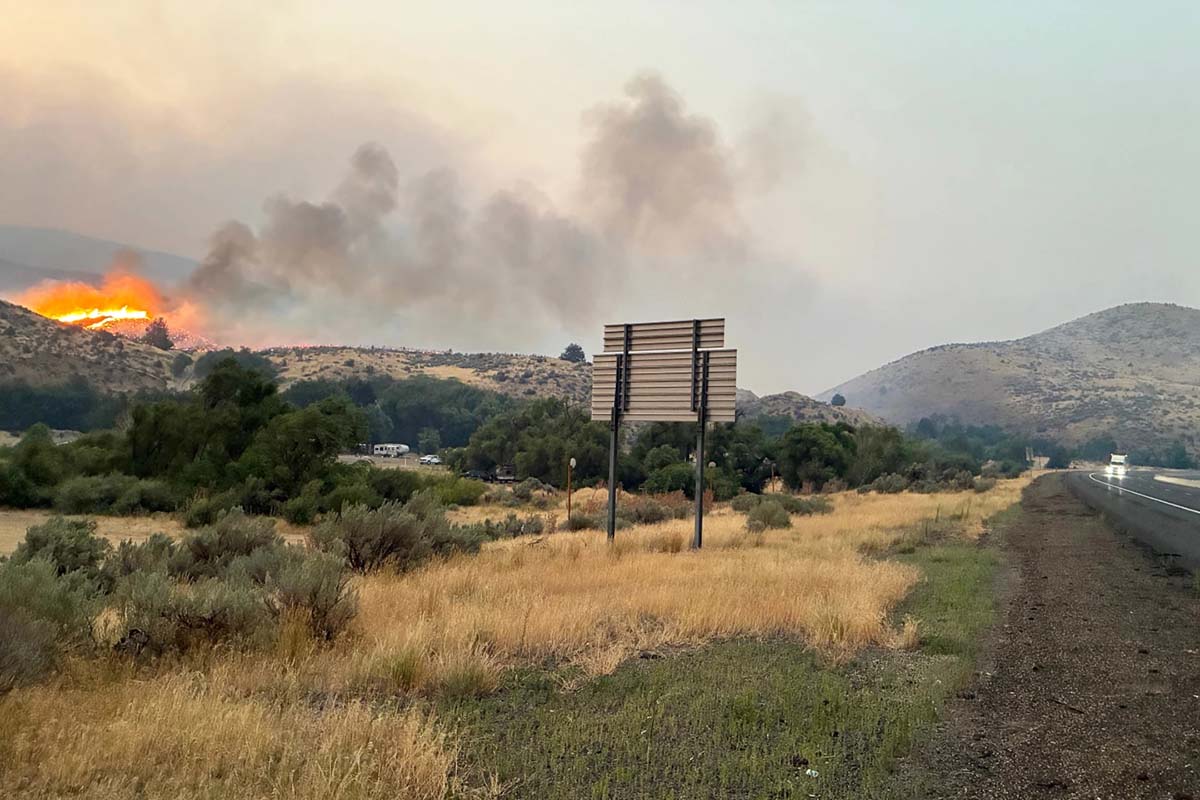
As firefighters continue working long shifts across a smoke-covered Oregon, the federal government has agreed to help cover the cost of battling three major wildfires. Two other requests, including one tied to a fire complex that grew to nearly 300,000 acres, were denied.
According to reporting from KGW, the Federal Emergency Management Agency approved Fire Management Assistance Grants for the Lower Dry Creek Fire, Akawa Butte Fire and Grasshopper Fire.
FEMA denied Oregon’s applications for the East Evans Creek Fire in Southern Oregon and the sprawling Rowe Creek Complex in north-central Oregon.
That means three of the five wildfire assistance requests submitted by Gov. Tina Kotek’s administration received federal approval.
That distinction matters because FEMA did not reject Oregon’s wildfire assistance across the board. The agency approved three of the five requests submitted by the state, meaning federal support is still being provided for the Lower Dry Creek, Akawa Butte and Grasshopper fires. In other words, this was not a blanket refusal to help Oregon, nor was every request from the state turned away.
Some headlines may leave readers with the impression that the federal government simply denied Oregon wildfire aid altogether. The fuller picture is more complicated. Most of the state’s applications were approved, while two were rejected after being reviewed individually. Even so, the denials involving the East Evans Creek Fire and Rowe Creek Complex deserve a clear explanation. Both incidents prompted serious evacuations and threatened homes, utilities, transportation routes and other critical infrastructure. Oregon officials and taxpayers have a legitimate interest in knowing why those two fires failed to qualify while three others met FEMA’s standards.
What the Federal Grants Cover
Fire Management Assistance Grants, commonly known as FMAGs, are intended to help states manage fires that threaten to become major disasters.
Under the program, the federal government can cover up to 75 percent of eligible firefighting expenses. Oregon and local agencies remain responsible for the remaining share.
Eligible costs can include firefighting equipment, supplies, field camps, mobilization, emergency protective work and other expenses directly connected to controlling the fire.
The grants are meant to provide assistance while a dangerous fire is still being fought. They are separate from a presidential major disaster declaration, which may unlock additional forms of federal help after widespread destruction has occurred.
Federal regulations state that FEMA should consider several factors when reviewing an application. Those include threats to lives and property, risks to important infrastructure and watersheds, the availability of state and local firefighting resources, current fire danger and the possibility of serious economic damage.
The written rule does not establish a simple acreage requirement or a fixed number of homes that must be threatened.
Three Oregon Requests Approved
The three fires approved for federal assistance were the Lower Dry Creek Fire near Milton-Freewater, the Akawa Butte Fire near Sisters and the Grasshopper Fire near Pine Hollow.
According to the office of Republican Congressman Cliff Bentz, FEMA determined that those fires had the potential to become major disasters without a rapid response.
Bentz represents Oregon’s sprawling 2nd Congressional District, which includes most of the state’s fire-stricken central and eastern regions.
His office noted that the approved grants can reimburse Oregon for as much as 75 percent of eligible firefighting costs. Bentz also acknowledged the seriousness of the fires, saying they had unfortunately grown into major incidents after the requests were submitted.
FEMA separately announced federal funding authorization for the Akawa Butte and Grasshopper fires during July.
Why Two Requests Were Denied
The more difficult question is why the East Evans Creek Fire and Rowe Creek Complex did not receive the same approval.
At the time Oregon applied for assistance, both fires involved Level 3 “Go Now” evacuation orders.
The East Evans Creek Fire had burned nearly 16,000 acres when FEMA rejected the application on July 22. According to information provided by Oregon officials to U.S. Sens. Ron Wyden and Jeff Merkley, more than 230 homes were under Level 3 evacuation orders.
The fire was also reported to be threatening roads, bridges, communication towers, electric and gas utilities, campgrounds, agricultural operations and irrigation infrastructure.
The Rowe Creek Complex presented an even larger challenge.
FEMA denied that application on July 24, when more than 400 people were reportedly under Level 3 evacuation orders. The complex was also threatening electrical systems, communication equipment and transmission lines.
By July 28, the Rowe Creek Complex had grown to nearly 295,000 acres. Earlier in the incident, it was reported as the largest wildfire in the United States.
The fire spread across a broad section of north-central Oregon, affecting parts of Wheeler, Crook, Jefferson and Wasco counties. Its footprint stretched across ranching country, public lands and remote communities where local firefighting resources can be limited.
An Oregon State Fire Marshal update from July 24 placed the complex at 192,681 acres and reported that evacuation notices remained active in Wheeler and Wasco counties. Officials said crews were protecting structures, working around Highway 26 and preparing for dangerous fire weather.
Oregon Senators Demand an Explanation
Wyden and Merkley, both Democrats, have asked FEMA to explain why the two applications were rejected.
Their criticism deserves to be reported, but it should also be presented for what it is: an argument made by elected officials who are requesting more information from a federal agency.
The senators said Oregon officials had previously understood FEMA’s informal benchmark to involve approximately 150 threatened primary residences, with the number reportedly rising above 200 in recent years.
Both rejected fires reportedly exceeded that range.
However, no such numerical threshold appears in the federal regulation governing the program. FEMA’s published rule instead gives the agency discretion to examine several factors surrounding each individual fire.
The senators contend that FEMA told state officials the two fires failed to meet the requirements for a major disaster declaration.
They argue that this interpretation would set the bar too high because the grant program is supposed to help stop a fire from becoming a major disaster, not force a state to wait until catastrophic damage has already occurred.
That is a reasonable issue for FEMA to address directly.
The senators have asked the agency to identify the standards used for the decisions, explain whether any criteria changed between 2025 and 2026, identify which federal officials reviewed the applications and disclose what information was used beyond the data submitted by Oregon. They requested a response by August 10.
The Full Picture Is More Complicated Than the Politics
It would be misleading to describe FEMA’s action simply as the Trump administration refusing to assist Oregon.
The federal agency approved most of the state’s requests, including assistance for three active and dangerous fires. Those approvals will help Oregon recover a substantial portion of eligible firefighting expenses.
It would also be a mistake to dismiss concerns about the two denied requests simply because they were raised by Democratic senators.
The East Evans Creek Fire and Rowe Creek Complex threatened homes, infrastructure and rural communities. The size of the Rowe Creek Complex alone makes FEMA’s reasoning worthy of public explanation.
This is ultimately less about party politics than government accountability.
Federal agencies are given discretion for a reason. Every fire develops differently, and acreage alone does not necessarily determine the danger to people or property. A smaller fire moving toward a populated community may present a greater immediate threat than a much larger fire burning through remote land.
Still, discretion must be applied consistently. When states are committing firefighters, aircraft, engines and emergency personnel during an already punishing fire season, they need to know what standards federal officials are using.
Oregonians deserve a clear explanation of why three applications qualified while two others did not.
Oregon’s Firefighters Remain on the Front Lines
While elected officials and federal administrators debate policy, the work on the ground continues.
Firefighters from local departments, state agencies, federal crews and private contractors are still cutting fire lines, protecting homes, operating heavy equipment and working through difficult heat, smoke and terrain.
Across rural Oregon, volunteer departments and small communities are again being asked to carry enormous responsibilities with limited resources.
Federal reimbursement decisions matter because wildfire response is expensive. Aircraft, engines, crews, fuel, equipment and emergency operations can quickly cost millions of dollars.
The approval of three grants is welcome news for Oregon taxpayers and emergency agencies.
The denial of two others deserves scrutiny, not exaggerated partisan storytelling. FEMA should explain its decisions clearly, Oregon officials should release the full applications and denial documents when possible, and the public should be allowed to judge whether the standards were applied fairly.
For now, the most accurate summary is straightforward: Oregon requested federal assistance for five wildfires. FEMA approved three applications and denied two.
The next step is getting a clear answer about why.
Wildfire resources: Find current incidents, mapped evacuation areas, smoke, road conditions, and recovery help on our Oregon Wildfire Map.