
Beekman Bank’s elaborate wooden front, the curved roofline next door and the close-set storefronts make Jacksonville’s downtown worth a second look in an old photograph. So much of the architecture remains recognizable. Along California Street, the town’s main commercial corridor, the buildings give that familiar 1950s-postcard feeling a much older foundation.
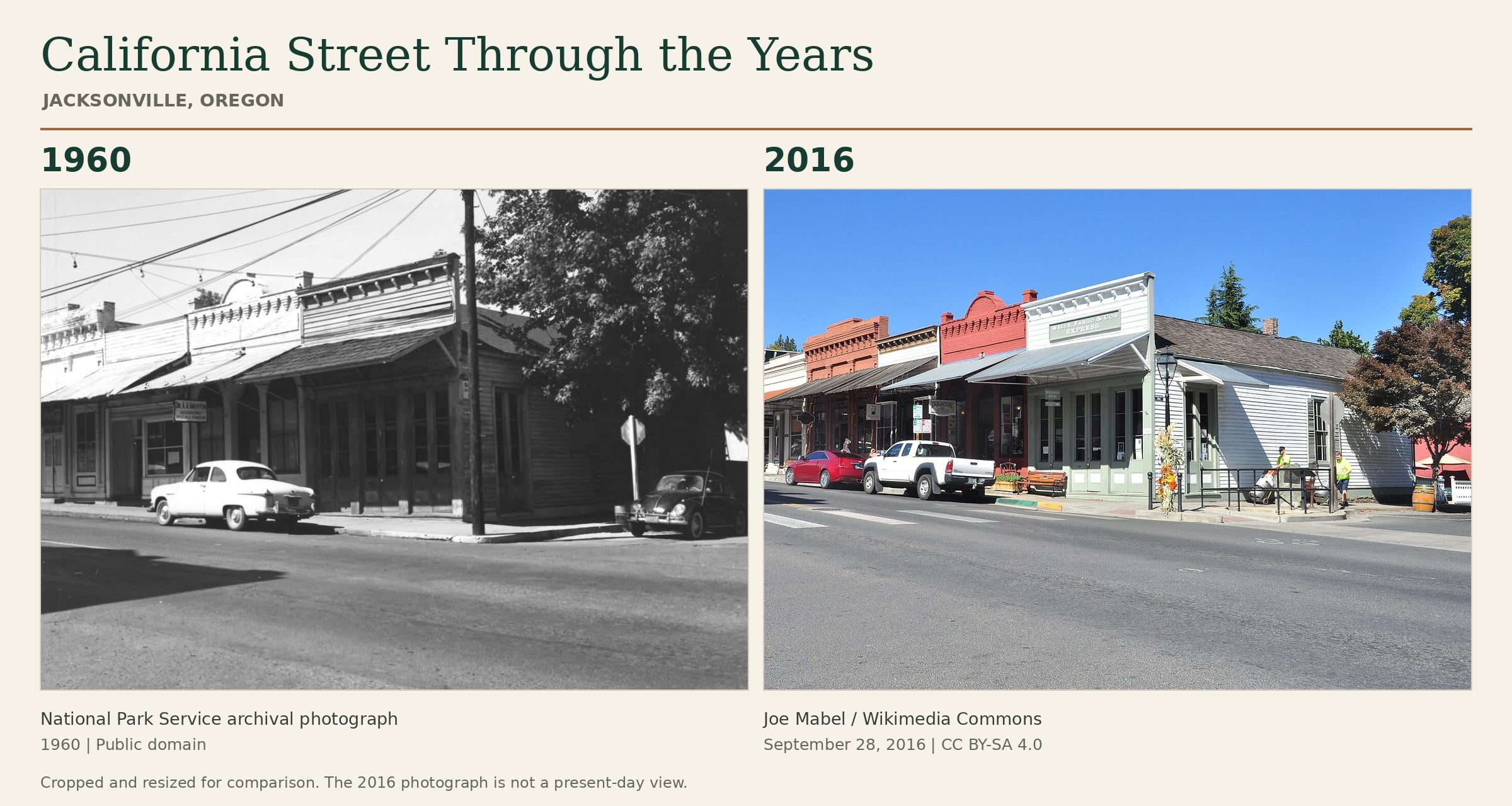
There’s a photograph to put beside that impression, too. A National Park Service image dated 1960 shows Beekman Bank and the neighboring storefronts, an unmistakable piece of the California Street lineup. A photograph of the same buildings from 2016 picks up the bank’s distinctive front and the neighboring curved parapet, despite different paint, signs and cars. The buildings that connect those pictures were already old when either photographer arrived.
That’s the appeal of Jacksonville, west of Medford in the Rogue Valley. Its preserved downtown reaches back to the gold rush, with enough surviving commercial buildings to make an architectural walk feel pleasantly unhurried. The changes are part of the outing, too: a hotel rebuilt after a fire, a frontier banking business, and a restaurant entrance with a Hollywood connection all belong to the street’s story.
A California Street Photograph From 1960 Still Has Familiar Faces
Start with the bank. In the National Park Service’s historic photograph file, its decorative wooden facade makes a useful landmark, with the neighboring shop fronts providing the rest of the comparison. The accompanying caption identifies the image as a 1960 NPS photograph. It’s a solid near-midcentury reference for this particular row, rather than a reason to declare every block untouched since the 1950s.
Put that image beside Joe Mabel’s September 2016 photograph and look above the shop windows. The bank’s tall front, the neighboring curved outline and the sequence of low commercial buildings are recognizable across the two views. Signs and street-level details are easier to replace than an entire building, so the upper facades offer a more useful comparison than the name above a doorway. You can follow the row without needing every detail to match.
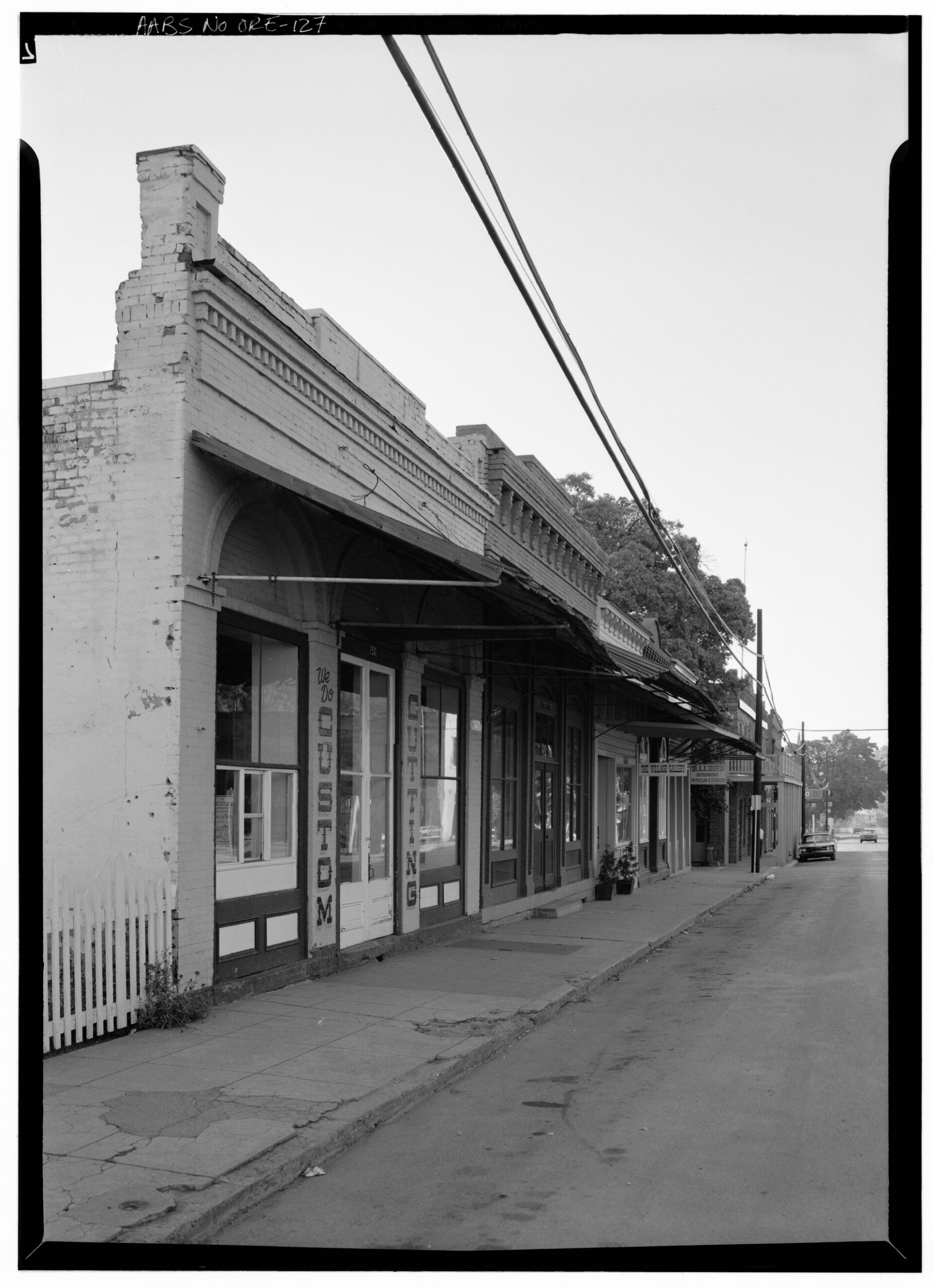
The 1971 Historic American Buildings Survey photograph offers another perspective, looking east along the north side of California Street. Here the buildings stretch away along the sidewalk, with parked cars farther down the street, giving the view depth rather than presenting a single landmark head-on. Those different views are worth keeping separate. Together they document an enduring downtown, while the dates remind us that each photograph captures its own moment.
The Downtown Was Old Long Before the 1950s
Jacksonville began taking shape after prospectors found gold at Rich Gulch on Jackson Creek in the winter spanning 1851 and 1852. The National Park Service’s district nomination places the discovery in either late December 1851 or early January 1852. A mining settlement grew quickly, and Jacksonville became the Jackson County seat in 1853. Merchants, lodging houses and the other businesses needed by a growing community followed the miners.
That beginning explains why a stroll here offers more than a collection of saloon fronts. The historic district includes commercial buildings, homes, churches and public buildings, representing different pieces of a working town. The federal nomination describes surviving Greek Revival, Gothic Revival and Italian Villa architecture, along with the relationships between buildings and their surroundings. Jacksonville’s history is visible in the way those places sit together, as well as in their individual walls.
By the time a midcentury photographer pointed a camera down California Street, the town had already passed through gold-rush growth, destructive fires and a long economic slowdown. The buildings in the picture belonged to an earlier chapter of Oregon. That helps explain the unusual feeling of the street: its architecture could look comfortably old-fashioned in a 1950s scene because it had been old-fashioned for a long time already.
For anyone drawn in by the nostalgic look, those layers give the walk more substance. A narrow commercial front can lead to a story about moving gold, housing travelers or rebuilding a business. A larger hotel speaks to the ambitions of people who expected Jacksonville to keep growing. The buildings were built for customers, tenants and work, and their histories offer plenty to follow beyond the photograph.
Beekman Bank Gives the Gold Rush a Front Door
Beekman Bank is a natural place to begin. Cornelius C. Beekman’s banking business grew out of an express and gold-dust operation established in 1856. Historic Jacksonville dates the surviving bank building to 1863, distinguishing the structure from the earlier business. It stands at California and North Third streets, with a decorative front that makes it particularly easy to pick out in old pictures.
The bank also connects California Street to a much larger network. Express businesses carried mail, parcels and money between mining communities and the places where travelers and goods could make onward connections. Gold needed to move, and people needed a way to conduct business beyond the settlement. A small banking office could have responsibilities far larger than its modest footprint suggests.
In the 2016 photograph, the bank’s wooden front rises beside the neighboring shop buildings, each with its own shape and treatment. That variation is part of the pleasure of looking closely. Rather than one uniform facade applied to a whole block, the row presents a succession of individual buildings. The photograph gives you time to notice where one storefront ends, where another begins, and how their different rooflines fit together.
Save the interior for a scheduled opening or tour rather than assuming that a historic bank operates like an everyday attraction. Historic Jacksonville maintains the official history and visitor information, including its changing programs. The exterior is the starting point for this particular comparison. Beekman’s business history adds a reason to return when a suitable program is available.
The U.S. Hotel Survived a Different Way: By Being Rebuilt
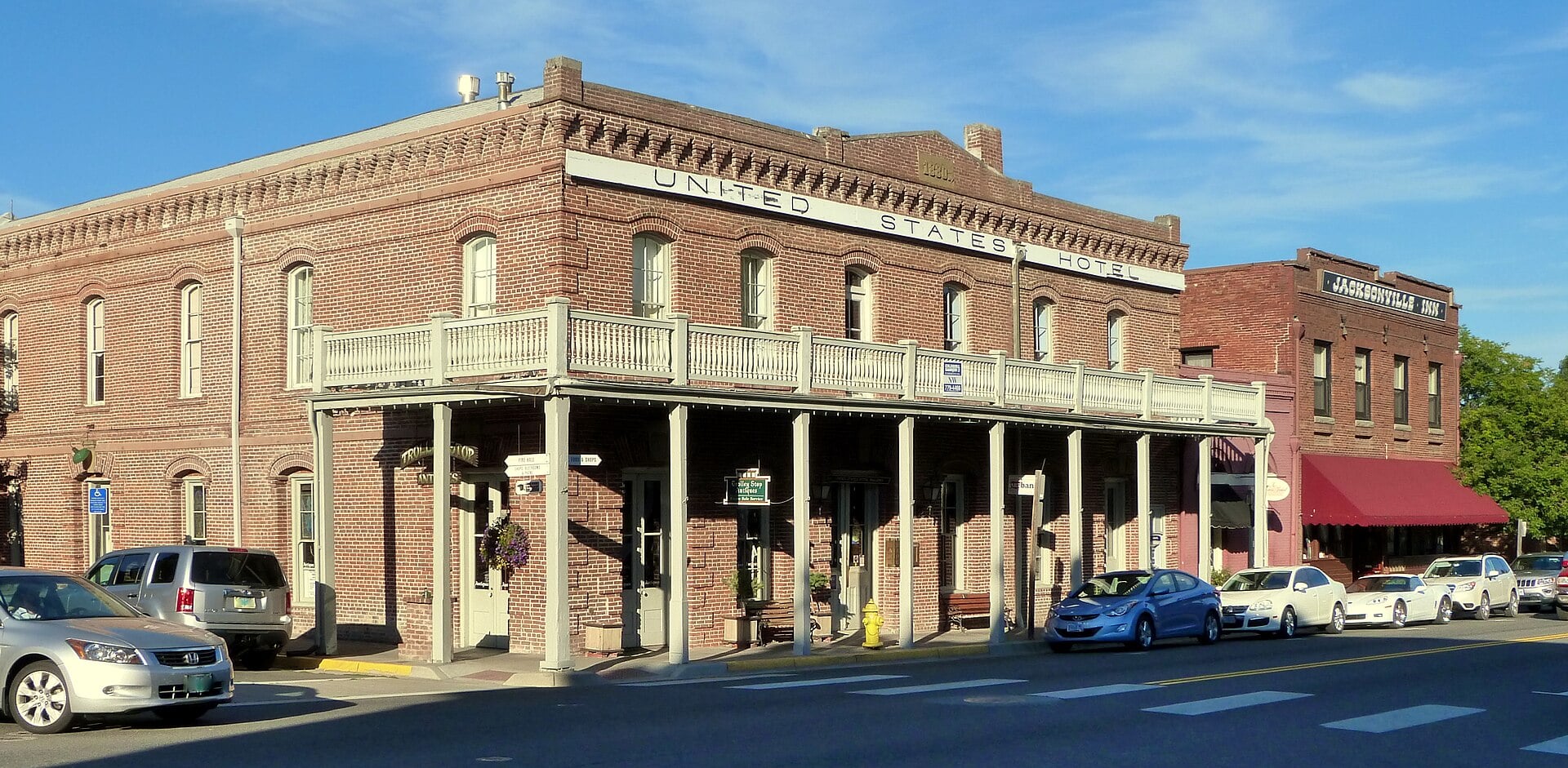
The U.S. Hotel offers a different lesson in survival. The brick hotel opened in 1880, replacing an earlier chapter of lodging on the site. Its predecessor was lost in the destructive 1873 fire, which consumed much of the surrounding block. The building people recognize as the U.S. Hotel belongs to Jacksonville’s rebuilding, rather than to the first rush of temporary construction.
It’s a substantial presence in Ian Poellet’s 2014 photograph of the hotel row, with a two-story brick front, repeated upper windows and decorative details above the street. The neighboring buildings make the scene feel like a continuous commercial block. Look at the line of storefronts and then at the upper floor, and the hotel is easy to distinguish without separating it from its surroundings.
Its construction also helps explain why the town’s gold-rush identity includes buildings from well after the initial discovery. A settlement could begin with tents and wood-frame structures, then acquire brick stores and more substantial lodging. Fires brought another round of rebuilding. California Street records that process, with later investment layered onto a town whose earliest residents had arrived chasing gold.
For a different outcome, look for the former Anderson & Glenn General Store at 125 West California Street. Historic Jacksonville identifies it as a brick building that survived the major fires of 1874 and 1884, when surrounding structures were lost. The store and the U.S. Hotel make a useful pair to consider on the walk. One offers a story of surviving the flames; the other owes its recognizable form to the rebuilding that followed a fire.
Bella Union Has a Hollywood Chapter Behind Its Old-Town Look
Bella Union complicates a first impression in an especially enjoyable way. Historic Jacksonville describes the property at 170 West California Street as three parts, rather than one building of a single age. Its oldest surviving brick portion dates to 1874. The middle section and main entrance came much later, created in 1970 when Jacksonville became a filming location for The Great Northfield Minnesota Raid.
That means a convincing old-town entrance can tell a movie-making story as well as a frontier one. The film connection is a good reason to check a building’s history before assigning it a date from its appearance. Bella Union’s recognizable street presence includes both an older brick structure and a later addition designed for a different purpose. Both have become part of the property’s history.
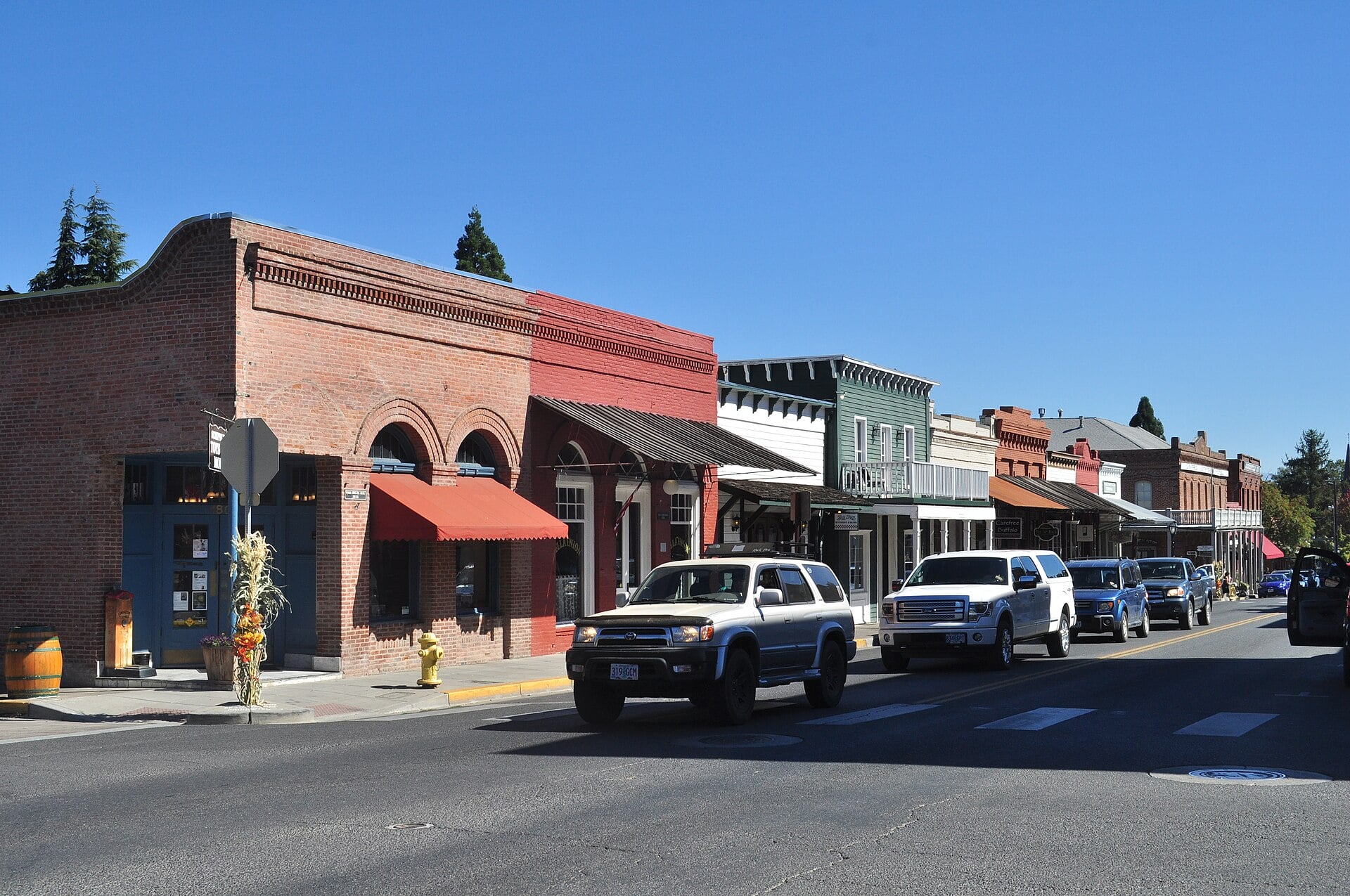
Mabel’s 2016 photograph shows Bella Union among the Fisher Brothers Store and other California Street buildings, with different facades, awnings and rooflines along the block. It’s a useful companion to the bank view because it broadens the walk beyond one particularly photogenic row. Once you’ve noticed the changes at Bella Union, the surrounding buildings invite the same closer attention. Their outlines can be familiar while their individual stories remain very different.
Why So Much of Jacksonville’s Downtown Remained
Jacksonville’s slower years helped preserve the setting that makes those comparisons possible. When the railroad bypassed town in the 1880s, commerce and growth shifted elsewhere. The transfer of the county seat to Medford in 1927 further diminished Jacksonville’s regional role. Buildings that might otherwise have faced replacement remained part of a quieter town.
Economic decline alone couldn’t guarantee their survival. Buildings still needed care, owners and useful purposes, and the historic district received National Historic Landmark recognition in 1966. Jacksonville also has historic protection and design regulations governing work in the district. The preserved streetscape reflects the town’s economic history and the later decisions made about what to keep.
The federal district nomination pays particular attention to scale and spatial relationships, a useful description of what makes a street feel coherent. One old building can survive beside a very different development. Here, the collection of commercial buildings and their relationship to one another became central to the district’s significance. The broader setting was part of what preservationists wanted to protect.
You can see why in the photographs. The eye moves from one storefront to the next, following upper windows, cornices and the line of the sidewalk. A bank, a hotel and a series of shops remain legible as parts of a town, rather than isolated landmarks. For a visitor who likes wandering without a packed itinerary, that gives California Street a satisfying amount to look at within a relatively small area.
Some Familiar-Looking Buildings Have Changed, and Others Are Gone
The same walk includes a few necessary surprises. The Beekman Express Office building at California and South Third is a 2003 reproduction of the original, according to Historic Jacksonville. It should be distinguished from the surviving Beekman Bank at North Third. The shared name and nearby locations make it easy to connect the two, but their buildings have different histories.
Other places have disappeared. The Lyden House once occupied a California and Oregon street corner later used for the telephone exchange building. West Main Street held Jacksonville’s Chinatown, much of which was lost in an 1888 fire. The handsome commercial blocks that remain tell part of the town’s history; they can’t stand in for every neighborhood or everyone who lived and worked here.
Those gaps make the local histories worth reading alongside the photographs. A building that looks convincingly old may be a reconstruction, and a site that attracts little attention may have held an important business or community. Learning about those changes doesn’t spoil the pleasure of California Street. It gives the walk more places to pause, including places where the architecture alone can’t explain what happened.
Plan a Walk Around California Street and the New History Center
For this outing, put California Street at the center of the visit. Beekman Bank is at 110 West California Street, at North Third, while Bella Union’s historic property is at 170 West California Street. Jacksonville also has a separate Main Street, so a search for the town’s main commercial strip is clearer when you use California Street by name. The hotel row, bank and neighboring storefronts give the walk its main architectural thread.
A useful starting point for the larger history is the Jacksonville History Center at 205 West Main Street, in the restored 1881 Old City Hall. Historic Jacksonville now lists the center as open daily from 11 a.m. to 3 p.m. Its exhibits introduce the town’s history and ways to explore the district, and the organization identifies the center as ADA accessible. Check the official website for current hours and programs before making a special trip.
Old City Hall has a building history worth adding to the route. Completed on the site of a brick store damaged in the 1874 fire, it incorporated recycled bricks and housed a town hall, recorder’s office, jail and fire station. The museum’s setting extends the walk beyond merchants and travelers to the everyday business of governing the town. Its reuse also offers a recent example of finding a new purpose for an old Jacksonville building.
The center is a helpful place to ask about individual building access, too. A walk through a historic district and a tour of a historic interior are different plans, and access arrangements can vary by property. Don’t assume that a museum, bank or private building will be open because its facade is part of the streetscape. Leave room to enjoy the exteriors and add an interior visit when the schedule works.
If you’re turning the walk into a longer getaway, our Jacksonville guide offers a broader look at things to do around town. Keep this route for the buildings and their histories, then make time for the other parts of your trip. A California Street comparison is easiest to enjoy when you can pause at a storefront without rushing to the next stop.
Bring the old photographs on your phone if comparing the street appeals to you. Start with the bank’s front, then follow the adjacent rooflines rather than trying to match every sign or parked car. The 1960 NPS view and the dated photographs here offer specific buildings to look for. Before you head out along California Street, stop at the History Center for the local stories behind them.