
Oregon City’s free elevator grew from a difficult commute into one of the state’s most unusual landmarks.
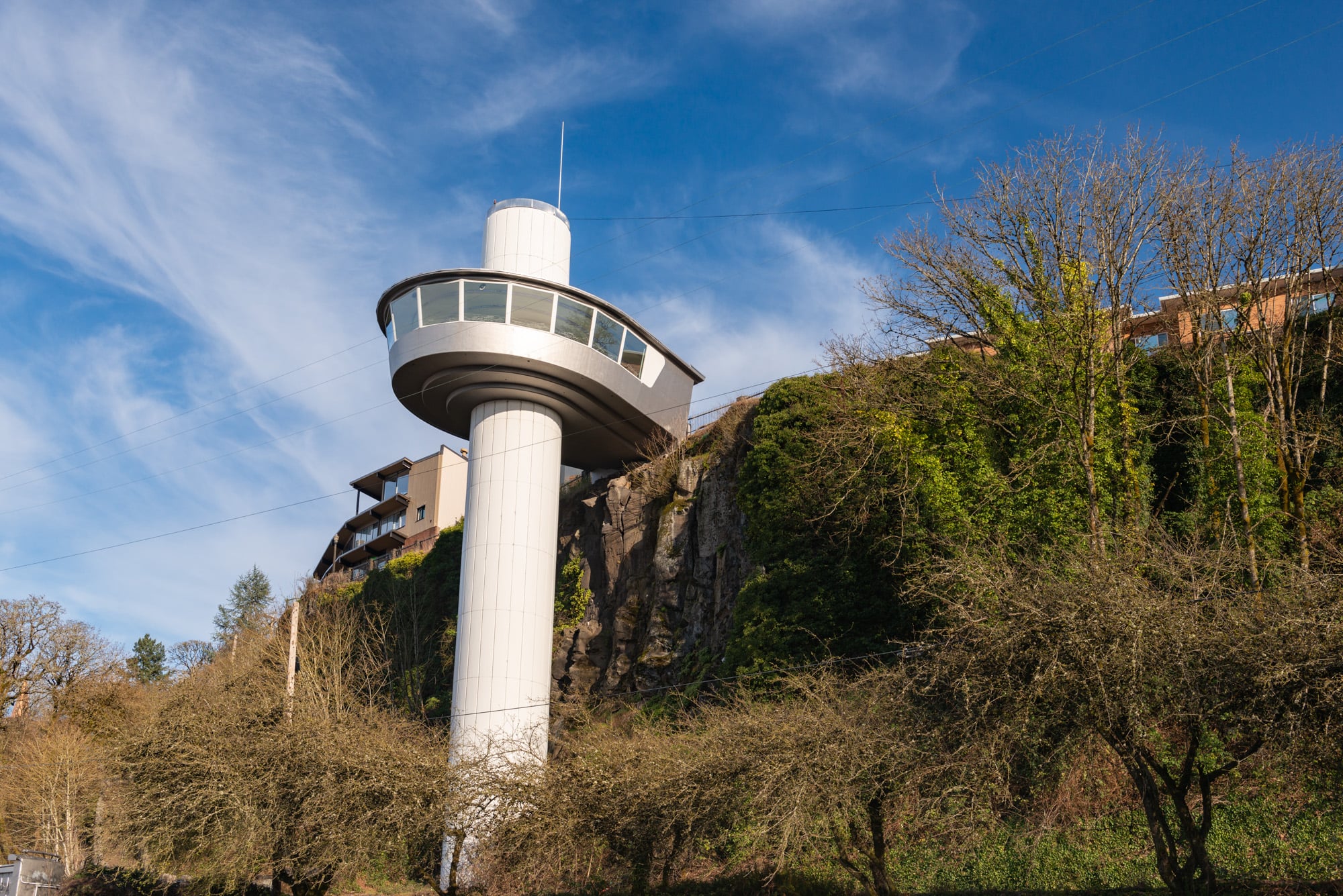
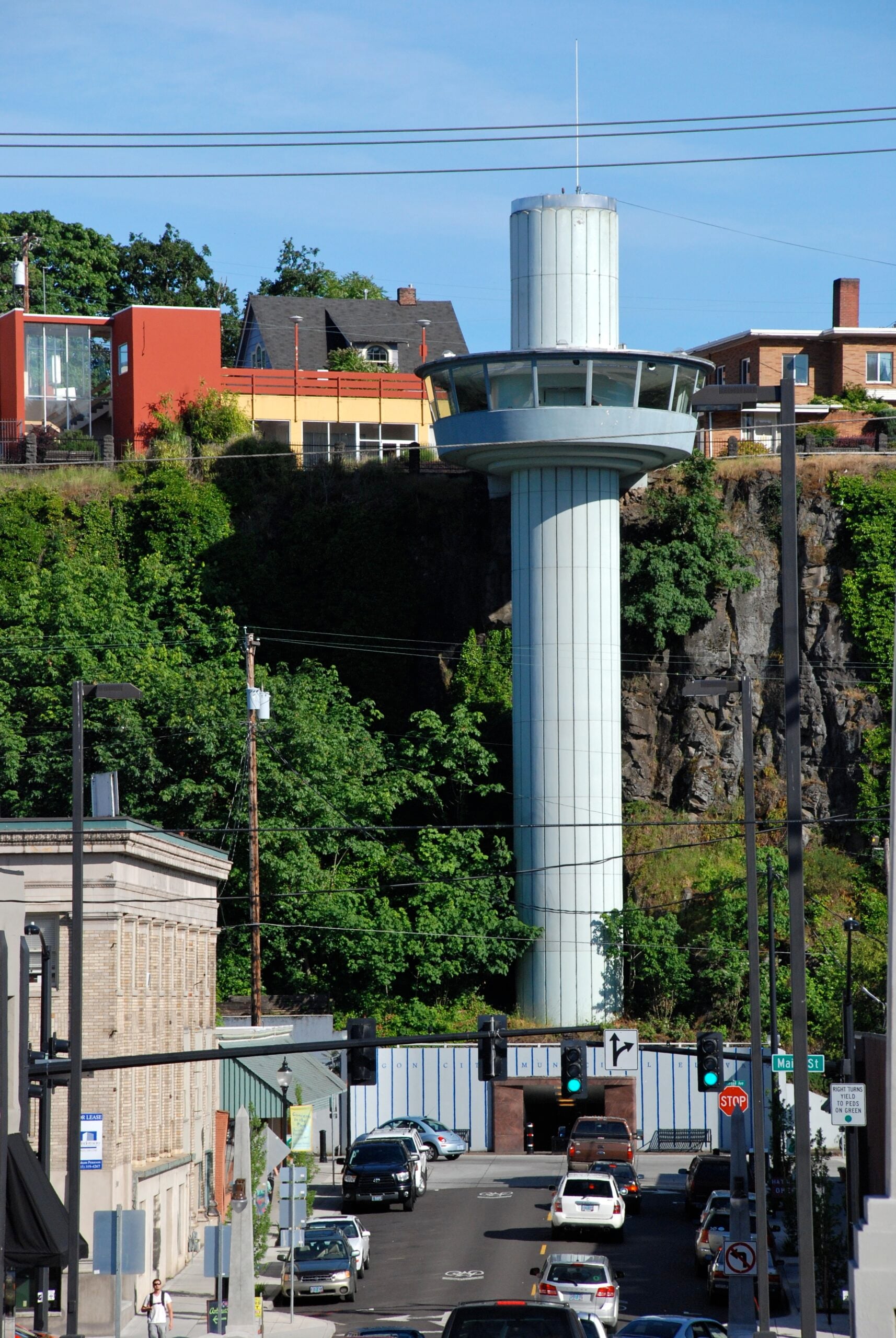
Oregon City gave its residents a street that goes straight up. The Municipal Elevator rises beside the downtown bluff, carrying people between the river-level business district and the neighborhood above. Its round tower and broad observation deck look wonderfully unlikely against the rock. The ride is free, the view is part of the deal, and the argument over how to build the original version was considerably longer than the trip takes today.
Long before the present concrete structure became a familiar piece of Oregon City’s skyline, people needed a less exhausting way home from work. The mills and downtown businesses sat below a steep bluff, while homes spread across the higher ground. An elevator offered an obvious convenience, but agreement on a useful idea did not settle questions about land, money, or water. Those disputes left a surprisingly detailed record of a community trying to connect two parts of itself.
Today, it is easy to enjoy the elevator as a brief stop during an Oregon City outing. Step inside, ride up, look over the river, and continue along the bluff. Knowing what came before makes those few moments more interesting. The tower is the latest version of a practical solution that residents have been using for more than a century.
The cliff was part of everyday life
Oregon City’s geography gave it advantages and inconveniences in the same small area. The Willamette River and nearby falls helped attract industry, but the steep terrain restricted easy movement as the town grew. Downtown and the upper neighborhoods could be close together on a map without being convenient to reach on foot. A short distance became a demanding climb.
Early paths, including routes used by Native people, were supplemented by wooden stairs as the city developed. For a visitor, stairs might be an interesting way to explore a bluff. For someone finishing a shift in a mill, they were part of getting home, with no particular novelty attached. The Center for Land Use Interpretation describes that daily climb as the problem the first elevator was intended to solve.
A useful idea still needed votes
The proposal went to voters in 1912, failed in July, and passed when it returned in December. The approved bond amount was $12,000. That gave the city permission to move ahead, but the financing and access arrangements still had to be worked out. An election result was the beginning of the project’s difficult work.
The surviving council minutes show how much attention the financial details received. At a November 1913 meeting, a bid for the elevator bonds was referred to the finance committee. The same record includes the city’s action on land needed for a street along the bluff between Sixth and Seventh Streets. The elevator was advancing through the same municipal machinery that handled street improvements, lighting, and other necessities.
Another election addressed the terms of the bonds themselves. The December 3, 1913, council record documents a charter amendment specifying bonds in denominations of at least $50, running for twenty years and paying five percent annual interest. They were to be sold to the highest bidder for no less than their face value and accrued interest. Even before a car carried its first passenger, the city had to decide exactly how the promise to pay for it would work.
Those details give the project a different character from the cheerful landmark people know today. The elevator was a public commitment with a long financial life, requiring decisions that extended beyond the novelty of riding up a cliff. Residents had to support a service that some would use regularly and others might scarcely need. That is a familiar question for any community trying to improve transportation.
Elevator Street crossed someone’s property
The upper connection created another problem: the city needed access through private property. Sarah A. Chase opposed the route across her land, and the dispute became part of the elevator’s early history. The city ultimately secured the access through condemnation proceedings. A convenient public route and a property owner’s wishes had come into direct conflict.
The June 17, 1914, council minutes make the outcome unusually concrete. They record an award of $1,651.20 to Chase for damages and costs associated with the appropriation. The minutes also state that the payment warrant had been prepared and tendered. This was a land transaction backed by government power, with a named owner and a specific cost, rather than a vague disagreement that disappeared once construction began.
At that meeting, the council directed the city engineer to stake out the land acquired for Elevator Street. The street superintendent and city attorney were to take steps to begin work. Councilman Hackett asked that his vote against the proposition be recorded. That small entry preserves the fact that moving forward did not mean everyone had come around to the same view.
The resolution formally established the street and directed that an accurate plat be filed with the county recorder. Its legal description follows curves, property lines, and points along the bluff, the careful language required to turn a proposed connection into a recognized public route. The name Elevator Street was therefore more than a nickname invented for visitors. It belonged to the actual business of laying out the city.
The wording of the resolution shows how closely the elevator and the street were connected. The city directed its officers to begin laying out and improving the route, then required a recorded plat within thirty days. That placed an engineering job, a construction job, and a legal filing on the same timetable. Chase’s compensation and Hackett’s recorded objection remain in the minutes alongside those instructions, preserving both the cost and the disagreement behind a route visitors now use freely.
The first ride ran on water
The original elevator entered service in 1915. It stood in a steel-and-wood tower and used hydraulic power for an 89-foot lift, followed by a catwalk to the bluff. A trip could take three to five minutes. That was slow by today’s standards, but it offered a very different way to make the climb.
Choosing water power introduced another argument. The city’s water board objected to connecting the elevator to the system, and the disagreement led to a change in the board and further legal action. Once the lift operated, it could reduce water pressure nearby. The machinery that made one part of daily life easier could create inconvenience somewhere else.
Electric power replaced the hydraulic system in 1924, making the trip faster and more dependable. The change matters because the elevator had to work as transportation, not just as an attraction people tried once. A useful route needs to be available when someone is going to work, running an errand, or returning home. Reliability was part of the elevator’s value from the beginning.
Thinking about that first machine also puts the current ride in perspective. Today’s visitors are not stepping into the wooden structure that opened in 1915. They are using its successor, built decades later after the earlier elevator had aged. The continuity lies in the purpose and the connection, while the technology and architecture changed.
Oregon City ordered a plain elevator and got a landmark
By the early 1950s, the old structure needed replacement. The city approved a bond measure for a new elevator, rejected bids that exceeded the available money, and returned to the design. A revised proposal brought the project within reach. The present elevator was dedicated on May 5, 1955.
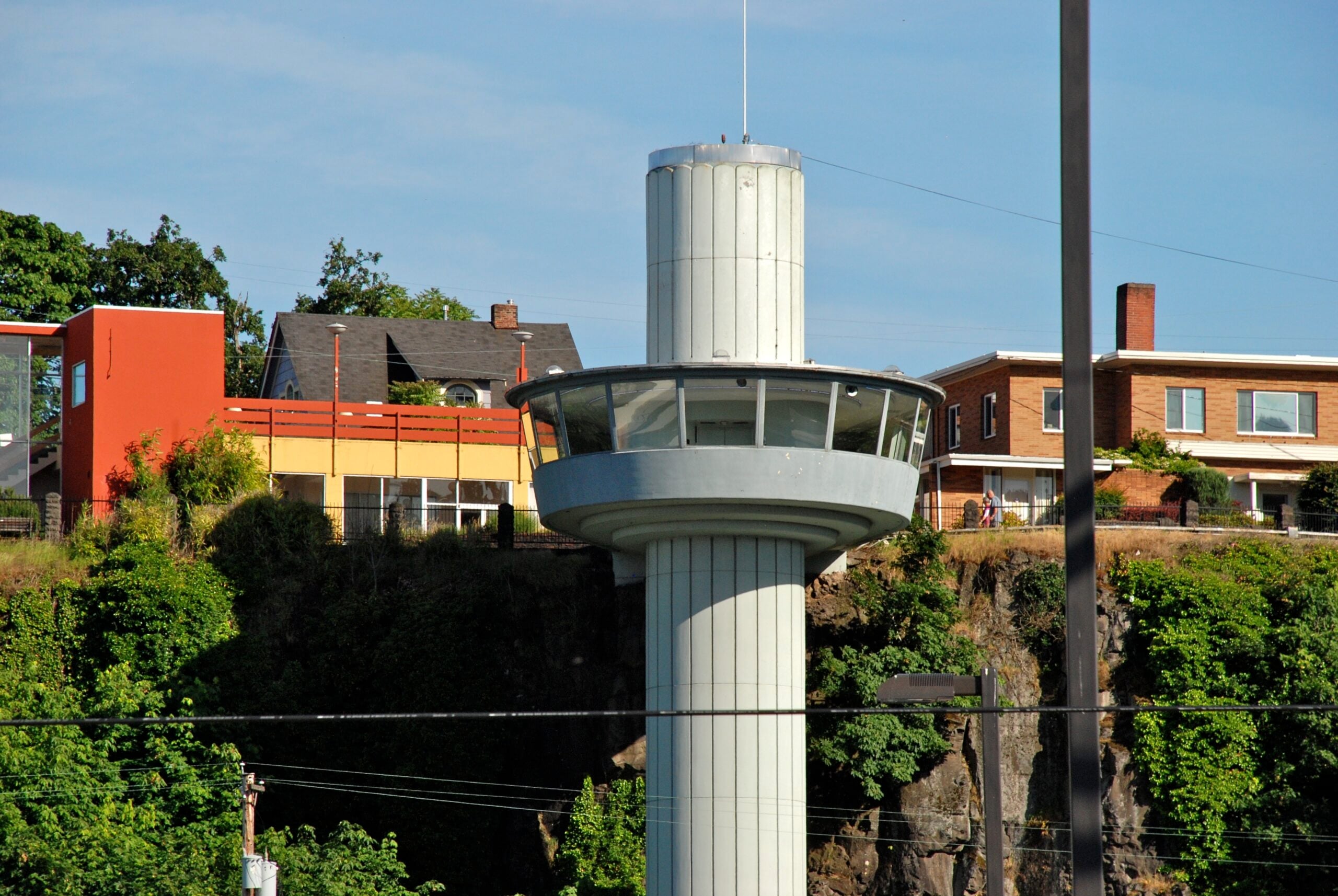
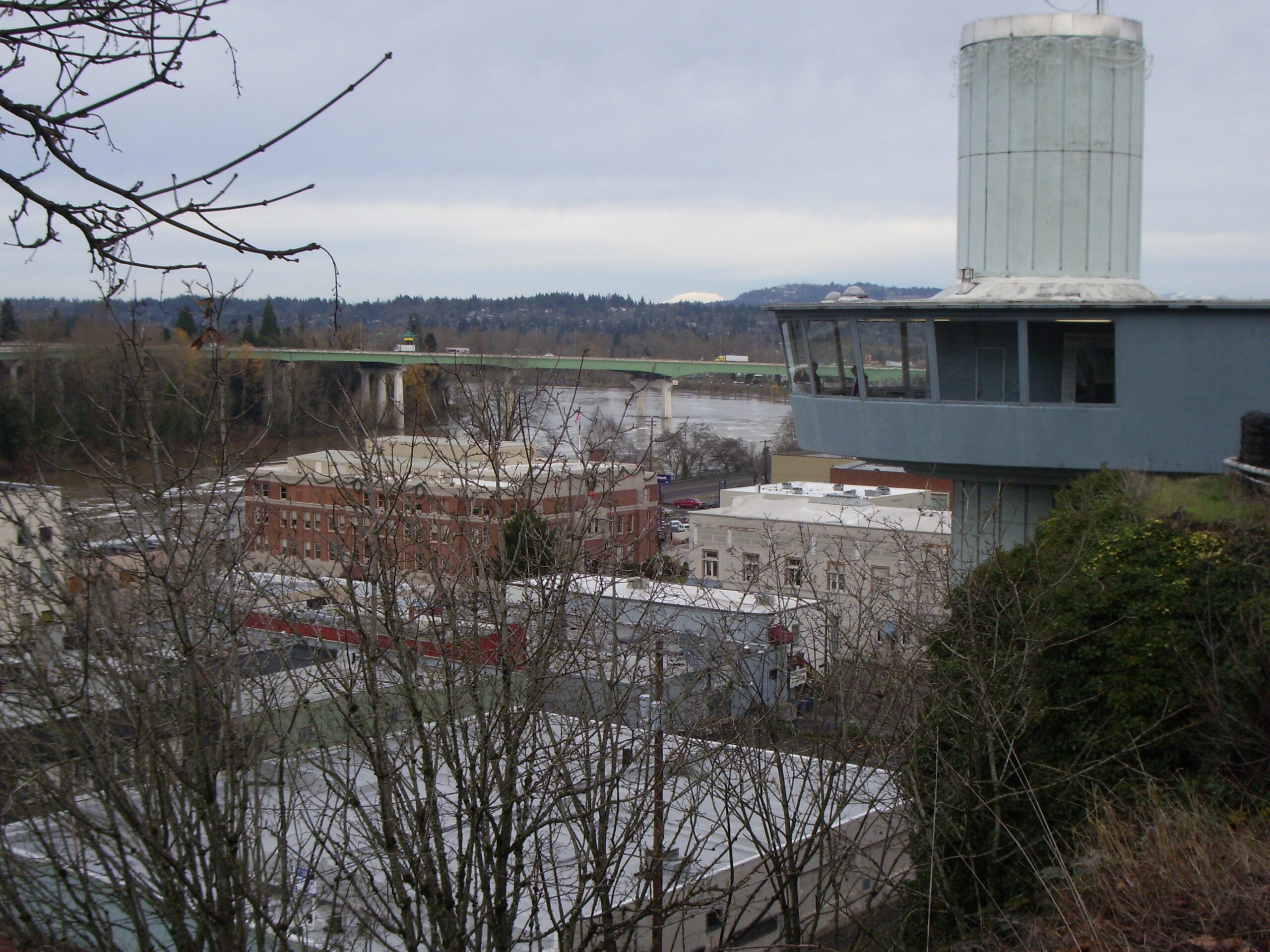
Architect Gordon E. Trapp of Stevens & Thompson designed the concrete tower, and James & Yost built it. The city wanted economy and little ornament. Trapp’s answer gave the elevator a narrow cylindrical shaft and a broad observation area at the top. Its shape achieved a memorable effect through proportion rather than applied decoration.
The observation deck is especially distinctive. Angled windows surround a horseshoe-shaped space that projects out from the shaft, giving people a place to look across the city. Against the bluff, the deck can seem much lighter than its substantial supporting structure. The silhouette belongs unmistakably to the middle of the twentieth century.
A short tunnel and a much quicker trip
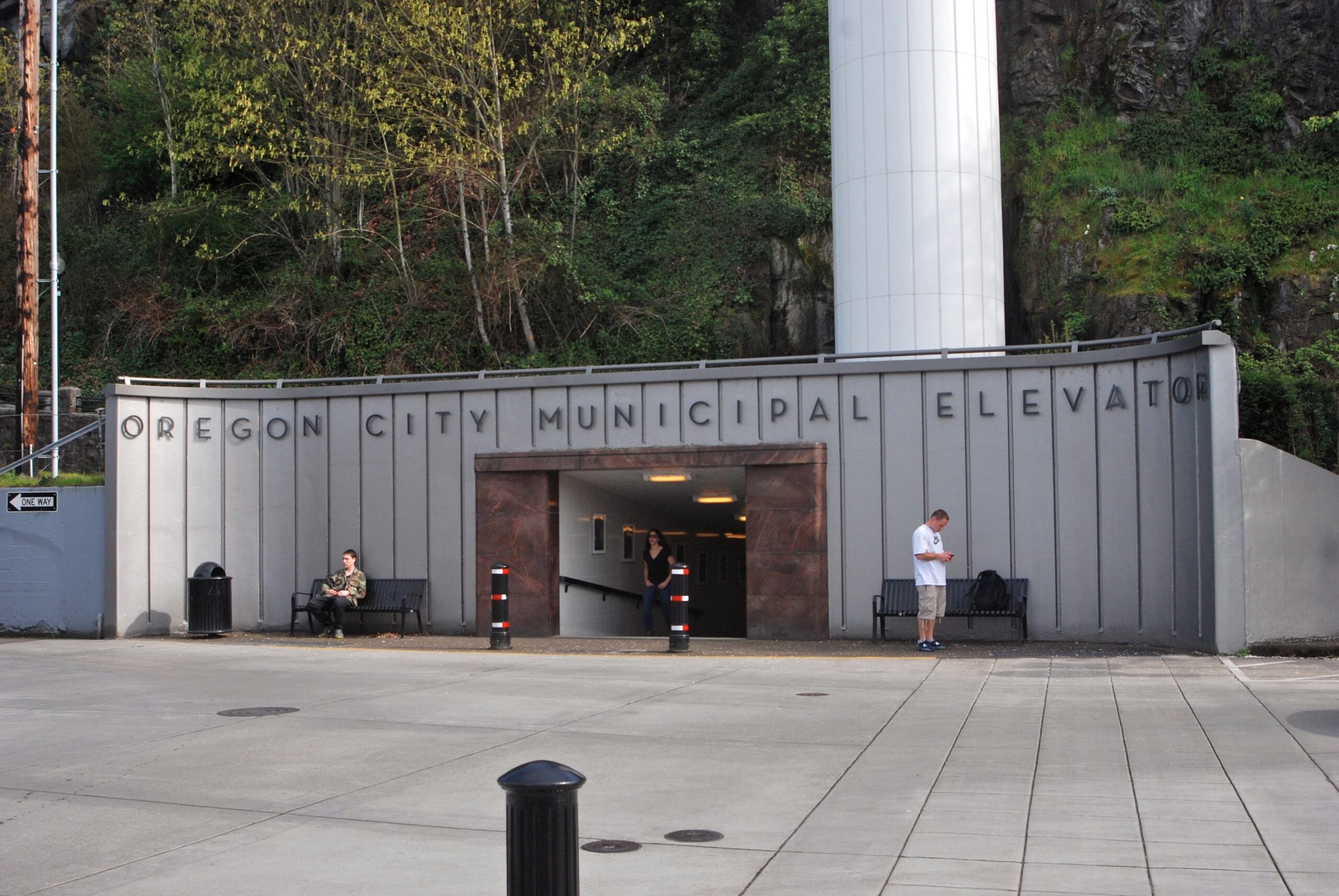
The lower entrance is near Seventh Street and Railroad Avenue. A tunnel takes pedestrians beneath the railroad tracks to the elevator, solving a second obstacle along with the bluff itself. Above, the tower connects to the McLoughlin Promenade. A person can pass from downtown streets to a bluff-top walk without negotiating the steep slope between them.
The structure stands about 130 feet high, and the present ride takes roughly fifteen seconds. That speed makes the trip feel brief, but the change in viewpoint is substantial. Downtown rooftops, the river, bridges, and the surrounding terrain become easier to understand together. The observation deck gives the journey a natural pause before people continue on their way.
It is worth allowing time for that pause. If you ride up and immediately head out, you have used the elevator successfully as transportation but missed part of what makes it enjoyable as a visit. Walk around the viewing area and notice how different the city looks from this height. The building was designed to give people a view as well as a lift.
The artwork changes as you move
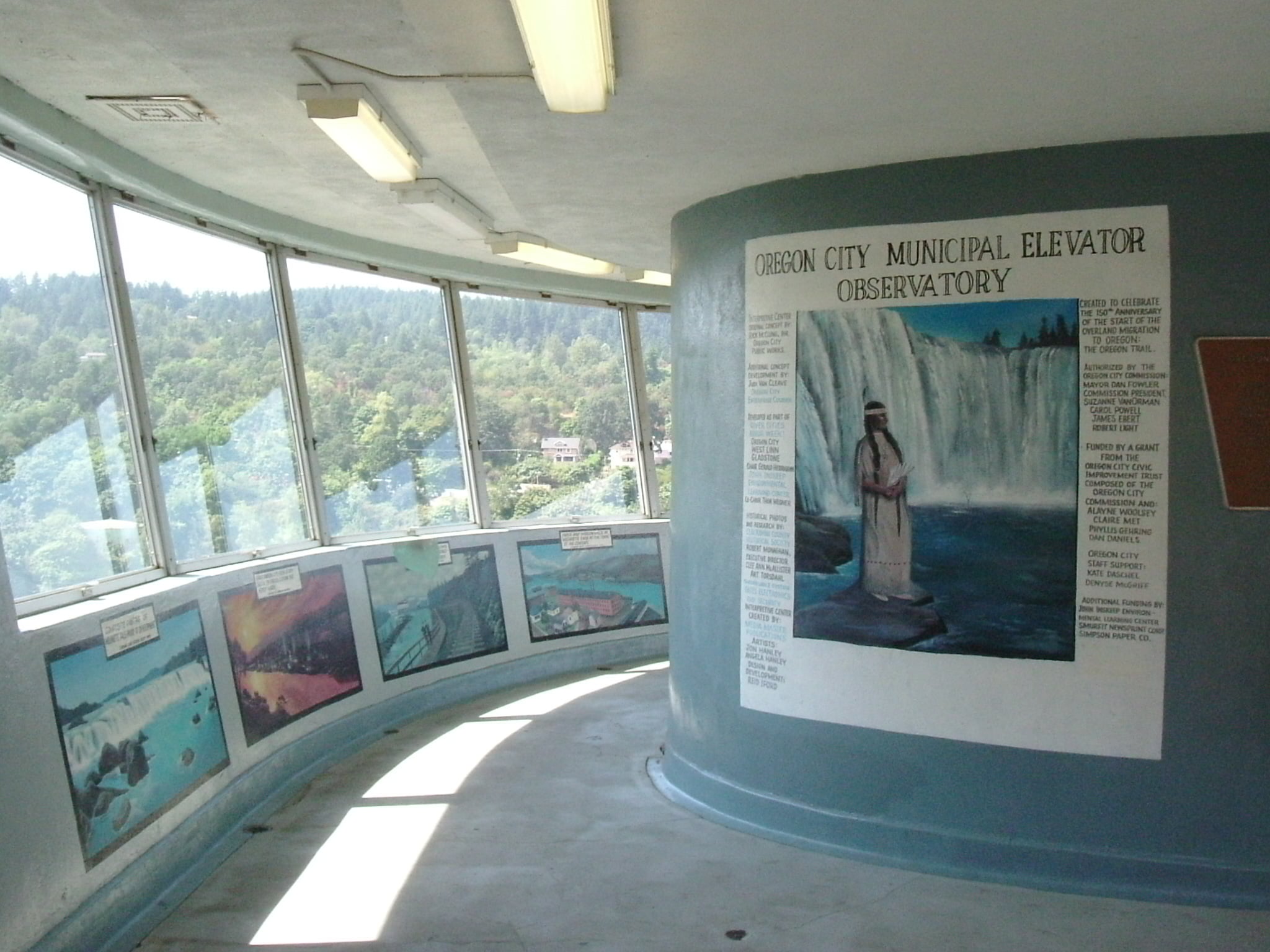
The elevator’s interior also contains a public art project by Michael Asbill called Elevations in Transition. It uses lenticular images, which can show different pictures as the viewer changes position. The subject matter includes Oregon City across time, people associated with its history, and the elevator’s construction. The city selected Asbill through a public art process in the 2000s.
The technique is a particularly good fit for a place defined by movement. Instead of a single historical photograph remaining fixed on a wall, an image changes as someone walks past it. That gives visitors a reason to slow down and look again. It also brings the history into the spaces people use while traveling through the structure.
Older photographs of the observation deck show earlier displays, so the date of an interior image matters. The artwork is part of the building’s continuing life, not something that was there when it opened in 1955. Like the change from hydraulic to electric power, it reflects a later decision about how the elevator should serve people. A working landmark accumulates those changes.
A free ride still needs people behind it
The elevator belongs to the city, but staffing arrangements have changed over the years. Oregon City began contracting for elevator staffing in 1991, and its public information records Downtown Oregon City taking over that contract in 2017. The current hours page still refers to elevator operators and their scheduled breaks. This is a service that depends on people as well as machinery.
That human side is easy to overlook when the ride costs nothing. Someone has to maintain the equipment, care for the public space, and keep the daily operation moving. The free ride is a continuing civic choice, with practical work behind it. For a visitor, the simplest way to respect that is to allow for the schedule and follow the operator’s directions.
The building received an individual listing in the National Register of Historic Places on May 15, 2014. Oregon’s historic-site documentation recognizes its transportation role and its modern architecture, along with the observation deck’s recreational purpose. Those are related reasons for keeping it in use. The elevator is valuable because of what it looks like, what it connects, and what people can do there.
A piece of the first elevator survives nearby
The original elevator’s sign has a home at the Oregon City Public Library. It announced that the ride was free, a message that still applies to the service today. The library displays it on the main floor in the media room. For someone interested in the earlier wooden structure, it is a tangible connection to the elevator that stood here before the concrete tower.
That small survival adds another layer to the story. The first elevator was replaced because the city needed a better working machine, but part of its public identity was kept. You can see the newer structure doing the old job and then find a surviving object from the earlier one.
Making the elevator part of an Oregon City afternoon
A visit works well as part of a walk through downtown rather than as an isolated drive to a single attraction. Start at the lower entrance, take the ride, and spend some time on the bluff before deciding where to go next. Our Oregon City guide offers a broader introduction to the town’s restaurants, shops, and historic places. The elevator gives that larger outing a memorable change of perspective.
The McLoughlin Promenade runs along the bluff, with views that continue beyond the enclosed observation area. In fall, a flexible plan is useful: enjoy a longer walk when conditions are comfortable and keep the outdoor portion shorter when the weather turns. The elevator itself does not require a dry summer day to be interesting. Its history and the relationship between the two levels of town are there in every season.
Photographers can find very different views from the lower streets and the upper bluff. From below, the full shaft explains the scale of the problem the city solved. Near the top, the observation deck becomes the main subject, with the river landscape behind it. Stay on public paths and sidewalks, and give people using the elevator room to pass while you look for a composition.
Hours and what to know before riding
The Oregon City Municipal Elevator is free and operates Sundays from 10 a.m. to 7 p.m., Mondays and Tuesdays from 7 a.m. to 7 p.m., and Wednesdays through Saturdays from 7 a.m. to 9:30 p.m. Operators take a ten-minute break every three hours. Allow for that brief pause rather than assuming a closed door means the elevator has finished for the day. Current service information appears on the city’s operating-hours page.
The city lists closures on New Year’s Day, Memorial Day, Independence Day, Labor Day, Thanksgiving, and Christmas. Check for service alerts before making a special trip, particularly if the elevator is important to your route between downtown and the bluff. Its ordinary schedule is generous, but it is still an operating piece of equipment. A little advance checking helps keep a simple outing simple.