
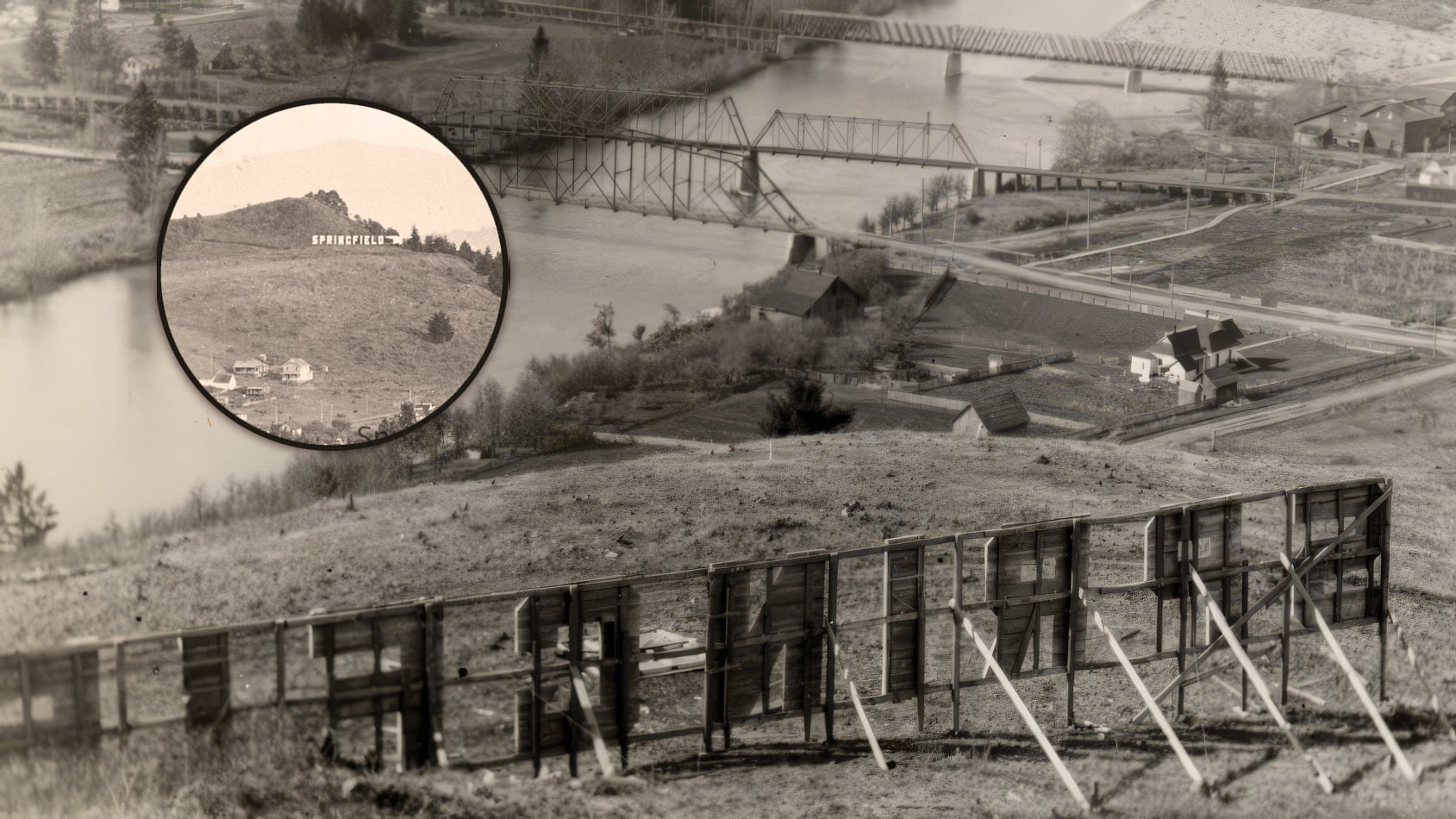
There’s an old photograph of Springfield that doesn’t look quite real at first.
The Willamette River bends through the frame. Steel bridges span the water. Beyond them, houses scatter across a mostly open hillside, where the trees are thinner and the town hasn’t yet climbed very far above the valley floor.
And then your eye catches it. High on the slope, in large white letters, one word:
SPRINGFIELD
Not painted on a barn. Not printed on a billboard. The name of the city itself was spelled out across Willamette Heights in giant freestanding letters, visible from across the river and, by design, from the railroad tracks below.
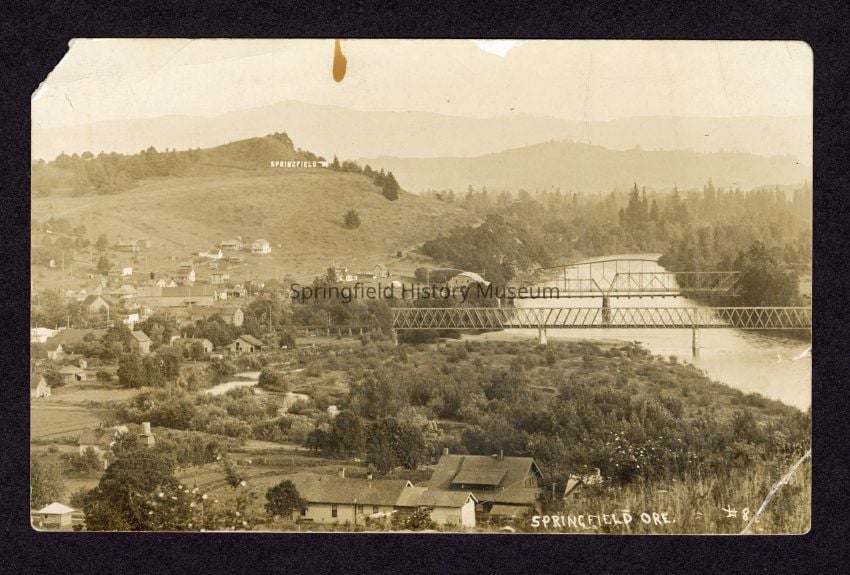
You may be inclined to yell “AI Slop”, but the photograph is very real, housed in the Springfield History Museum’s archives.
More than a century ago, Springfield built an enormous illuminated sign above town, large enough to be seen from miles of railroad track. It was there before the iconic Hollywood sign. It survived storms, repairs and at least one attempt to restore it. Then, sometime in the early 1920s, it disappeared.
What happened to it is only part of the story.
The better question is why a young Oregon town wanted something that audacious in the first place.
At a Glance
What was the Springfield hillside sign?
An enormous illuminated sign spelling SPRINGFIELD on Willamette Heights above Springfield, Oregon. The sign had a giant hand to the right of it, pointing to the sign and to the downtown area itselfWhen was it built?
The project was announced in July 1909, and construction was underway by that fall.How large was it?
Contemporary newspaper reports described the sign as roughly 120 feet long and 12 feet high, or alternatively, 100 feet long and 30 feet high.Where was it built?
In Willamette Heights at approximately 44°02’20.3″N 123°01’17.1″WWhy was it built?
To advertise Springfield to travelers, particularly people passing on the Southern Pacific railroad line.Who built it?
Hayward & Co. was identified in October 1909 newspaper coverage as the contractor putting the letters in place.How was it funded?
The community raised money through events including a social dance and a “tag day,” while local real estate men reportedly agreed to pay the electricity bill.Did the sign light up?
Yes. It was conceived as an electric sign, and contemporary newspaper accounts describe the letters being illuminated.Did weather damage it?
Yes. Strong winds knocked several letters down in January 1910. By March, the sign had been rebuilt stronger, lower and closer to the hillside.Was it still there later?
Yes. Newspapers referred to it as a Springfield landmark in 1913, and surviving photographs show it on Willamette Heights during the 1910s.What happened in 1919?
A newspaper reported that the sign would be “restored to its original position,” suggesting it had again fallen into disrepair or been displaced.When did it disappear?
We don’t yet know the exact date. By June 24, 1923, the Morning Register said the sign “has since been torn down.”Why was it removed?
That remains unknown. The sign had a documented history of wind damage, but no source we’ve found identifies the reason for its final removal.Did it predate the Hollywood sign?
Yes. Springfield’s letters were erected in 1909, fourteen years before the original HOLLYWOODLAND sign appeared in 1923.
So Where The Heck Was This Giant Signage?
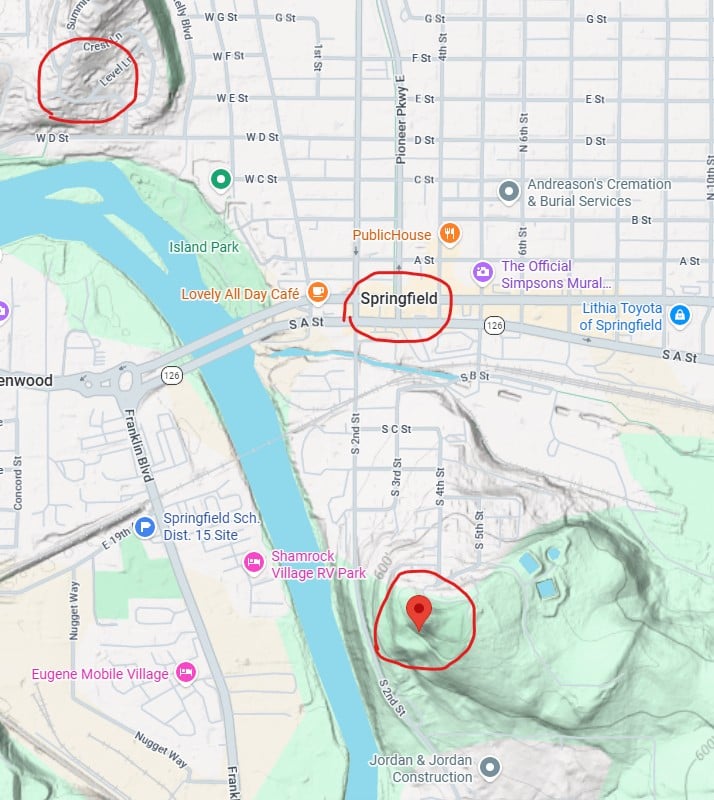
Based on the surviving photographs, contemporary newspaper mentions, and some Facebook history discussions, the sign looks to have stood on the northwestern slope of Willamette Heights, above Springfield and facing toward Glenwood, the Willamette River, railroad corridor, and bridges below.
Our best estimate puts it near 44°02’20.3″N 123°01’17.1″W, which fits the old sightlines well: high enough to be seen from across the Willamette, but positioned so the letters faced the people Springfield most wanted to impress, especially travelers moving through the valley by rail.
One Tiny But Important Detail That May Have Been Forgotten By History
Something in the surviving record may have gone largely unnoticed for more than a century.
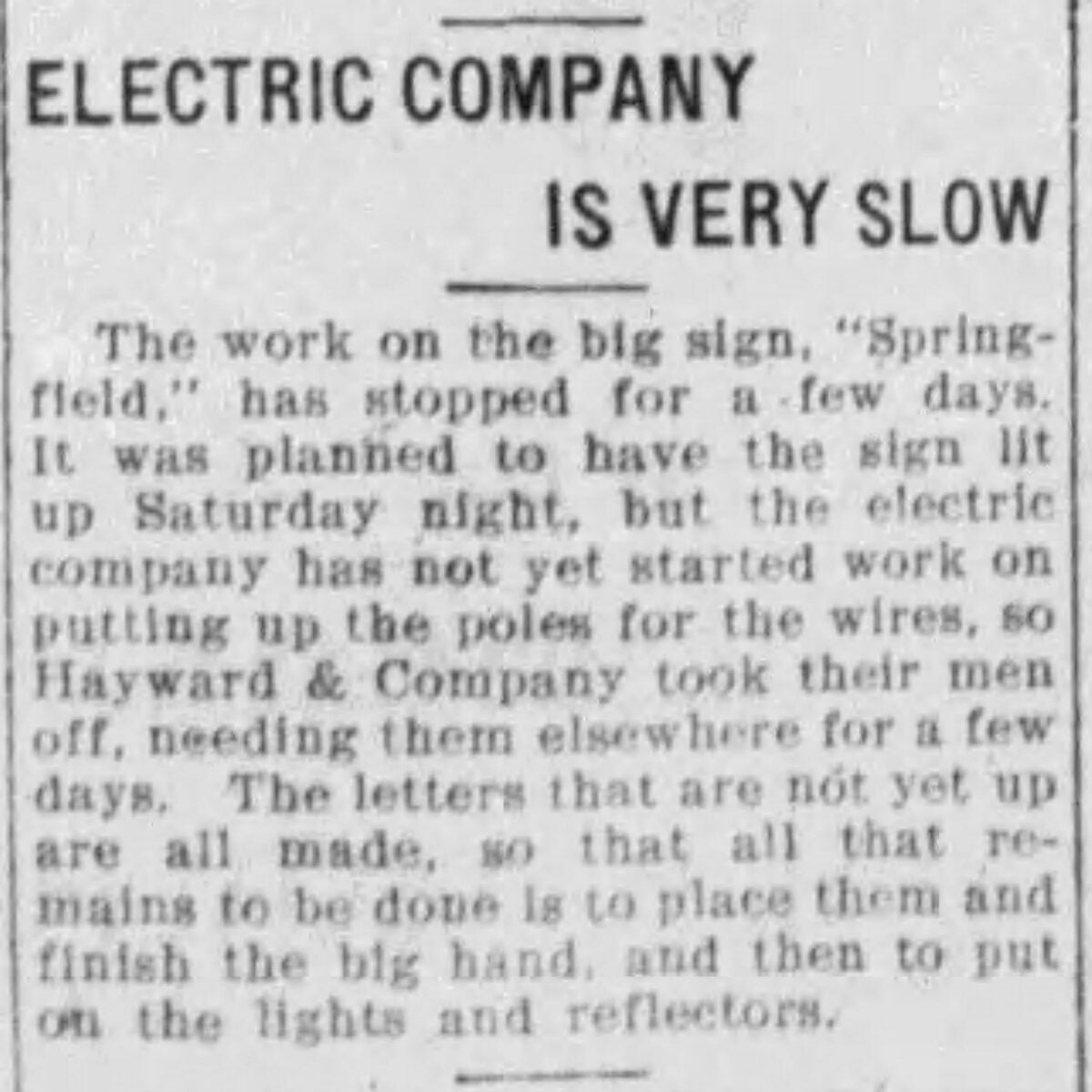
In its October 14, 1909 coverage, the Twice-a-Week Guard reported that the remaining work on the hillside display was to “finish the big hand” before the lights and reflectors were added.
Hold up…what big hand??
So I referred back to the large, high res image from the Springfield History Museum’s files.
Zoom in.
Big hand.
The large white shape that sits immediately to the right of the word SPRINGFIELD.
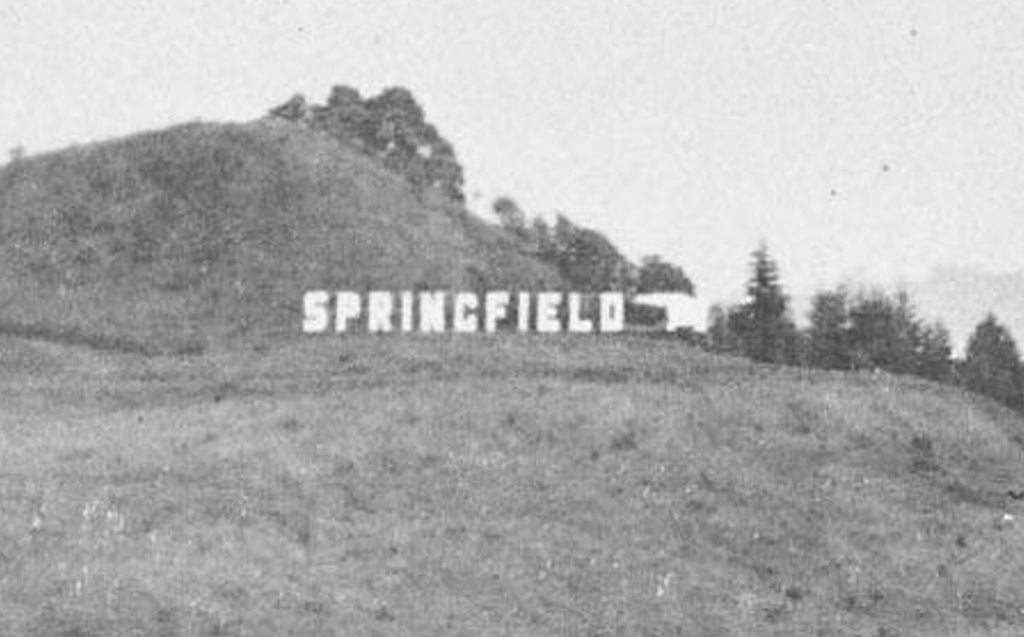
The one I assumed was just an adjacent building or some other structure.
No, on closer inspection, it matches the newspaper description: a giant pointing hand.
These were incredibly popular in newsprint of the day, and actually had a name: a manicule.
Based on the sign’s apparent location on Willamette Heights, that hand would have pointed directly north toward Springfield itself. Not just the general location, but right at downtown. It also points at another, ridiculously relevant modern landmark that we’ll get to later.
After a bit of further digging, there it was. The eureka moment. The huge manicule was the real deal:
“Lights Point the Way.
The city council, at the instance of the Commercial elub, is erecting a huge
sign, about 100 feet long and 30 feet high, near the top of the butte. Great
cut-out letters spell the name of the city, and above is to be a hand, point-
ing to the town. The sign will be out- lined with electric lights, and is lo-
cated so that, day or night, it will point passers-by on the trains to the
busy city of Springfield.” -The Morning Register, October 5, 1909
[I’ve contacted the Springfield History Museum and the City of Springfield to confirm whether this feature has been previously identified in their records.]
Springfield Was Looking Up
Springfield was still a young city when the sign went up, but its roots reached back to 1848, when Elias and Mary Briggs settled near a bubbling spring beside the prairie that would eventually give the town its name (a spring in a field: “Spring-field“). A ferry across the Willamette and the old territorial road tied the little settlement to the outside world, but Springfield remained relatively isolated for decades.
That changed quickly after the city incorporated in 1885 and the railroad arrived in 1891. The tracks brought new people, new business and a growing sense that Springfield’s future could be much bigger than its past. By the first years of the 20th century, the town was expanding, improving its streets and bridges, and looking for ways to announce itself to the wider world. In that atmosphere, putting the word SPRINGFIELD across an entire hillside suddenly doesn’t seem quite so outrageous.
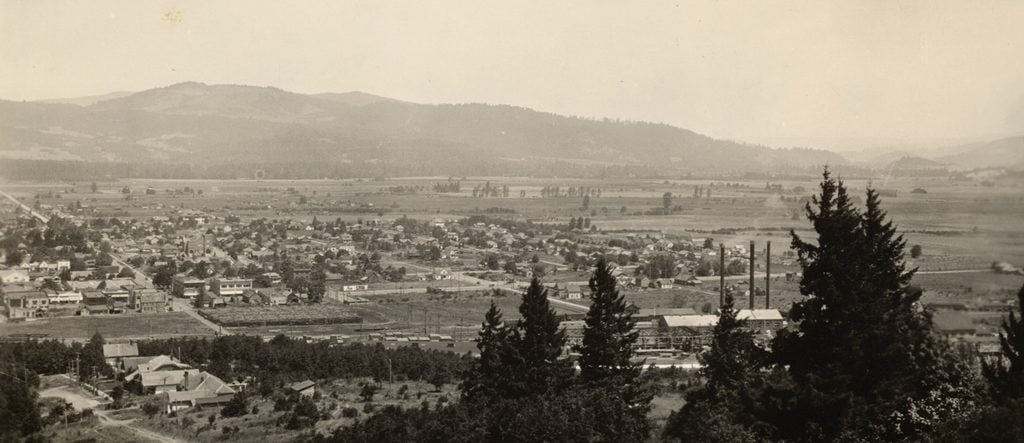
You can practically feel the buzz of the mood of the place in the newspaper pages from that summer.
Mills were expanding. New houses were going up. Railroad payrolls mattered. Freight moved in and out of the depot. Local businessmen organized through the Commercial Club and talked constantly about growth, investment and what Springfield might become.
On one page of the Eugene Daily Guard that fall, the stories pile up almost on top of one another: Springfield needed a larger public school. The city wanted electric arc lights along Main Street. Property values were rising. The flour mill was running night and day. A new theater was being prepared.
And tucked among all of it was the progress report on those giant letters taking shape above town. The sign wasn’t really separate from all that optimism. It was part of it.
A few years earlier, newspapers in Eugene had floated the idea of placing a giant sign on Skinner Butte where railroad passengers could see it. The thinking was pure turn-of-the-century boosterism: catch the eye of travelers and make sure they remembered where they were.
“Eugene should have a large sign on top of Skinner’s butte in view of trains
from the depot advertising the city and Lane county. This would catch the
eye of a great many travelers each day and would result in at least attract-
ing the eye in a direction other than at the depot.”-The Register Guard, Sep 29, 1906
Except it was Springfield that actually went and did it.
On July 17, 1909, the Eugene Daily Guard announced the project beneath the headline “HUGE LETTERS TO ADVERTISE CITY.” Springfield, the paper reported, intended to “follow in the steps of Tacoma” by erecting a giant electric sign above town.
The proposed dimensions were enormous: about 120 feet long and 12 feet high (the earlier mentioned account says 100 ft. long and 30 ft. high), and the whole point was visibility. The Guard said the letters would face the railroad and could be seen along “miles and miles of railroad track.” The town was placing its name directly in the sightline of travelers passing through the valley.
It was advertising on the scale of geography.
The sign wasn’t built mainly for Springfield.
It was built for everybody passing Springfield.
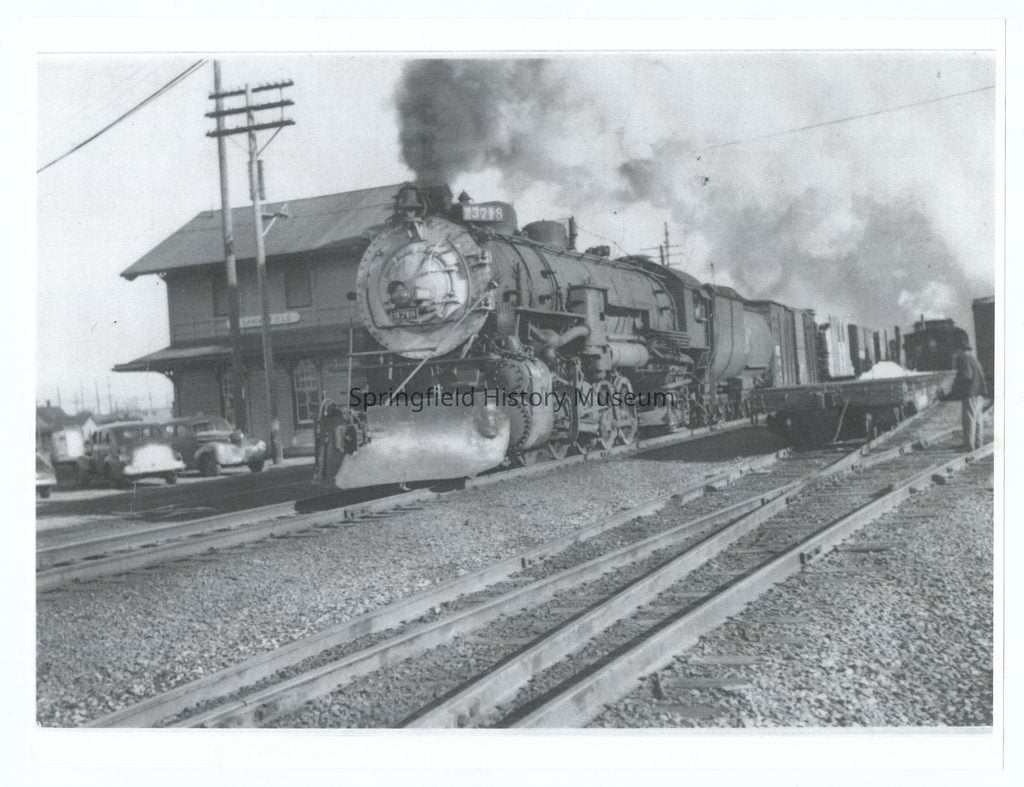
At the dawn of the automobile age, the railroad was still the great moving window through Oregon. Passengers looked out at towns they might never visit, and Springfield’s boosters apparently decided that nobody should roll through this part of the valley without learning its name.
The city would put it on the hill in letters too large to miss. “Look how progressive we are. We can afford this massive sign announcing our name to the world. We’re pretty much a big deal. Certainly better than Eugene, over there.”
Ten Cents at a Time
That same July 1909 article reported that money raised from a social dance would help get the project started. Several local real estate men had agreed to pay the cost of electricity so the letters could remain illuminated.
Three weeks later, the fundraising became even more local.
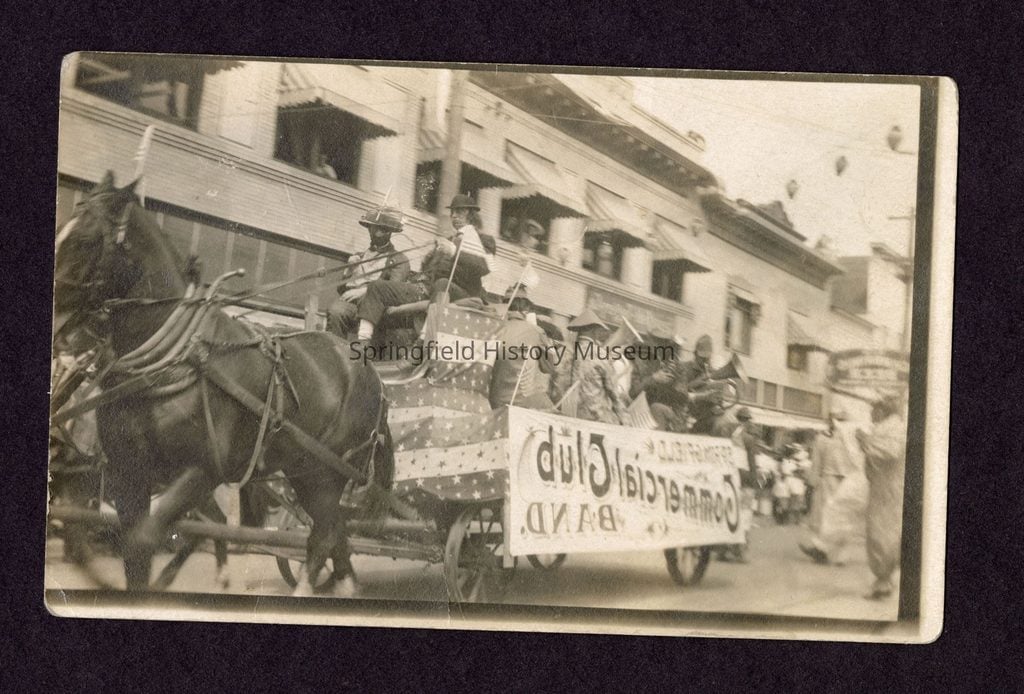
The Eugene Daily Guard reported on August 7 that the Women’s Auxiliary of the Springfield Commercial Club was organizing a “tag day.” Women would circulate around town tagging residents and visitors for ten cents apiece, and by the account, these women were wonderfully ruthless in their efforts. Serious respect for that hustle.
“[The ladies] will tag every person in Springfield and every stran-
ger who enters the city limits. Not only will they put a tag on every
man who shows his face on the street or opens his window blind,
but they will collect ten cents from him.” -Eugene Daily Guard, Aug 7, 1909
“The fund collected,” the clipping explained, “will be used to erect the big Springfield sign on the Butte.”
There’s something almost irresistible about that detail. One of the boldest visual statements Springfield would ever make was being financed, at least in part, a dime at a time.
Then came the moment where somebody actually had to build the thing.
First Came “S P R I N”
By October, Springfield residents could look up and watch the word emerge.
The October 2, 1909 Eugene Daily Guard reported that “the big sign on the hill is beginning to assume its form.”
Only part of the name was there:
“S P R I N“
Hayward & Co., with a crew of four men, expected to complete the remaining letters and have them illuminated the following Saturday, assuming the power company could get electricity to the hillside.
Even unfinished, the paper said, the letters could already “be read for several miles.”
Picture what that must have looked like from below.
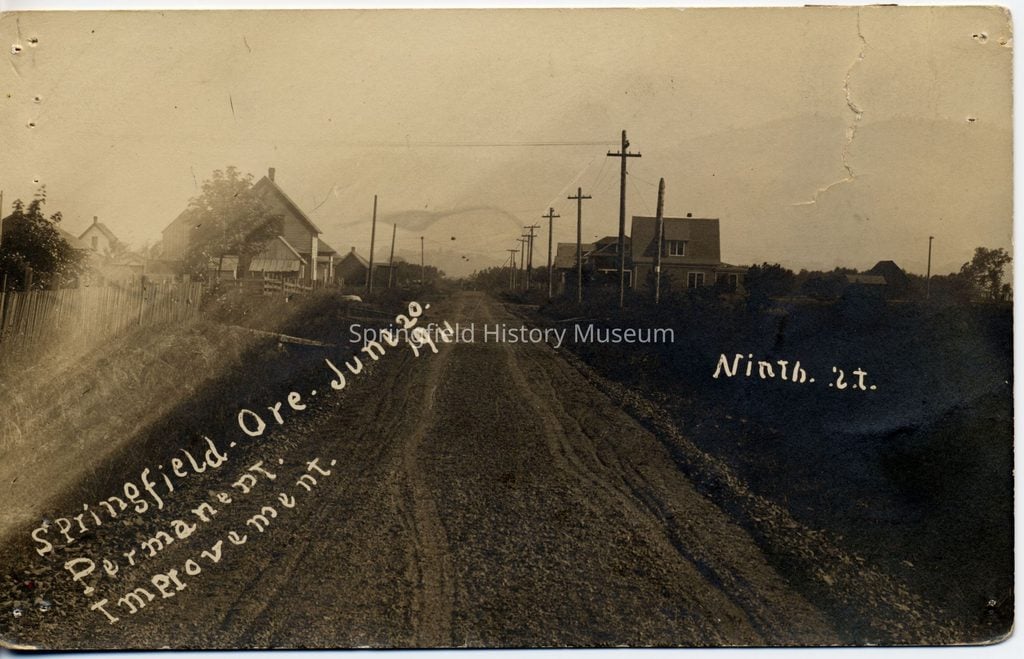
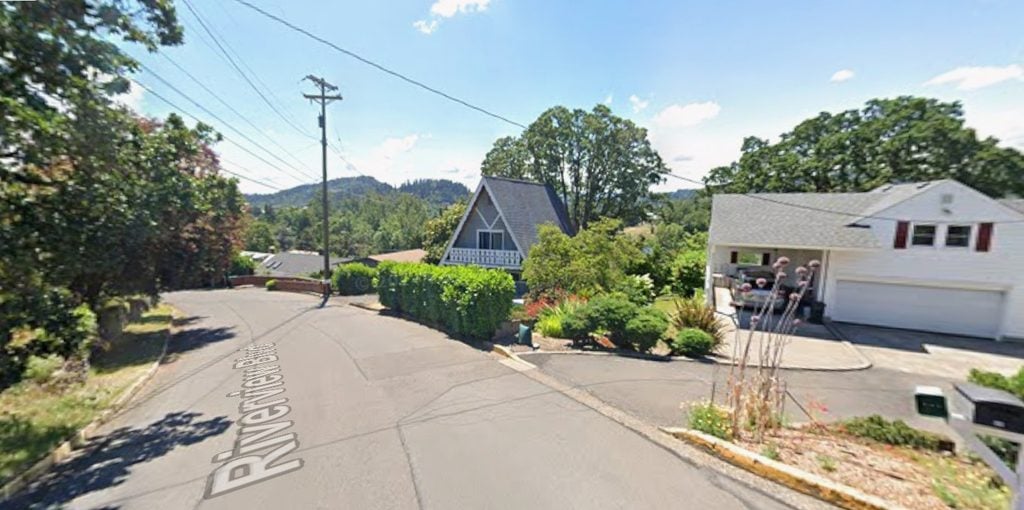
Springfield was still low and compact then. Beyond the business district, the landscape opened quickly into fields, mills, rail lines and the river. Willamette Heights rose above all of it with relatively little development to hide the slope. Today, trees and homes obscure the view, but in the 20th century’s first decade, that view would have been pretty darn impressive.
For a few days in October 1909, the city apparently advertised itself to the valley as SPRIN.
There was one more complication before Springfield got the full effect: the all-important electricity piece. Because this sign was about to get lit.
The Twice-A-Week Guard followed the project on October 14 with a headline that sounds like the complaint of an impatient homeowner waiting on a utility appointment:
“ELECTRIC COMPANY IS VERY SLOW.”
In other words, the letters were ready, but the poles and wiring weren’t. Work stalled while Hayward & Co. waited for power to reach the hill.
The sense of urgency came from a planned gala “Booster Event” on October 16th, hosted by the Springfield Commercial Club. Prominent Portland booster Tom Richardson was going to speak. There was to be a full-blown orchestra. Everyone who was anyone in the area was invited to attend. The Women’s Auxiliary who ‘tagged’ half the town for their dimes to fund the sign were going to be there.
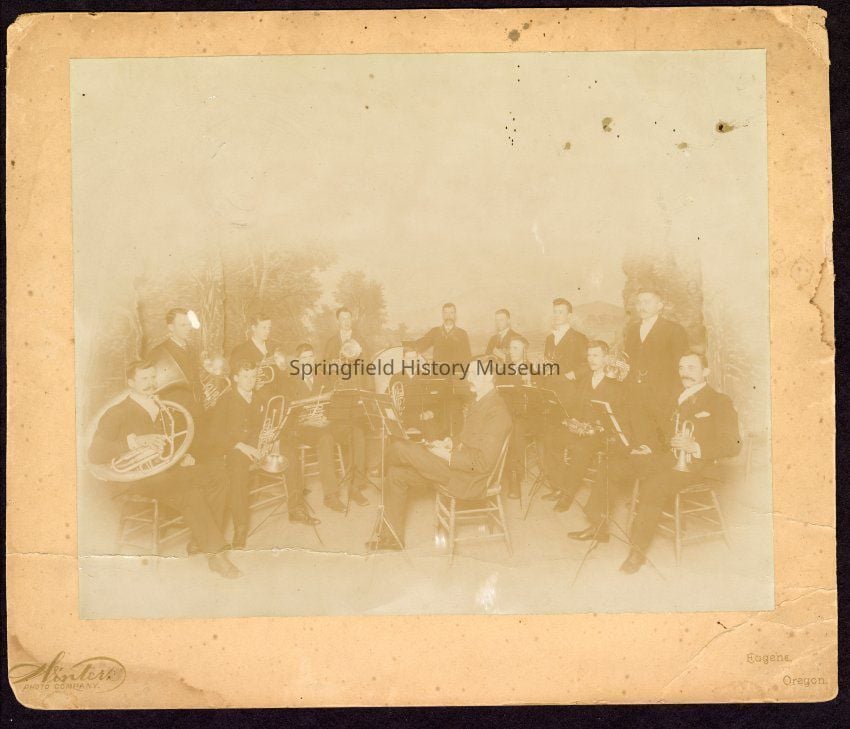
To have a half-lit giant sign just wasn’t going to cut it.
The morning after the big event, The Guard described Springfield as “glowing with light“, but read between the lines, and it’s apparent what happened.
The electric company didn’t come through, but the enterprising citizens did the best they could under the circumstances.
They half-assed it.
With fire.
“The great sign on the butte was partially lighted with electrics, and also by big bonfires.” -The Register Guard, Oct 17, 1909
Still, for a town preoccupied with growth, it must have felt like a declaration.
Springfield had arrived, and it had put its name in lights.
The Hill Fights Back
The first Oregon winter wasn’t kind.
On January 25, 1910, the Eugene Daily Guard opened a brief report from Springfield with an alarming sentence:
“Three-fifths of Springfield was destroyed by a storm last night.”
The joke was that Springfield itself was perfectly fine, but its name wasn’t. Wind had torn down several of the giant hillside letters, and what remained standing was “SPR——-D“.
Springfield’s hillside glory had literally been up only a few months.
By late March, Springfield was putting it back together. The Eugene Daily Guard reported on the 28th that the letters had been rebuilt “much stronger” and moved lower, closer against the hillside where they would be less exposed to winter winds, but that small newspaper item may tell us more about the sign’s eventual fate than anyone realized at the time.
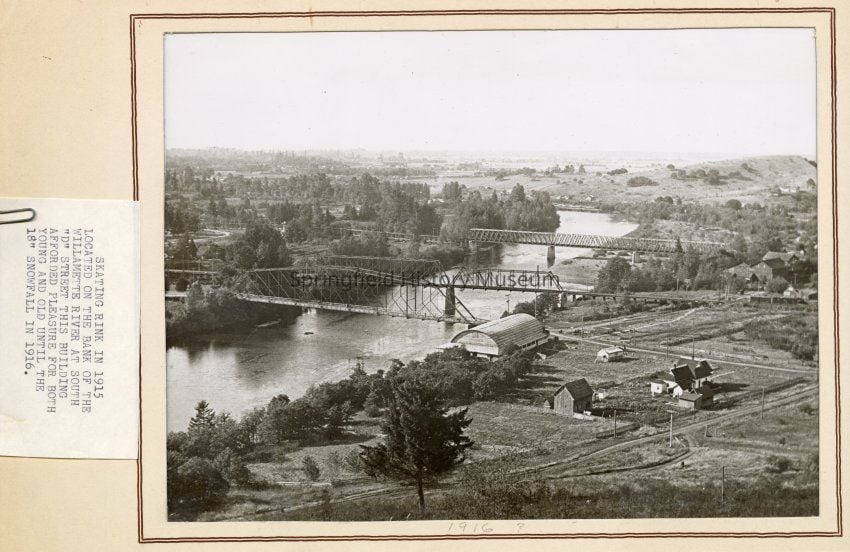
From its first winter, maintaining the thing was a fight, yet Springfield did maintain it.
Years passed. Homes crept farther up Willamette Heights. The city grew around its mills and railroads. The oversized letters stopped being a novelty and became part of the local geography.
By 1913, newspapers could use the sign simply as a landmark. Reporting on property on Willamette Heights on June 4, the Eugene Daily Guard described the area as the hill south of Springfield “where the big ‘Springfield’ sign is located.”
Everybody knew what that meant.
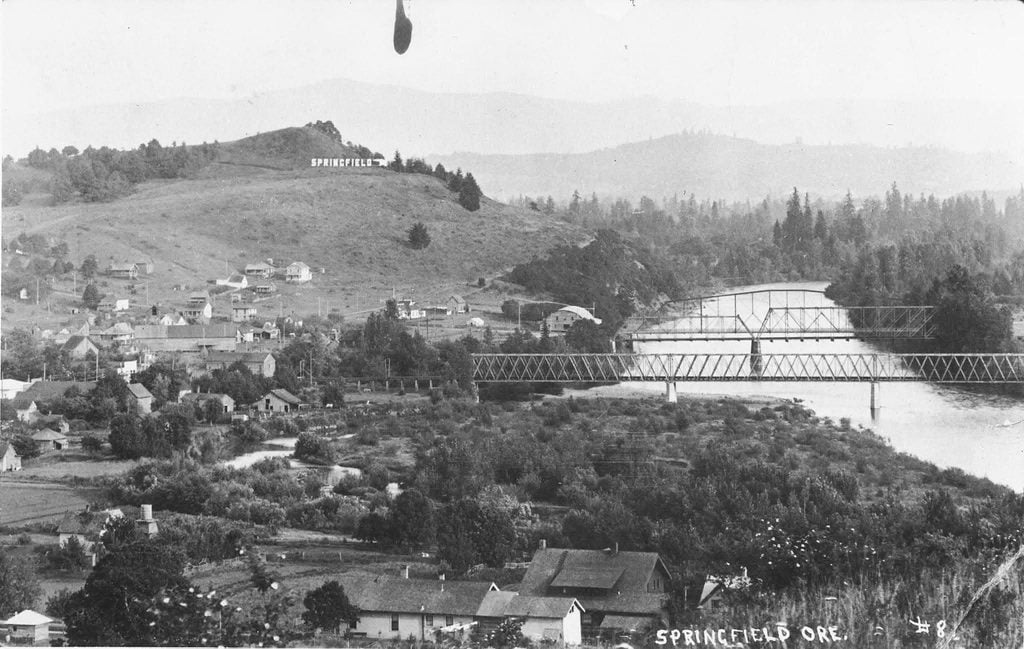
The few extant online photographs confirm just how visible it was.
It Became Part of the Landscape
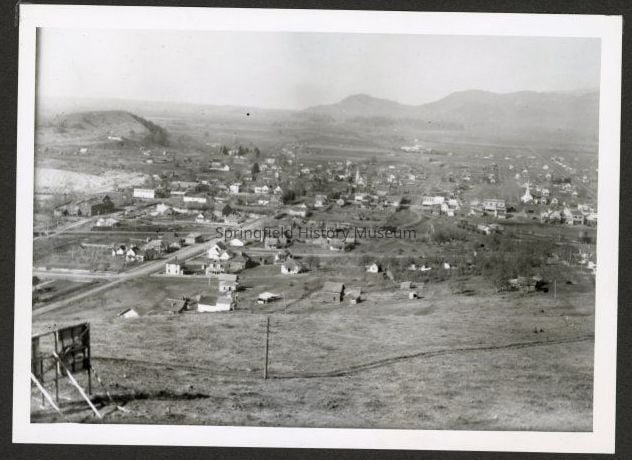
In one remarkable image preserved by the Springfield History Museum, the camera looks from Kelly Butte across the river toward town. The bridges occupy the middle of the frame. Springfield spreads beyond them. And there, on the opposite hillside, is the city’s name in huge white letters.
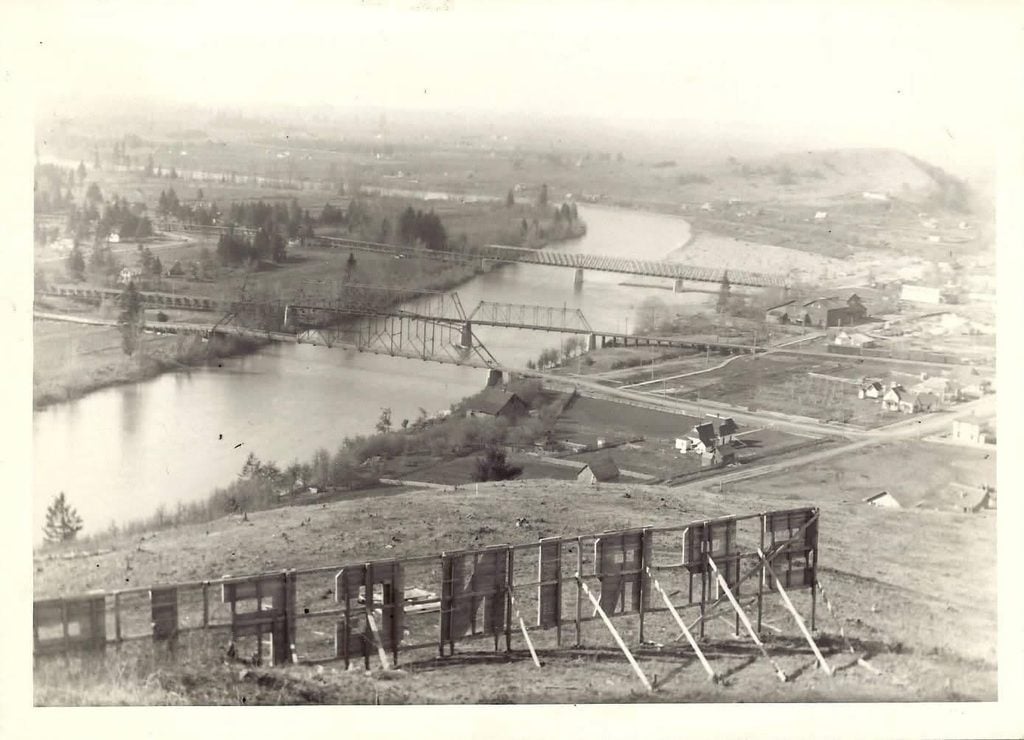
Another photograph, dated to 1911, turns the scene around. The photographer stood up behind the sign on Willamette Heights, looking northwest across the backs of the giant letters toward the river crossings and Springfield below.
These weren’t decorative letters tucked into some obscure corner of town.
They were part of the view.
By 1919, The Sign Needed Saving Again
The newspaper trail grows quieter after those early years, but it doesn’t disappear.
On May 16, 1919, the Register-Guard carried a small article beneath the headline “Large Sign to be Restored.”
“The large sign, ‘Springfield,’ on the butte south of town,” the paper reported, “will soon be restored to its original position.”
The item came out of a meeting of the M.E. Brotherhood, where members had been discussing civic improvements around town. Restoring the hillside letters was considered alongside work on the local auto campgrounds, and then the article quickly moves on to other local happenings.
That wording is pretty tantalizing because it gives us just enough to know there was a problem, but not enough to tell us what the actual problem was.
Had another storm knocked letters down? Had part of the structure collapsed? Had years of rain and wind simply loosened it?
We just don’t know.
It’s tempting to look back at that first winter, when half the word practically blew off the hill, and assume the sign spent the next decade losing a slow war with Oregon weather.
Maybe it did.
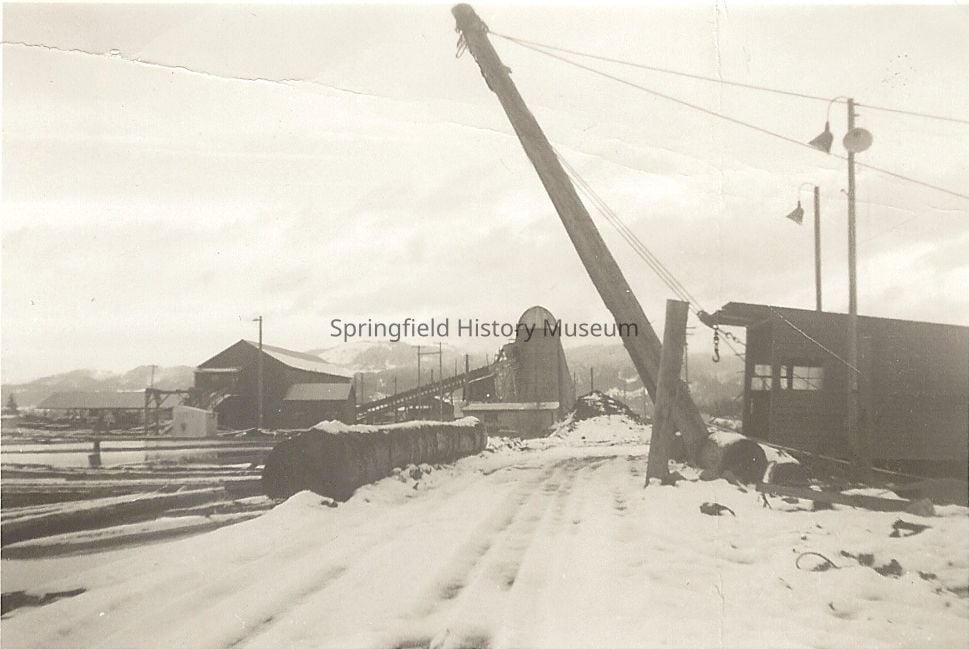
But a historian has to resist a satisfying answer when the source material doesn’t actually give one.
No newspaper clipping we’ve found says the sign was ultimately removed because of wind. No city record has surfaced explaining the decision. There’s no farewell photograph showing workers taking the letters apart.
Instead, the sign simply fades out of the record.
Sometime Before 1923, Springfield Came Down
Four years later, the old sign appears one last time in the papers, and by then it had already slipped into the past.
The Morning Register was writing on June 24, 1923 about a proposed municipal park and the possibilities of the hill near Willamette Heights. A road already led to the top, the paper noted, and the view over Springfield was excellent. Then, casually, came this:
“Years ago a huge sign, the word ‘Springfield,’ was built on the side of the hill facing the main line of the Southern Pacific, but this has since been torn down.”
That’s as close as the newspapers presently bring us to the end.
By June 1923, the letters were gone. The article doesn’t say when they came down, who ordered it, or why. That missing explanation is important, because history gets dangerous when a good theory starts sounding better than the evidence supporting it.
The repeated wind damage makes an obvious suspect. The sign suffered badly during its first winter, required heavier construction, and later had to be restored again. Maybe maintenance eventually became more trouble than the landmark was worth.
But maybe not.
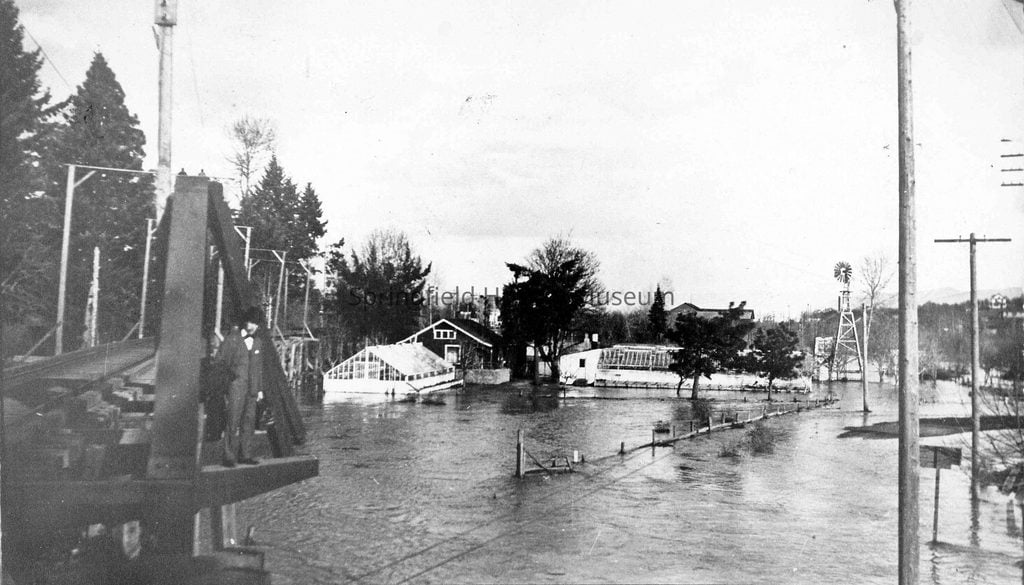
Perhaps the electrical cost mattered. Perhaps the structure simply deteriorated. Perhaps the hillside was changing. Perhaps the railroad-oriented advertising idea had lost some of its usefulness as the automobile began reshaping how people moved through Oregon.
At this point, those are possibilities, not answers.
All we can say with confidence is that the sign survived well into the 1910s, needed attention again in 1919, and was remembered as something already torn down by June 1923.
Somewhere between those points, Springfield disappeared from its own hillside.
And Then Hollywood Put Up a Sign
There’s another twist that makes the photographs nearly impossible to look at without smiling.
The original “HOLLYWOODLAND” sign went up in Los Angeles in 1923, built as an advertisement for a real estate development.
Springfield had erected its giant hillside letters in 1909.
Fourteen years earlier.
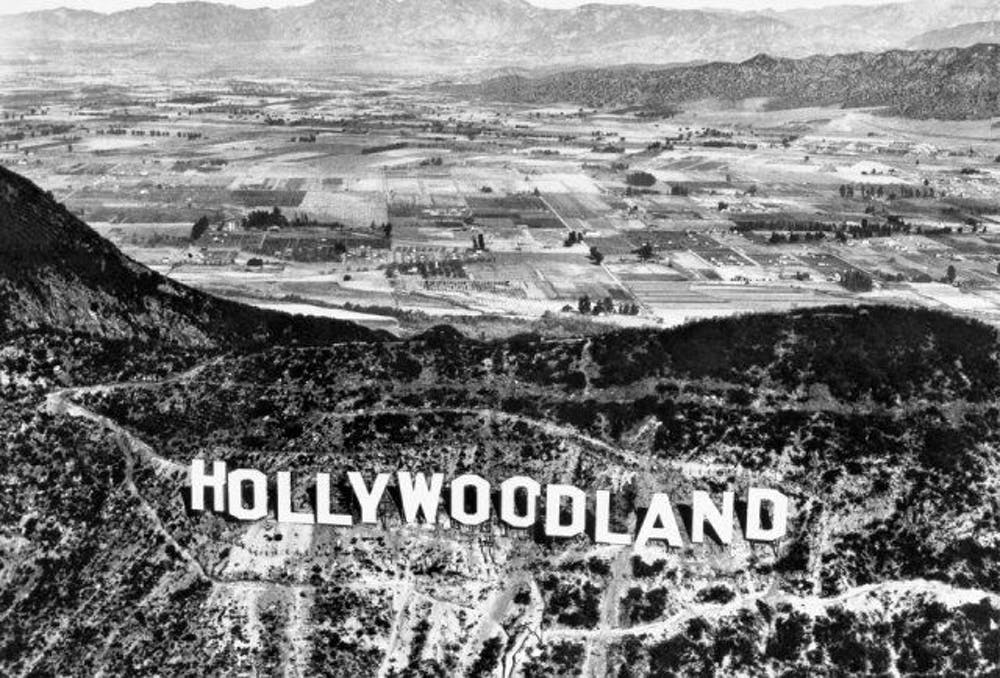
And in case you’re wondering, the answer is no. Even though it’s a wonderful thought, there’s absolutely zero evidence that Hollywood copied Springfield. Springfield itself had borrowed the general idea from elsewhere. Giant civic signs were part of the booster culture of the American West.
Still, history has a sense of humor.
In the same exact year a newspaper in Oregon was referring to Springfield’s hillside sign in the past tense, another set of giant white letters was appearing above Los Angeles.
Those letters eventually became famous around the world, while our little Oregon city’s were almost forgotten.
But Then The World Went Yellow
Springfield eventually got its hillside letters back in a way those early residents could never even have fathomed.
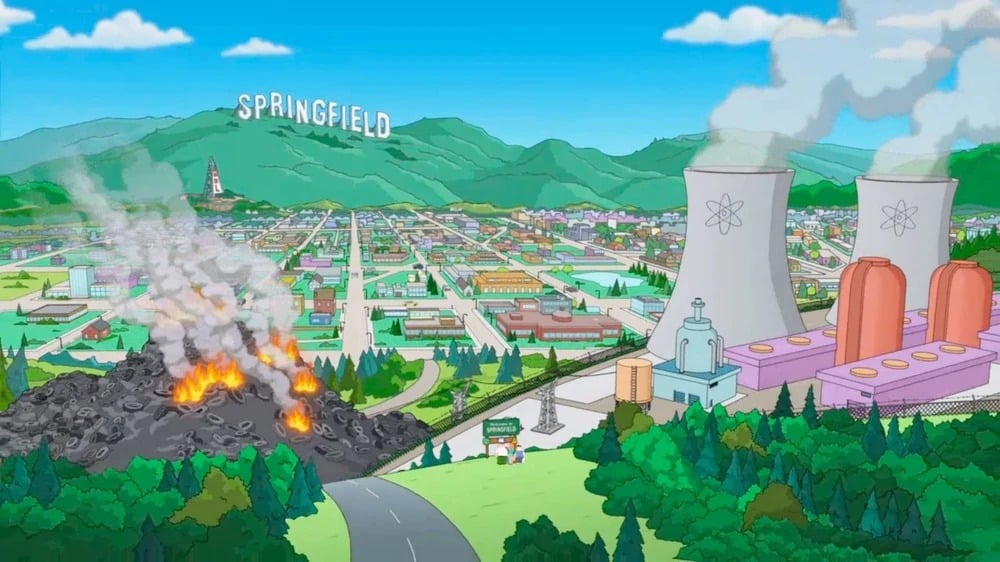
Anyone who’s ever watched The Simpsons has seen it: the giant SPRINGFIELD sign stretched across the hills above the fictional town, an unmistakable riff on Hollywood.
Ordinarily that’d be just a fun little coincidence and nothing more.
Except the man who created The Simpsons grew up in Oregon.
And he named the town after Springfield, Oregon.
In a 2012 interview with Smithsonian, Matt Groening was asked directly why the Simpsons lived in a place called Springfield.
“Springfield was named after Springfield, Oregon,” he said.
FULL STOP.
Groening explained that while growing up in Portland, he had watched Father Knows Best, heard that its fictional family lived in Springfield, and imagined it meant “the town just down the road”. Later, realizing how many Springfields existed around the country (according to the USGS there are 93), he liked the idea that viewers everywhere could believe the Simpsons belonged to them.
That Oregon connection runs much deeper than the town name. Portland street names became character names, among them Flanders, Kearney, and Lovejoy. Groening borrowed names from his own family. The first prominent white settler in what would become Eugene was Eugene Skinner, just like Bart’s favorite principal. Oregon was part of the raw material from which Springfield was built.
Then the fictional Springfield began bleeding back into the real one.
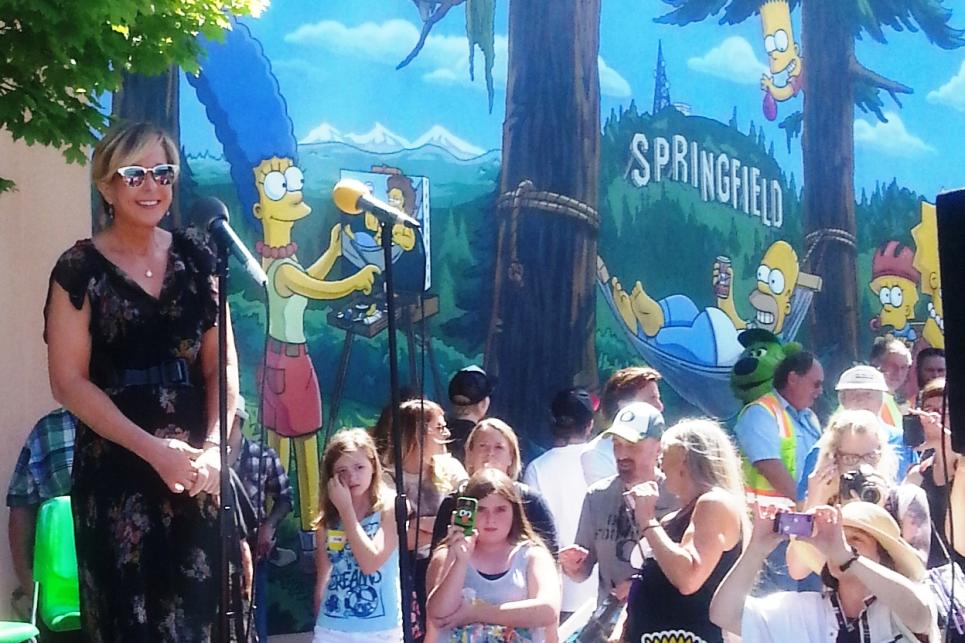
In 2014, Springfield partnered with The Simpsons production team on the enormous official mural now covering the side of the Emerald Art Center downtown (which is conveniently located right next to the Springfield History Museum, by the way). The design came with direct involvement from the show’s artists and Groening. When Lisa Simpson voice actor Yeardley Smith came to Springfield for the big unveiling, she played along with the decades-old geographic mystery:
“We have always said that Springfield is every town in America,” Smith told the crowd. Then she added: “But that is a dirty lie. Springfield is obviously in Oregon.”
And the crowd went wild. Because damnit, we KNEW.
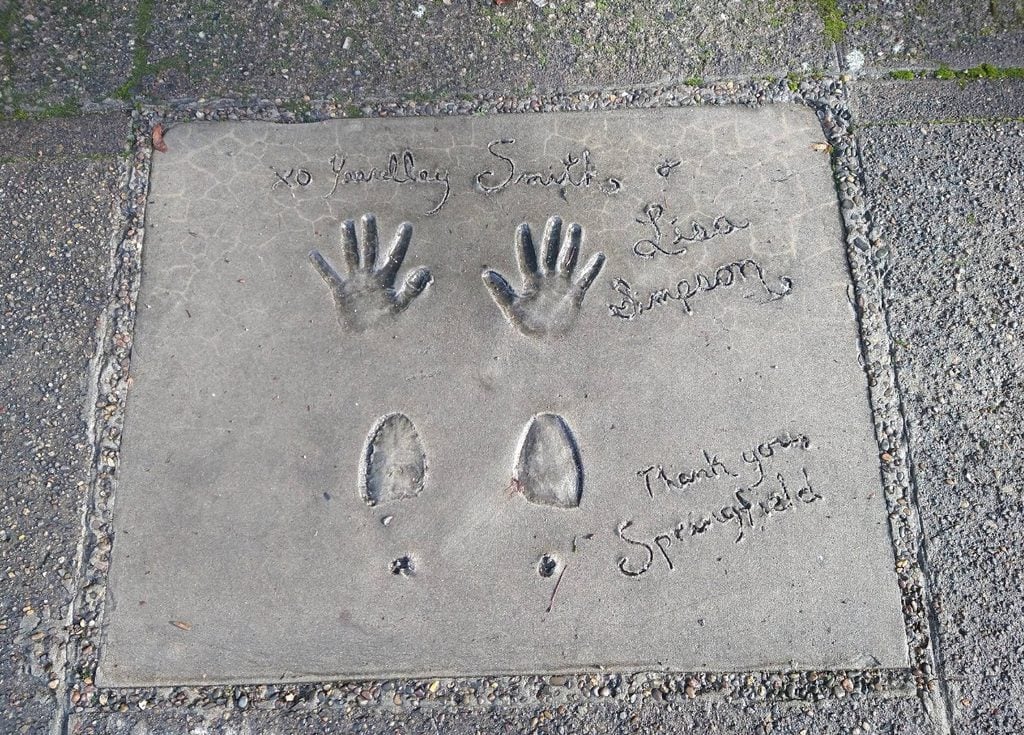
Since then, Simpsons imagery has spread through downtown. Local artist Bayne Gardner has painted countless characters around the city, from Ned Flanders to Mr. Burns, creating a kind of unofficial conversation between the real Springfield and the animated one. The official mural itself celebrated its tenth anniversary in 2024.
And The Simpsons is hardly fading into nostalgia. The series passed its 800th-episode milestone in 2026, with new Disney+ episodes continuing through the summer, including “Yellow Mirror,” released August 26, 2026, which contained this scene:
Host: Homer, I gotta ask, what state is Springfield in?
Homer: Oregon.
Host: Oh. Yeah, I thought it was this mythical place that could be anywhere.
Homer: Nope, Oregon.
Which brings us back to that old photograph.
One Concidence Too Many?
We gotta be careful here.
There’s no known interview in which Matt Groening says he saw Springfield’s 1909 hillside sign. We’ve found no production note connecting the historic Oregon sign to the giant SPRINGFIELD letters in the animated town.

The cartoon sign is an obvious parody of Hollywood.
So we can’t say beyond a doubt that the big Springfield sign on the butte, Oregon’s lost landmark, inspired it.
But c’mon now. Look at the circumstances.
- Groening grew up in Oregon.
- He explicitly named his fictional town after Springfield, Oregon.
- The show absorbed Oregon names and references from his childhood.
- The real city later formed an official relationship with the production, unveiling a Simpsons mural created with the show’s involvement.
- And in the fictional Springfield, high above town, is a huge white SPRINGFIELD sign.
Meanwhile, back in Oregon, almost forgotten even by people who grew up here, Springfield really had one, decades before the cartoon, and decades before Hollywood’s iconic sign.
That doesn’t prove anything.
It does make you wonder.
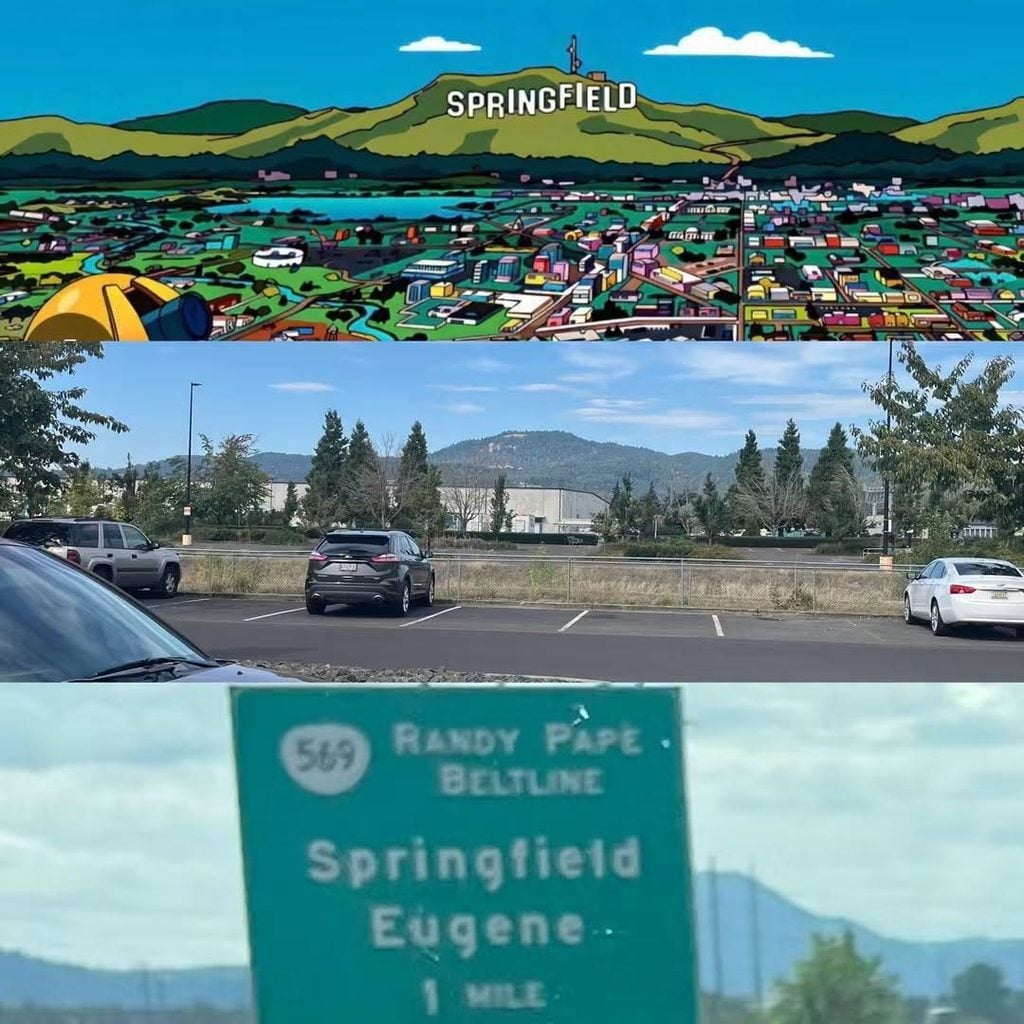
Because once you place the old photograph beside the animated image, the question is difficult to unsee: Did somebody involved with The Simpsons know?
Maybe Groening saw an old postcard as a kid. Maybe he heard about the sign from someone in Oregon. Maybe nobody connected with the show knew a thing about it and history simply managed to rhyme in a remarkably specific way.
[Matt, if you’re reading this, reach out and let us know, okay?]
Until somebody finds the missing link, the honest answer is that we don’t know.
And somehow that makes the story even better.
The Town That Wrote Its Own Name Across the Sky
What remains certain is the part Springfield left behind in newspapers and photographs.
In 1909, this was a town looking toward its future. Its boosters wanted industry, investment and growth. They wanted train passengers to look out the window and remember the name Springfield.
So they raised money at dances. Women collected ten-cent contributions in the street. Local businessmen helped pay the electric bill. Four men climbed Willamette Heights and began assembling letters big enough to read from miles away.
The wind knocked them down.
Springfield put them back up.
Years later, somebody proposed putting them back again.
Then sometime before 1923, the letters came down for good, and the hill slowly reclaimed the view.
A century later, nearly everyone knows a certain Springfield with a giant sign over it.
They just may not know that the actual Oregon town actually had one first.
If you want to explore more of the city behind this story, start with our Springfield, Oregon guide and the broader Willamette Valley guide. For more forgotten stories from around the state, visit our Oregon History archive and Oregon Cities & Towns hub.