
Near Shedd, a free tour brings Oregon’s oldest standing water-powered grain mill back to life.
The Oregon mill that can still make its own power
On a quiet Linn County road east of Shedd, water from the Calapooia River can still turn the machinery inside Thompson’s Mills. Visitors who join a guided tour can watch the gates open and hear a working system that once gave nearby farmers a place to turn wheat into flour. The demonstration gives the old building its voice back.
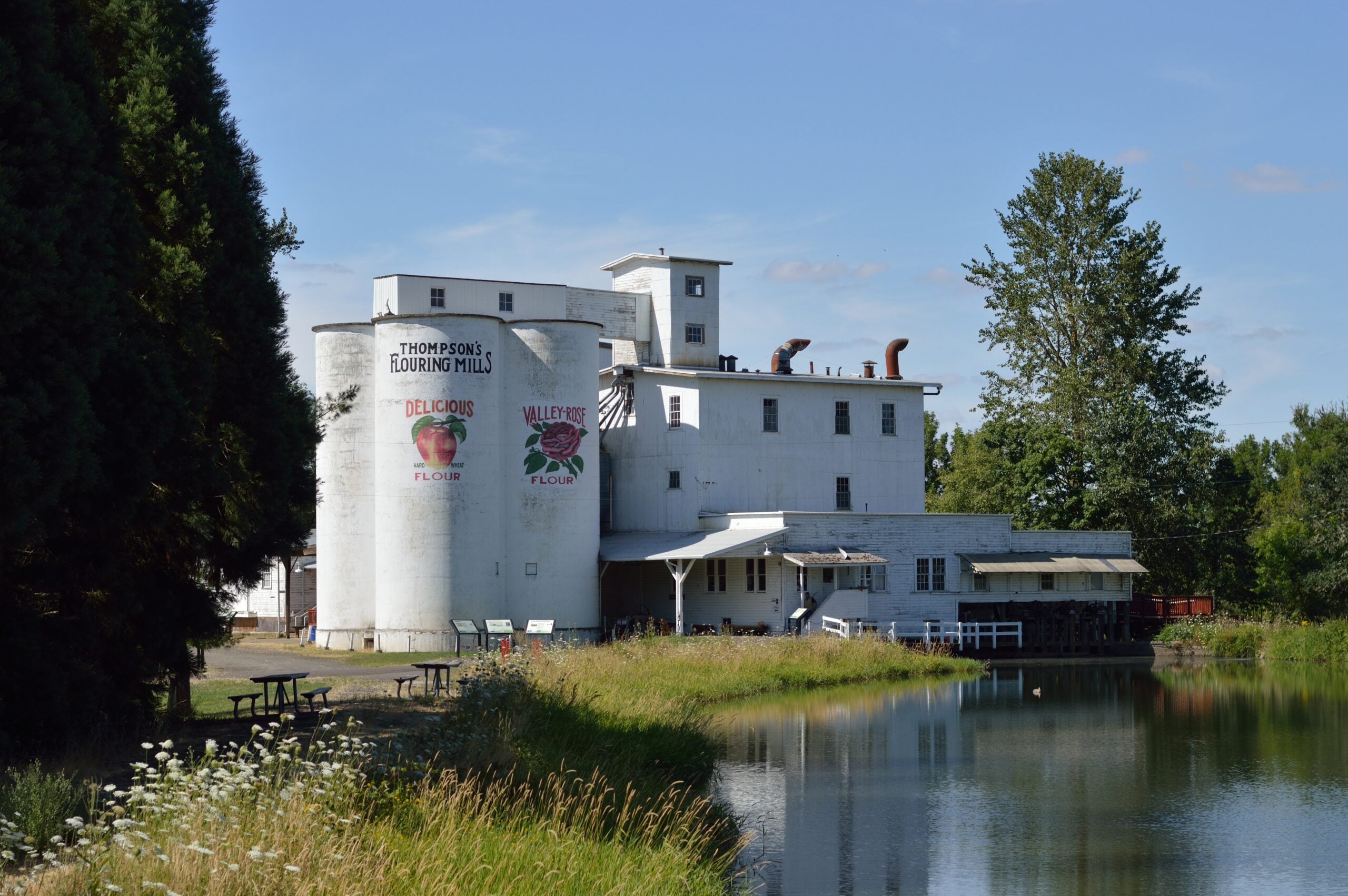
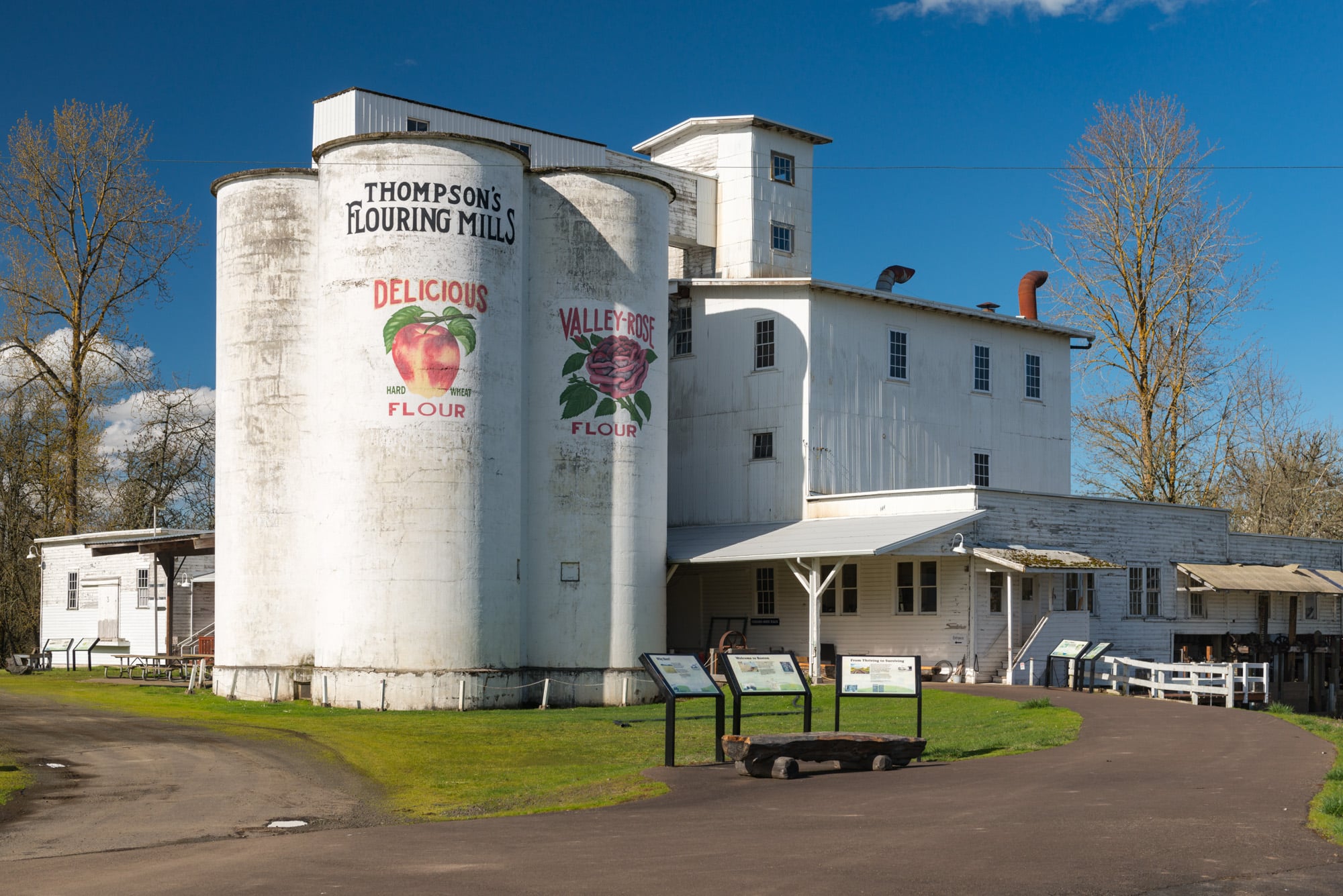
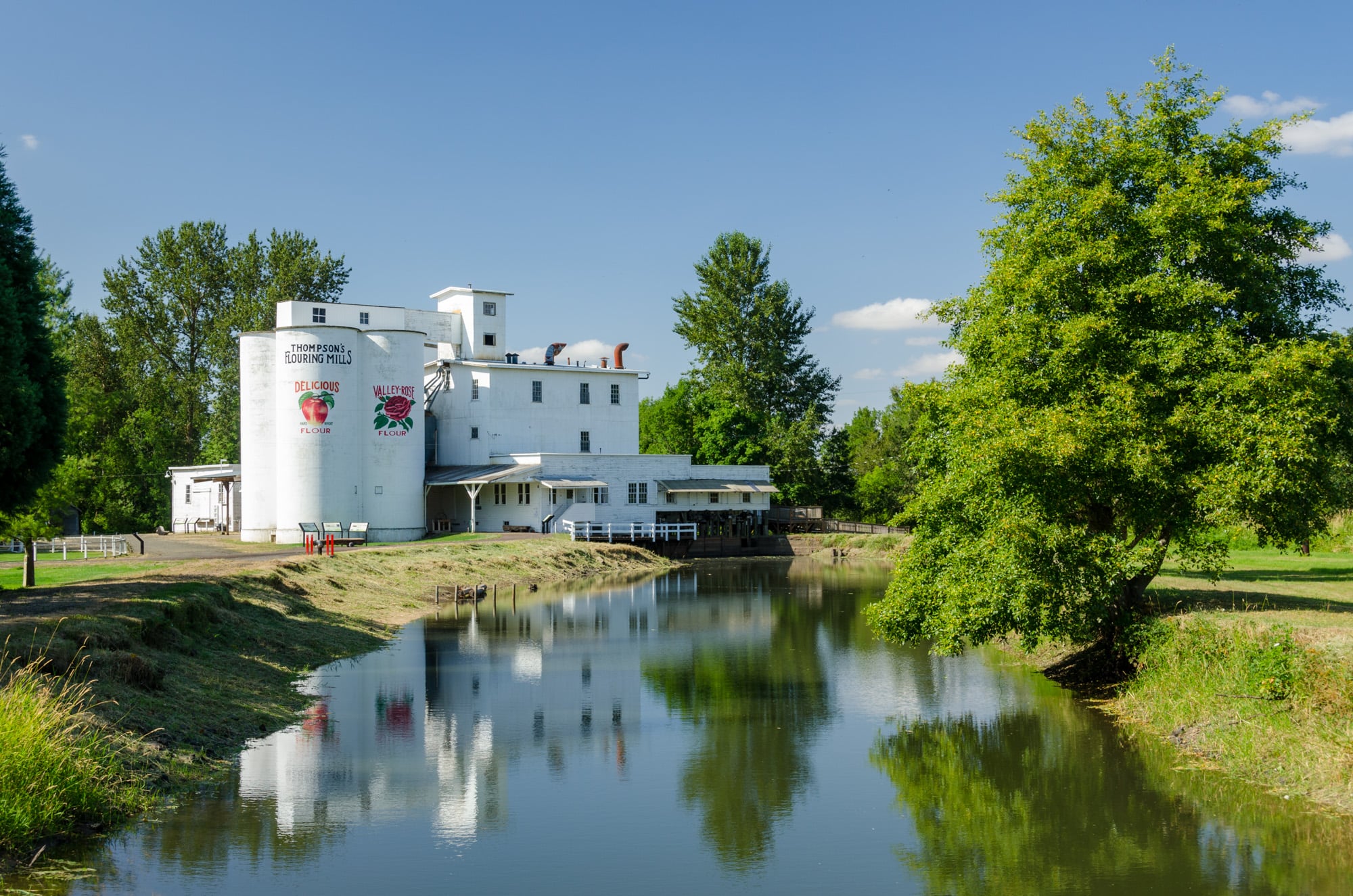
The white mill, its tall silos and the water beside it make a good first impression, but the view from the road only tells half the story. Thompson’s Mills is Oregon’s oldest standing water-powered grain mill, a place shaped by farmers, river engineering, a vanished town and a family that kept changing the business to survive. Today it belongs to Oregon State Parks, and admission to the mill and its tours is free. The scale of the place makes its long history easy to follow.
Part of the appeal is how little ceremony the trip requires. The heritage site is a short drive from Interstate 5, close enough to fit into a midvalley day trip but far enough into farm country to feel like a detour with a purpose. You can spend half an hour on a tour or stay longer to look at the millrace, the buildings and the equipment that turned a local operation into a regional one. The park’s current information says the grounds are open dawn to dusk and the mill is open from 9 a.m. to 4 p.m.
A river powered a town that disappeared
The story begins in 1858, a year before Oregon became a state. Miller R. C. Finley and partners Philemon Crawford and Alexander Brandon built Boston Mills beside the Calapooia. They were meeting a practical need: farmers had grain to process, and people traveling toward southern Oregon’s gold fields needed flour. In an era when a long wagon journey could determine what a family ate or sold, a dependable mill was essential local infrastructure.
The founders did more than put a wheel next to a stream. As historian Kristine Deacon describes in the Oregon Encyclopedia, they developed a system of dams, a millrace, headgates, a flume and turbines to direct the river’s force into the building. Water had to arrive at the right place and in the right amount before it could turn the equipment. The surviving site makes that relationship easier to understand than a diagram ever could: the channel, building and machinery remain parts of one connected operation.
A small settlement called Boston grew behind the millkeeper’s house. It had a post office, stores and a blacksmith by the late 1860s, the sort of services that made a rural community feel permanent. Then the Oregon & California Railroad laid its line through nearby Shedd in 1871. Boston lost its place on the region’s map, but the mill adapted by sending its flour to the rail station in the new center of activity.
That change is one reason the mill is more than a relic of an old town. Its owners did not preserve an 1858 business in a glass case while the rest of Oregon changed around it. They moved goods, found customers and kept working. Boston has disappeared, yet its mill remains in use as a state heritage site.
The building standing today is not the first mill on the site. The preservation society’s historical timeline records a fire in 1862 and a rebuilding the following year with two water turbines. That early loss complicates the familiar phrase “built in 1858”: the business and waterpower system began then, while the structure carries the changes and repairs of later generations. Looking at the mill as a continuing worksite makes its survival more remarkable than imagining that every board has been untouched since territorial days.
The Boston settlement also had more substance than a name on an old map. The preservation society estimates that about eighty people lived nearby in 1869, when the post office, stores and blacksmith made it a service center for the farms around it. The railroad did not erase the mill’s customers overnight, but it shifted where goods and people moved. A warehouse opened beside the tracks at Shedd in 1872, giving the mill a practical way to keep selling into the new transportation network.
That decision is a small but telling piece of Oregon history. A grain mill could not pick up its turbines and follow a railroad, yet its owners could move the flour. The river fixed the machinery in place; the warehouse extended the business beyond that fixed point. The modern visitor can still see the mill where Boston once stood, while the settlement and its railroad-era warehouse have vanished.
The Thompson family kept finding another way
By 1880, the mill was handling oats, corn and barley as well as wheat, and its flour reached buyers in Portland. Martin and Sophia Thompson arrived with their children in 1891. Martin eventually took full ownership and replaced older equipment with steel roller machinery that improved output and consistency. The operation became Boston Roller Mills, a new name for a business that was again adjusting to a wider market.
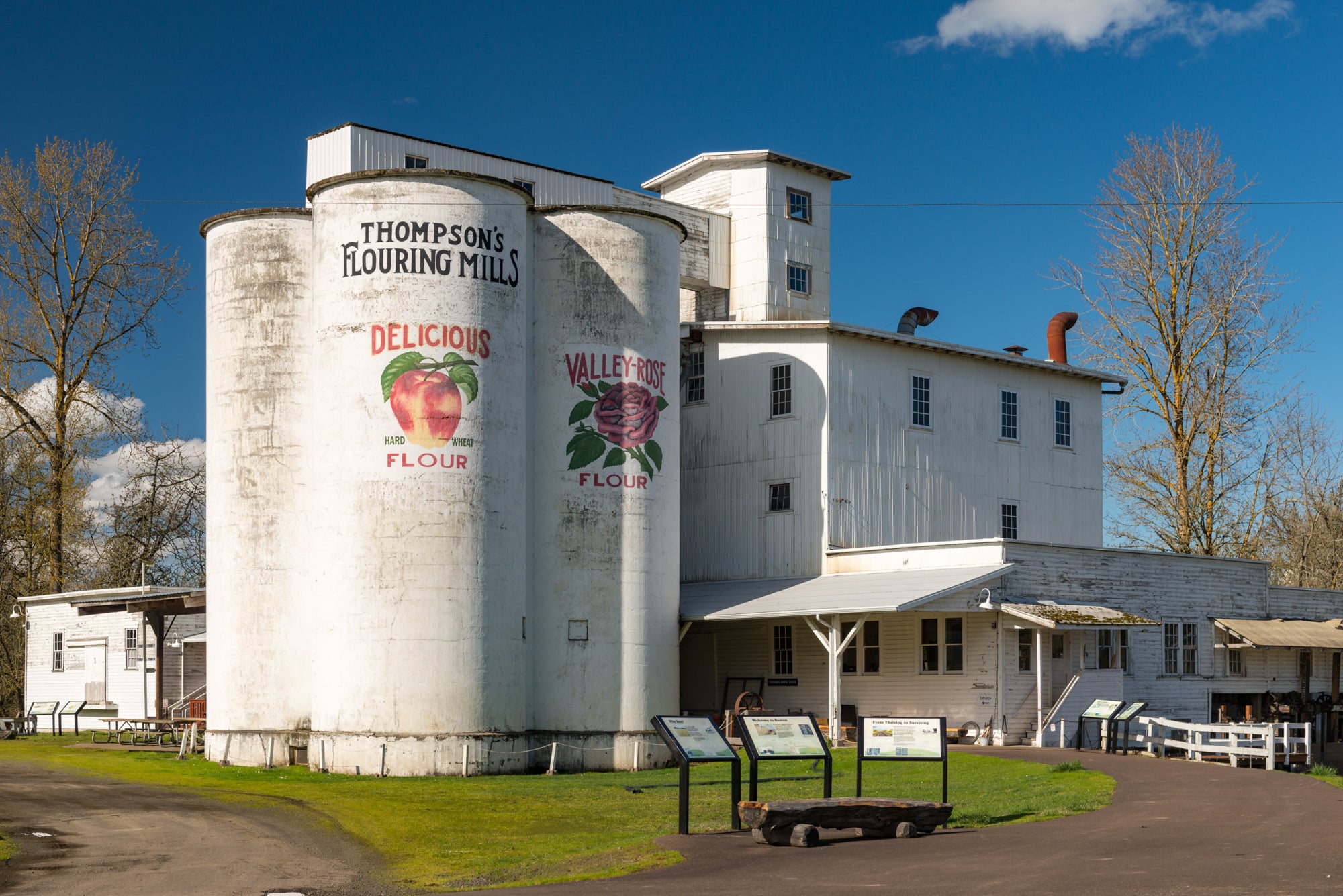
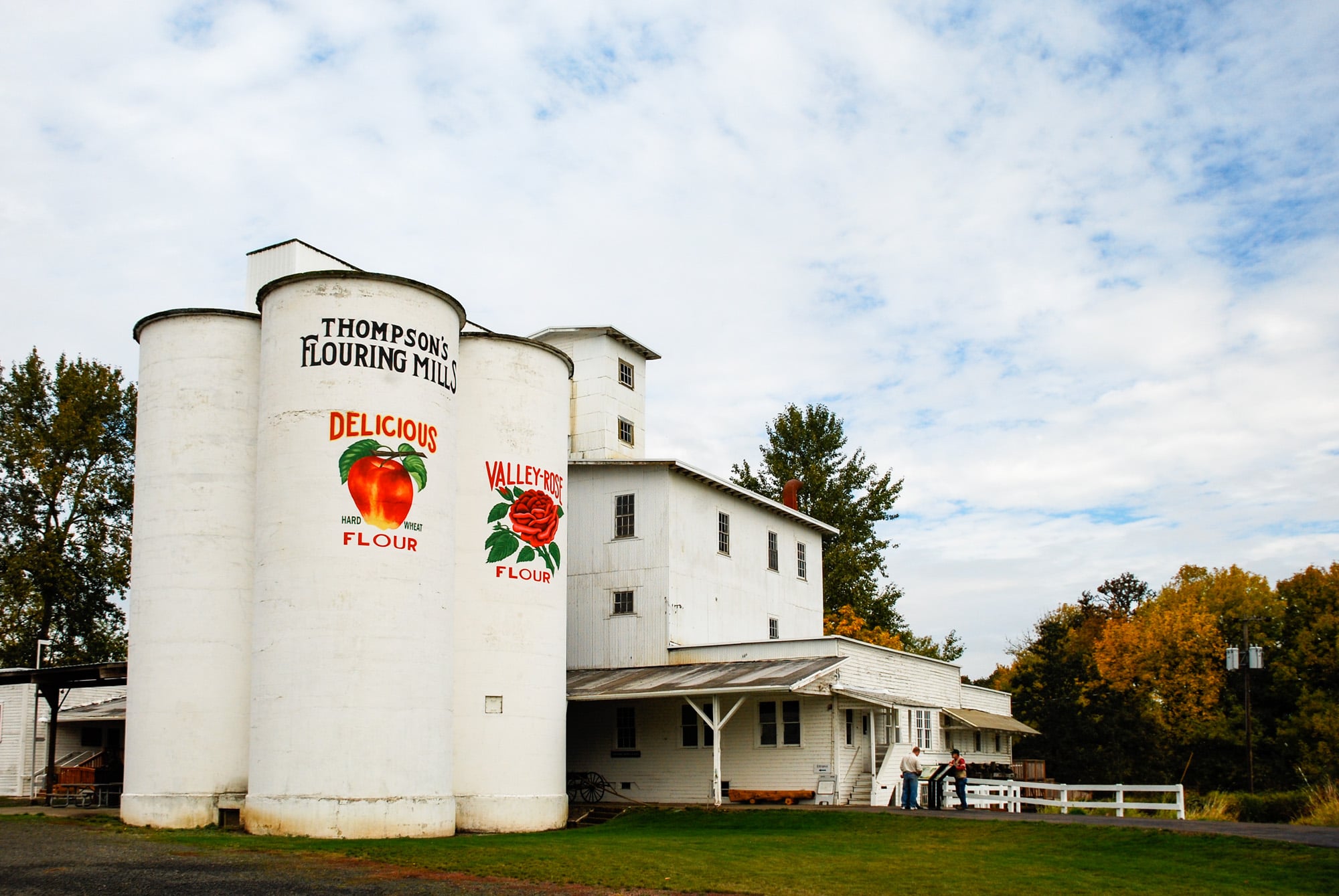
After Martin died in 1910, Sophia and sons Otto and Leo carried the work forward. They renamed it Thompson’s Flouring Mills and sold flour under labels including Valley Rose, Thompson’s Best and Cream of the Valley. The large concrete silos that now dominate many photos of the site arrived in 1917. They held eastern Oregon hard winter wheat and helped make production less dependent on the immediate harvest season.
Those silos are worth a second look because they explain something that the picturesque riverside view can hide. Flour milling was a business of storage, timing and transportation as much as grinding. Wheat from another part of Oregon had to be kept dry and available, then moved through the mill and sold under a recognizable brand. During World War I, the facility worked around the clock supplying flour to the U.S. Food Administration’s relief effort in Europe.
The four silos rose about 50 feet, a conspicuous addition to a mill that had begun with local wheat and river power. They gave the family room to buy hard winter wheat from eastern Oregon and hold it for future production, connecting a small Linn County operation to farms far beyond the Calapooia. The flour brands made that reach visible on the finished sacks. Valley Rose and Cream of the Valley sound local, but the grain, storage and sales network had become much wider than the old Boston townsite.
A change in customers altered the mill again. By 1940, the mill had shifted away from flour for people and toward feed for animals. Electric power joined the water system in 1941, ending a long period when river energy alone drove the operation. The Thompson family held the property until 1974, long after the early settlement and its original business model had disappeared.
Later owners David and Marlene Babits found yet another use for the water. In 1986, they installed a generator and began selling power to Pacific Power and Light while the mill continued smaller specialty jobs. The state bought the property in 2004 and, after structural and safety work, opened it as a heritage site. Across those decades, it processed flour and feed, handled specialty milling and sold electricity. Visitors can still trace each of those uses through the building and its waterworks.
Modernization came in layers that are still useful to picture inside the building. The preservation society’s timeline says Martin Thompson installed more efficient steel roller mills in the late 1890s, changing how grain was ground without giving up river power. Around 1903 or 1904, the business added a small direct-current generator driven by a turbine. That was an early electrical use of the water, decades before the later owners sold hydroelectric power to a utility.
Martin also built the Queen Anne-style millkeeper’s house that remains on the property in 1904. The earlier house came down a few years later, and the working mill gained additions, an office and a loading dock as the business grew. Those changes matter because a photograph of the site can tempt us to assign a single date to everything in the frame. The mill is a collection of decisions made at different moments, each one answering a need for more space, different equipment or a new way to move grain.
The twentieth century kept demanding such decisions. The preservation society records concrete work around the flume and tailrace in the early 1930s, and a raised roof that created more working space in 1933. The business moved from wagons and horses to powered trucks as transportation changed. By 1946, after the shift toward animal feed described in the Oregon Encyclopedia, it had stopped making wheat flour and bought a water-powered pellet mill. The name on the building remained familiar, but the product leaving it was changing.
The best part of a visit is inside
The mill’s exterior is easy to photograph, but a guided tour is where the history becomes much more interesting. The state park says its interpreters can demonstrate machinery powered by water and electricity, though the mill no longer produces a commercial product. You can hear and see equipment move through a building whose timbers, chutes and working systems make the old process legible. A static exhibit could explain the same dates; it could not give the mechanisms this kind of presence.
Guides can also make sense of the path grain once followed. A mill had to receive a crop, store it, move it between floors, process it and package what came out. Each step depended on another, so a small change in power or equipment could affect the whole day’s work. The six-floor building and its surviving machinery are an opportunity to follow that chain instead of imagining it from a finished sack of flour.
The state park’s tour information is refreshingly straightforward. Self-guided visits run daily from 9 a.m. to 4 p.m. Guided tours are scheduled at 11 a.m., 1 p.m., 2 p.m. and 3 p.m. Monday through Thursday; Friday through Sunday, staff offer them on demand during the same 9-to-4 window. A guided visit generally takes about 30 to 45 minutes, and groups of more than 10 should contact the park ahead of time.
Because this is a historic working site, the most satisfying way to visit is to leave room for questions and for a slower walk around the grounds. Look at where the water approaches the building, then compare that route with the equipment inside. Look at the silos after learning why the Thompsons built them. Even visitors who arrive for the engineering may find themselves thinking about the people who had to keep the place working through harvests, markets and changing technology.
Families can make this an especially useful stop because the tour connects things children already recognize, water, grain and bread, to the machinery between them. The park describes a five-station program for school groups and says it can tailor the material by age. A family visit does not require a school reservation, but a large group should make arrangements in advance. Younger visitors may be more interested in seeing a gate open than in hearing every date, and this is one historic site where that curiosity helps explain the whole place.
Photography is welcome inside, including flash and tripods, according to the park’s visitor guidance, provided that people respect the barriers and do not block others. That matters in a site where the original machinery and circulation routes are part of the attraction. Some areas remain off limits for safety and preservation. Its protected work areas and original machinery call for a little patience and care from visitors.
Why the water still matters
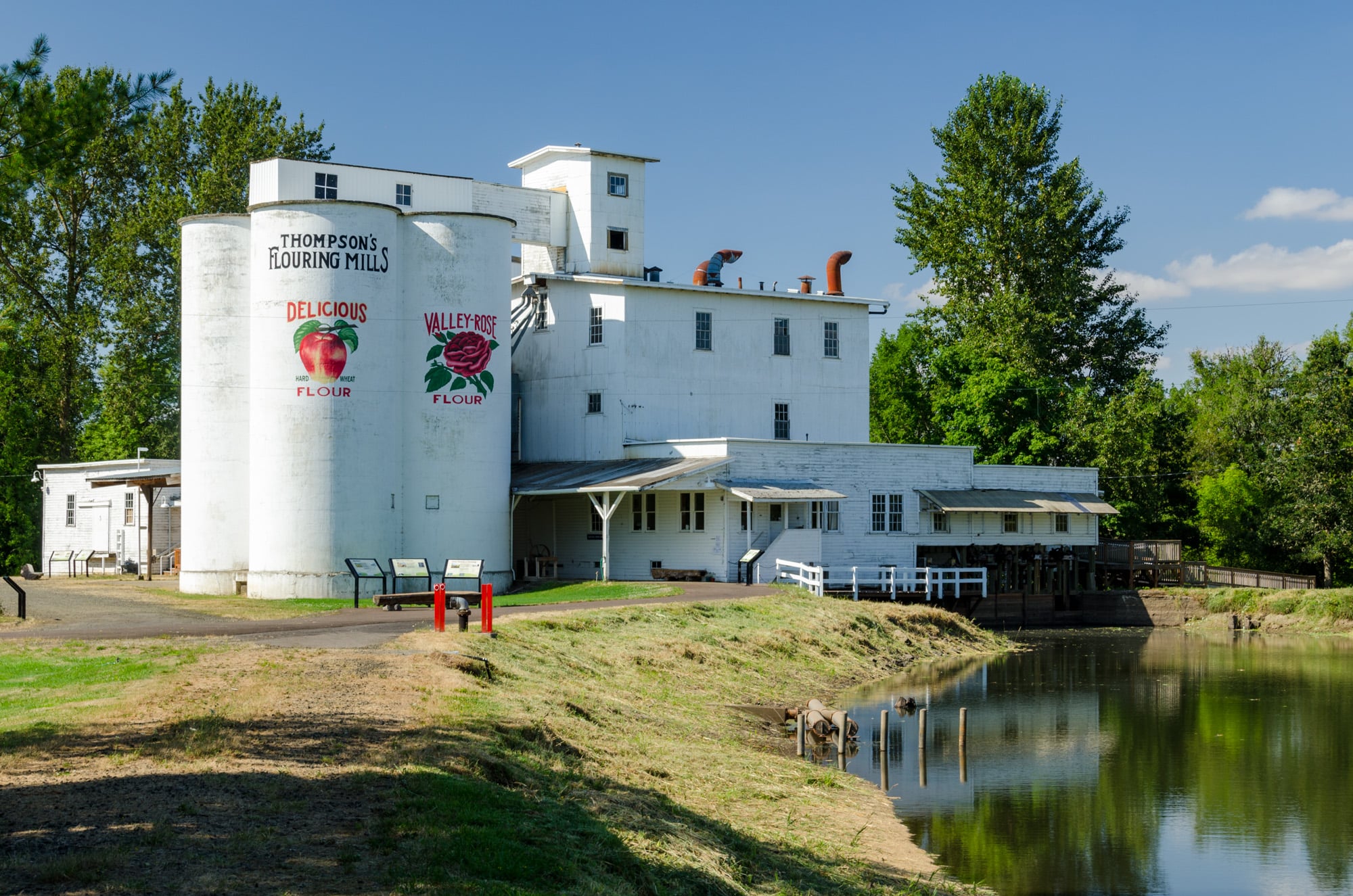
Water at Thompson’s Mills is not a scenic extra. Its right to draw from the Calapooia predates Oregon statehood, and the flow still lets staff demonstrate the machinery. The state describes a millrace and adjustable dam that preserve the look and function of the site while allowing fish passage and drainage after winter rain. The newer works let the park demonstrate an old machine while caring for the river.
The system has not always been as simple as opening a gate. Oregon State Parks says work on river structures included removing Sodom and Shearer dams and installing an adjustable dam in 2013. That arrangement lets the river run freely while maintaining water in the millrace for demonstrations. The building, millrace and river are best understood together.
There is a larger Oregon story in that relationship. Streams powered mills before electrical grids reached rural places, but water rights, fish habitat and flood management later became central concerns of their own. Thompson’s Mills lets visitors see several eras at once. The old business needed the river to earn a living; the present-day heritage site needs to care for the river while explaining how that business worked.
The grounds also hold more than the main milling building. The Oregon Encyclopedia describes a millkeeper’s house, carriage house, hay barn and other service structures across the roughly 20-acre property. Their presence helps resist the familiar mistake of seeing an old mill as a single photogenic facade. People lived near the work, maintained equipment, stored supplies and handled the unglamorous tasks that kept a water-powered business running. The surrounding buildings and open space give the main mill a setting that a stand-alone museum exhibit could never recreate.
The site’s survival also gives a rare sense of continuity to a stretch of the Willamette Valley often experienced at highway speed. Grain grown in one part of Oregon, flour sold in another, a railroad that moved commerce away from Boston and a river that still drives the machinery are all gathered here. None of those connections is hard to understand once you have spent a little time with the place. Together they show how a rural Oregon business managed to stay relevant for well over a century.
Keeping the mill standing has required more than painting old siding. The preservation society’s timeline records a partial building collapse during the summer of 1979 after water-management trouble, followed by repairs that year. Flooding in 1996 damaged water gates and a turbine, prompting more work on the headgates and a replacement for a 1916 turbine. These episodes belong to the site’s history as surely as the flour labels do. A water-powered building is always exposed to the river that made it useful.
The state’s purchase in 2004 also began a different kind of operation. Oregon State Parks says it paid for the property and associated equipment, then spent three years on structural and safety work before welcoming visitors. A working demonstration requires machinery that can move safely, not merely machinery left where the last private owner stopped. The park continues repairs and waterworks projects, so preserving this mill is an ongoing public job rather than a one-time restoration.
Water rights still connect the property to decisions far beyond its walls. The preservation society reports that, after the state purchase, a portion of the old right was transferred to improve river health. Oregon State Parks describes the later removal of two dams and the installation of an adjustable structure that keeps water available for demonstrations while allowing fish passage. The details are technical, but the question is plain: how can Oregon show people a working nineteenth-century mill without treating the river as though nothing has changed around it? Here, the answer is visible in the watercourse as well as inside the building.
Make a day of the midvalley detour
Thompson’s Mills is at 32655 Boston Mill Drive, about two miles east of Shedd. The park is open daily apart from major holidays, though its own page gives slightly different holiday wording in different sections; checking the current park notice before a holiday trip is wise. Tours are free, and the grounds can be enjoyed beyond the mill’s 9 a.m. to 4 p.m. opening hours. Bring a picnic if you want to turn a short tour into an unhurried stop.
This is a good fall destination for reasons that do not depend on a promise about peak foliage. The mill operates year-round, the tour is indoors for much of its route, and the farm-country setting makes an October drive pleasant even on a gray day. The Thompson’s Mills Preservation Society also has a cider pressing listed for Saturday, October 24, 2026, at the site. Check the preservation society’s 2026 event announcement before building a trip around it.
Before you go, use the Oregon State Parks page for the latest tour schedule and any site advisories. A historic mill has multiple levels and protected machinery, so visitors with specific mobility questions should check current access information with park staff. Fishing is allowed along the millrace and river under Oregon Department of Fish and Wildlife rules. It is a flexible stop, yet the guided demonstration is the part most likely to make the journey memorable.
If you want another stop nearby, TOL’s story about Country Bakery in Halsey suggests a sensible food pairing, while our Vault 244 feature offers an Albany dinner inside another adapted historic building. Neither stop replaces time at the mill. They simply make the drive through this part of the valley feel less like an errand and more like a small Oregon outing.
Boston faded, the railroad changed the local economy, and the Thompson family modernized the business. Later owners sold electricity from the same water system. Today state park staff open the gates and run the machinery so visitors can see how it all worked.