
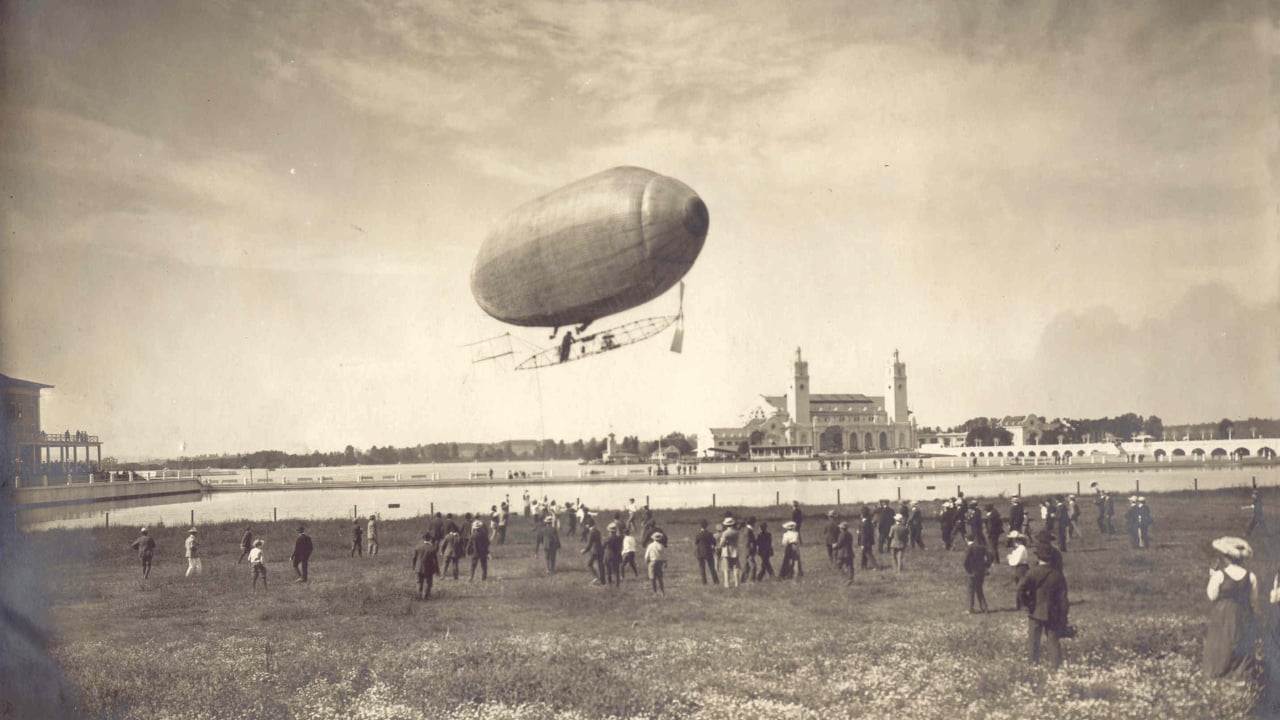
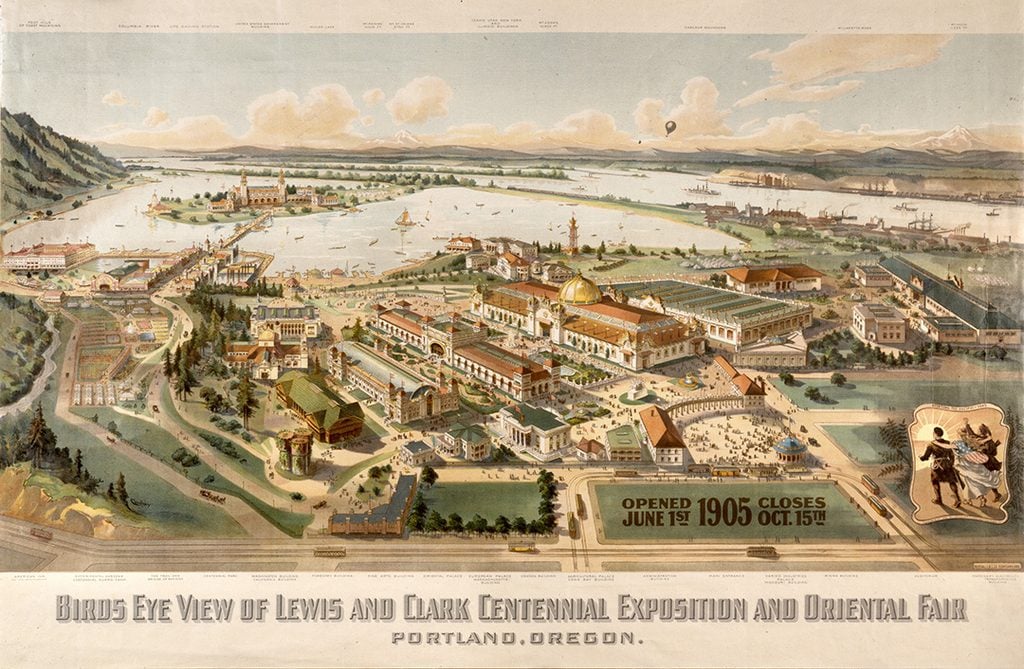
Imagine standing on a grassy hillside in Portland, Oregon, in the summer of 1905. Below you, magnificent white buildings rise above a sparkling lake. An enormous bridge stretches across the water toward a palace with twin towers. Thousands of people wander through gardens and exhibition halls, while an enormous cigar-shaped airship floats almost impossibly through the sky.
It looks like something out of a fantasy novel, or perhaps an early science-fiction film. But the photographs are real, and so was the extraordinary city-within-a-city that Portland built.
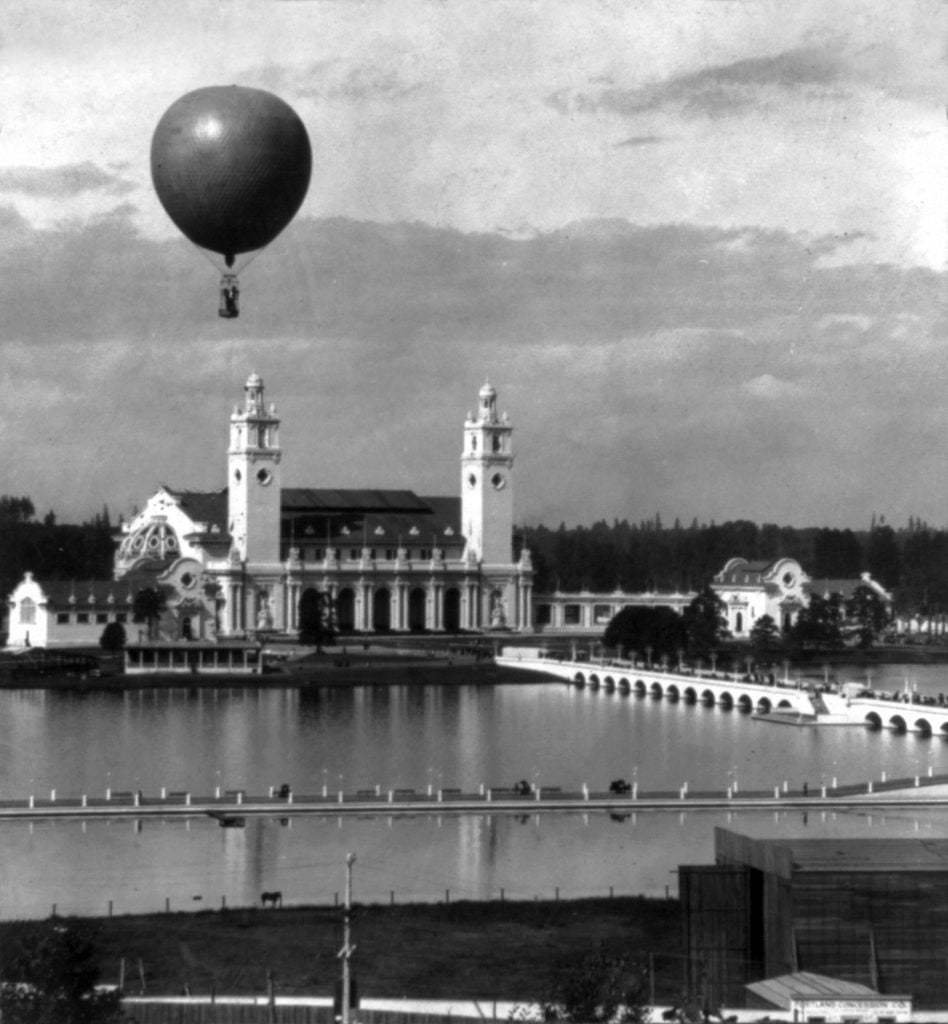
For four and a half months, the Lewis and Clark Centennial Exposition transformed a relatively small Pacific Northwest city into the host of one of the most ambitious public spectacles in its history. Visitors arrived from across America and around the world to see astonishing inventions, elaborate architecture, international exhibits, and an enormous celebration of the American West.
The numbers alone are almost unbelievable. Portland’s population was estimated at approximately 120,000 people in 1905, yet the exposition recorded nearly 1.6 million paid admissions. That’s more than thirteen admissions for every person living in the city.
But here’s where this remarkable chapter of Oregon history takes an even stranger turn.
If you stood at the site of the original fairgrounds today, you wouldn’t find the grand exhibition palaces, the fantastical bridge, or the sparkling lake that once dominated the landscape. Most of the buildings were dismantled. Others were moved. The grounds were transformed for industrial development.
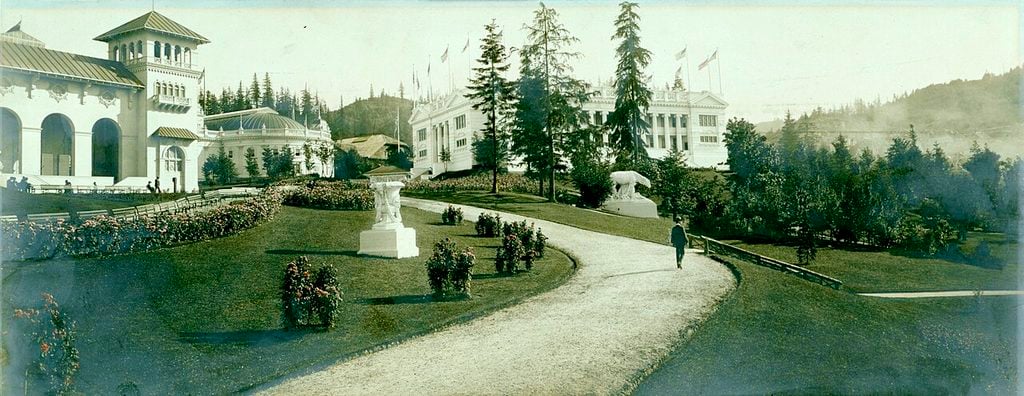
And Guild’s Lake, a body of water covering roughly 250 acres, was eventually filled in.
You read that right. Portland didn’t simply lose an enormous world’s fair. The lake beneath much of it doesn’t even exist anymore.
So what happened to this extraordinary place, and is there anything left of it today?
As it turns out, a few pieces of the story are still hiding around Portland, including an actual exposition building you can walk inside. But let’s talk history first.
At a Glance: Portland’s Lost World’s Fair
- Event: Lewis and Clark Centennial Exposition, commonly called the 1905 Lewis and Clark Exposition
- Dates: June 1 through October 15, 1905
- Duration: 137 calendar days, approximately four and a half months
- Location: Guild’s Lake, Northwest Portland, Oregon
- Fairgrounds: Approximately 400 acres
- Attendance: Approximately 1,588,000 paid admissions
- Portland’s population in 1905: Roughly 120,000 residents (an estimate rather than an official census count)
- Major attractions: Grand exhibition palaces, the Forestry Building, Bridge of Nations, moving pictures, electric displays, airships, and international exhibitions
- What remains: A relocated exhibition building, reused construction materials, a bronze statue, museum artifacts, and possibly another relocated structure
- What happened to Guild’s Lake: It was progressively filled for industrial development during the early twentieth century
The event’s dates, attendance, and fairground size are documented in historian Carl Abbott’s account for the Oregon Encyclopedia. The original 1905 exposition guide preserved by the Library of Congress also confirms the June 1 through October 15 dates.
A World’s Fair in Portland? In 1905, That Was an Enormous Deal
It’s easy to forget just how different Portland was at the beginning of the twentieth century.
There were no towering modern office buildings, no interstate highways, and certainly no Pearl District filled with upscale apartments and trendy restaurants. Portland was a rapidly growing river city, built around shipping, timber, agriculture, railroads, and the enormous economic opportunities opening throughout the Pacific Northwest.
And its leaders had ambitions.
Portland was competing with cities such as Seattle, Tacoma, and Spokane for investment, new businesses, and future residents. The city wanted to prove it was more than a distant outpost on the edge of the continent.
It wanted the world to stand up and take notice.
What better way to accomplish that than to host a spectacular international exposition?
World’s fairs were a hugely trendy phenomenon in the nineteenth and early twentieth centuries. These enormous exhibitions brought together architecture, manufacturing, science, agriculture, entertainment, and inventions in carefully designed settings that were meant to leave visitors speechless.
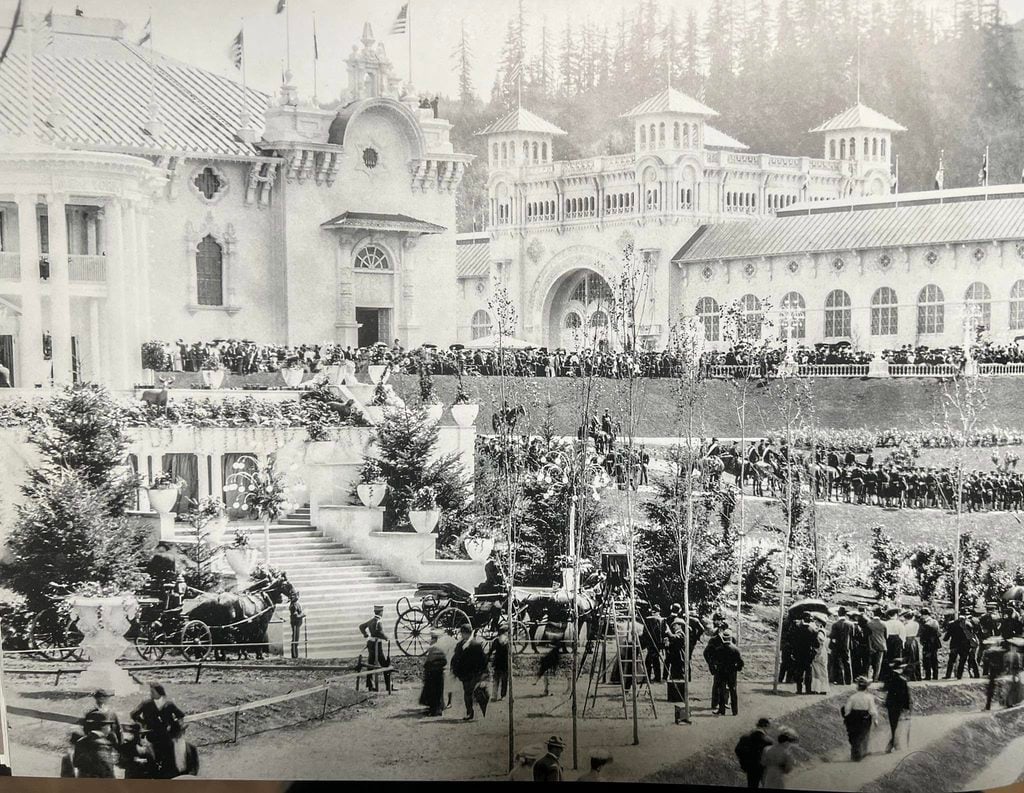
Chicago had hosted its legendary World’s Columbian Exposition in 1893. St. Louis followed with the Louisiana Purchase Exposition in 1904.
Now Portland wanted its own turn in the spotlight.
The Lewis and Clark Expedition provided the perfect anniversary. It had been approximately a century since Meriwether Lewis, William Clark, and their party reached the Pacific Northwest during their journey across the continent.
Organizers built their celebration around that milestone, although the exposition ultimately became much more than a historical commemoration. It was a gargantuan advertisement for Portland’s future.
According to the Oregon Historical Society’s account of the exposition’s organization, wealthy Portland business leaders backed the effort to attract investors, visitors, and newcomers to the region. Railroads and other businesses stood to reap enormous financial and economical benefits from the crowds expected to arrive.
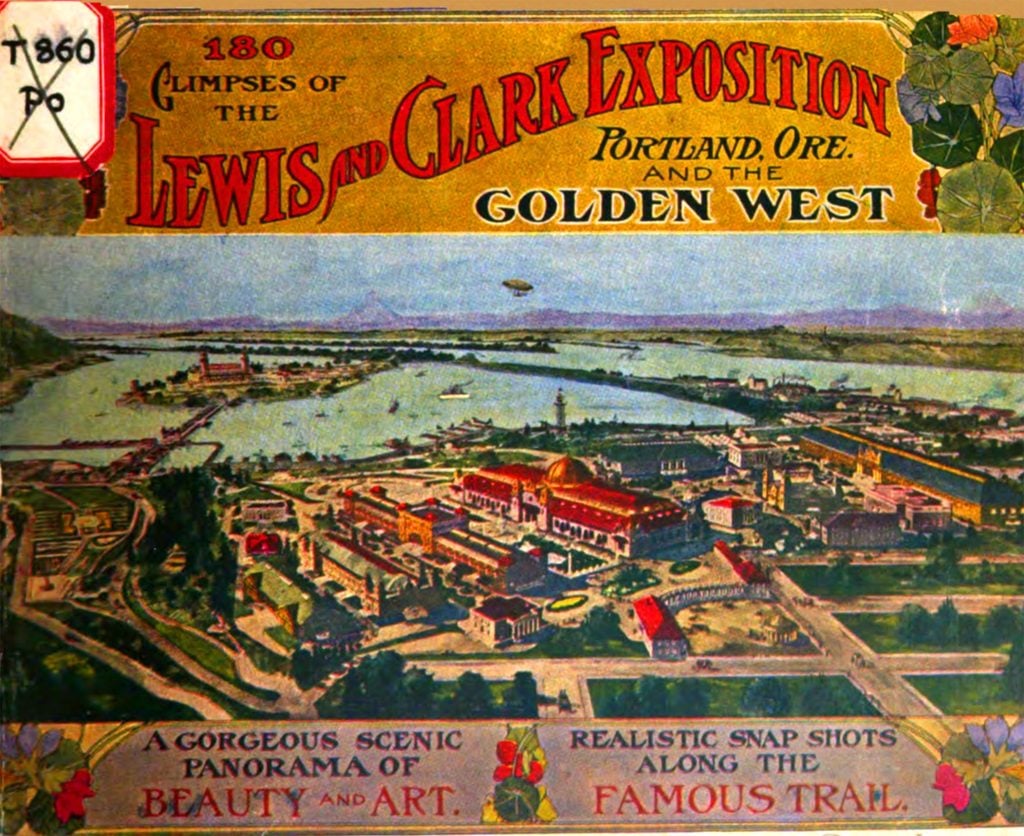
Image and caption courtesy Offbeat Oregon
Among its major financial supporters were the Northern Pacific Railroad and Portland brewer Henry Weinhard.
The official name was a mouthful: the Lewis and Clark Centennial and American Pacific Exposition and Oriental Fair. The terminology reflected the commercial ambitions and colonial worldview of its time, particularly America’s growing interest in trade across the Pacific.
But to most people, it was simply the Lewis and Clark Exposition.
And Portland was determined to make it spectacular.
First, They Had to Build an Entire City Around a Lake
Long before anyone imagined a world’s fair in Northwest Portland, Guild’s Lake was part of a sprawling wetland landscape below the West Hills.
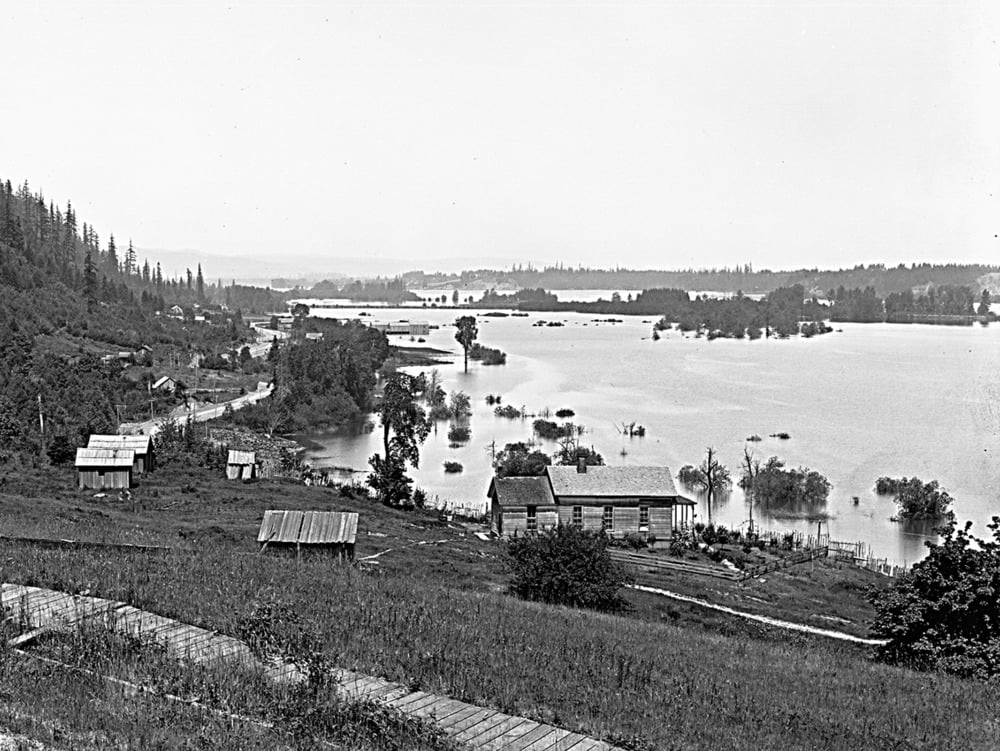
Named for early settlers Peter and Elizabeth Guild, the shallow, crescent-shaped lake was surrounded by marshland, farms, and low-lying ground. Balch Creek once flowed into it, and its water levels fluctuated seasonally.
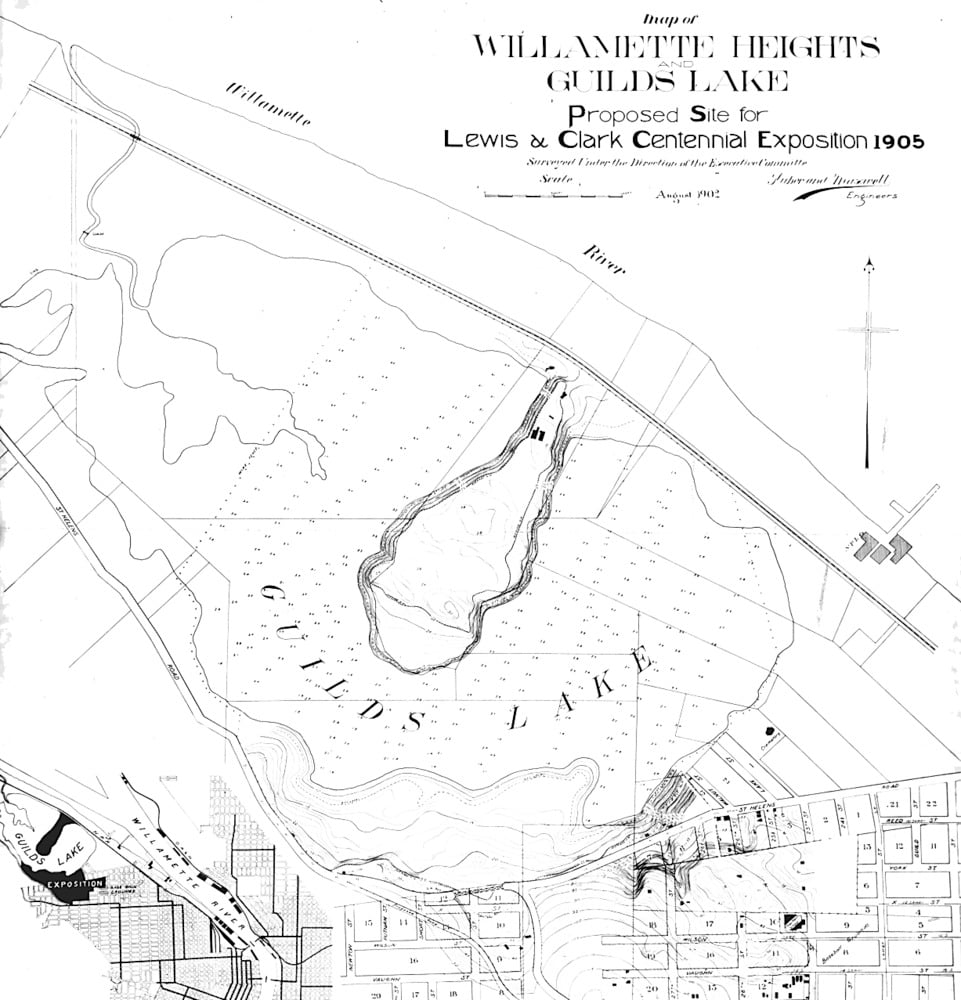
According to historian Kathy Tucker’s history of Guild’s Lake, the body of water covered approximately 250 acres and was likely formed from an old channel of the Willamette River.
It wasn’t exactly the kind of place you’d expect to find towering palaces and thousands of well-dressed tourists.
But that’s what made the transformation so extraordinary.
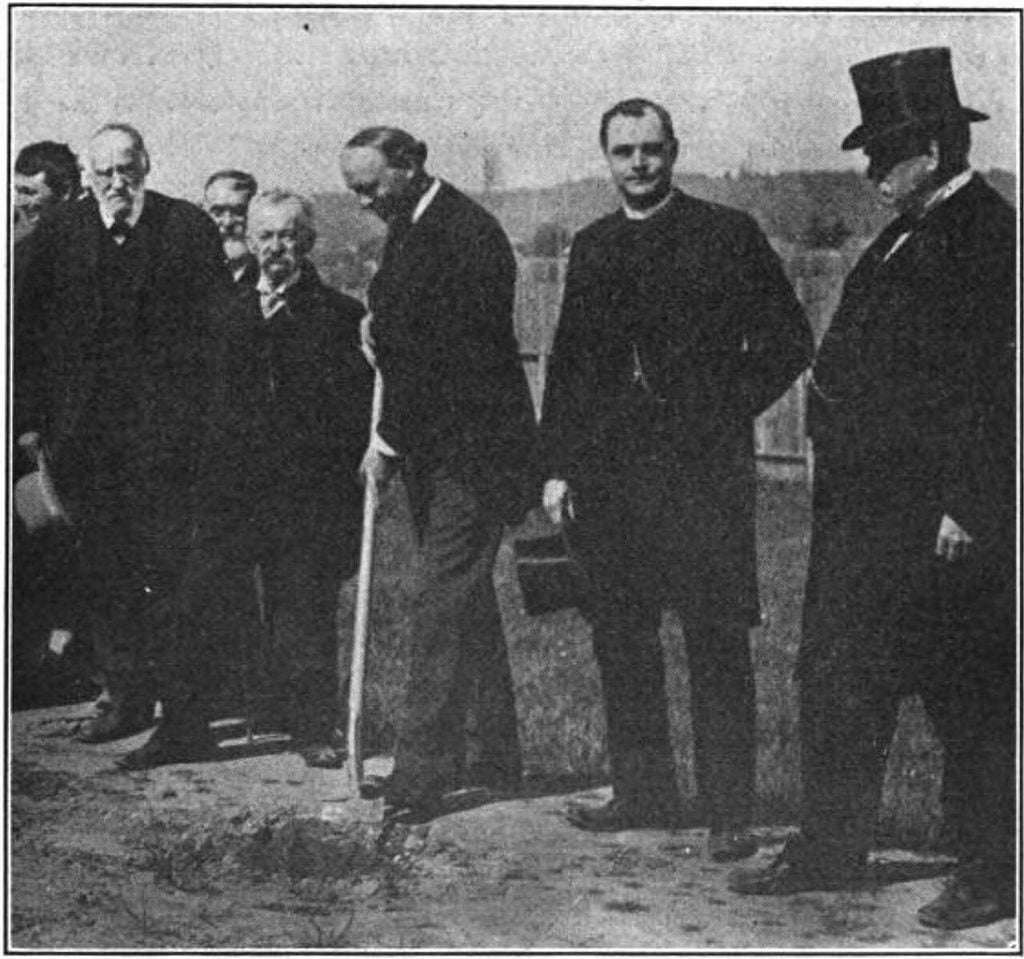
Working from a landscape plan developed by John Olmsted, engineers and construction crews spent roughly two years reshaping the area into a spectacular exhibition ground. They leveled land, prepared terraces, built roads, installed utilities, and transformed the shallow lake into a centerpiece worthy of a major public spectacle.
The required engineering itself was immense.
As described in an Oregon History Project account of the proposed exposition site, the fair’s water system was designed to pump approximately 20 million gallons of Willamette River water into Guild’s Lake each day.
Imagine the work involved in preparing that entire landscape without modern construction equipment.
By the time the grounds were ready, graceful exhibition halls crowned the hillside. Gardens and walking paths connected the buildings. A peninsula extended into the lake, and a monumental bridge led visitors toward the United States Government Building.
The buildings looked as though they belonged in some grand European capital rather than a young Oregon city.
There was just one rather important caveat:
Most of them weren’t built to last.
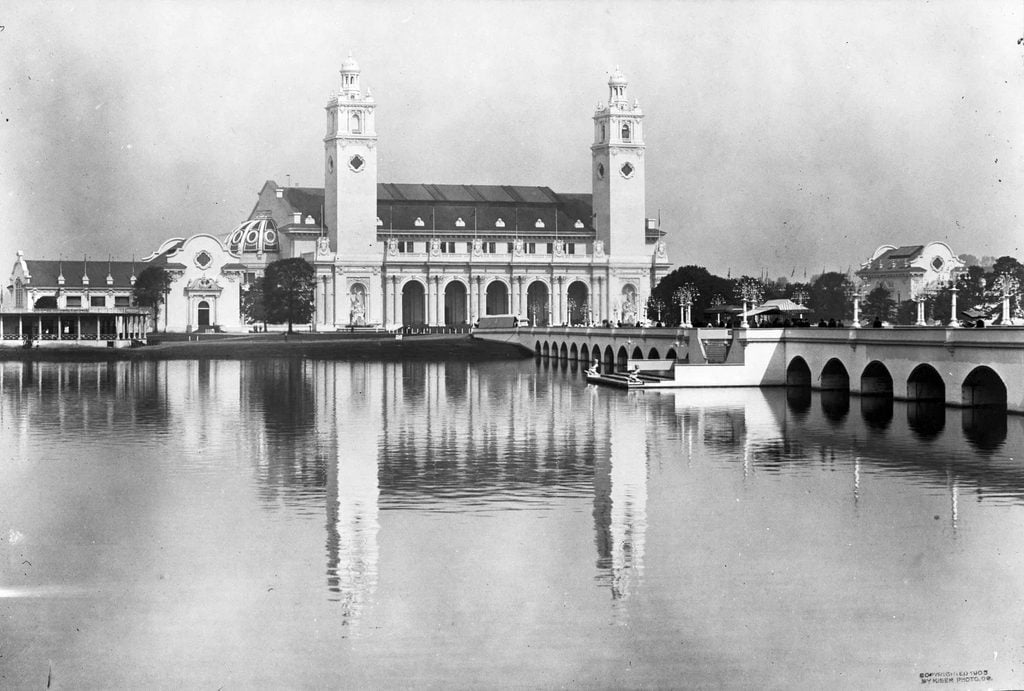
Their beautiful facades concealed relatively inexpensive construction using wooden frameworks, wire mesh, and plaster. They were designed to impress visitors for one spectacular season, not to survive for generations.
For the time period, that probably seemed perfectly reasonable.
More than a century later, it’s part of why the fair has almost completely disappeared, both physically and in memory.
Summer 1905: Portland’s Big Moment Finally Arrives
On June 1, 1905, the exposition officially opened.
The city marked the occasion with a grand parade and ceremonies attended by US Vice President Charles W. Fairbanks. Bands played, military units participated, and crowds gathered to witness a day that Portland’s civic leaders had spent years preparing for.
The opening had all the ingredients of an event designed to announce that a city had arrived.
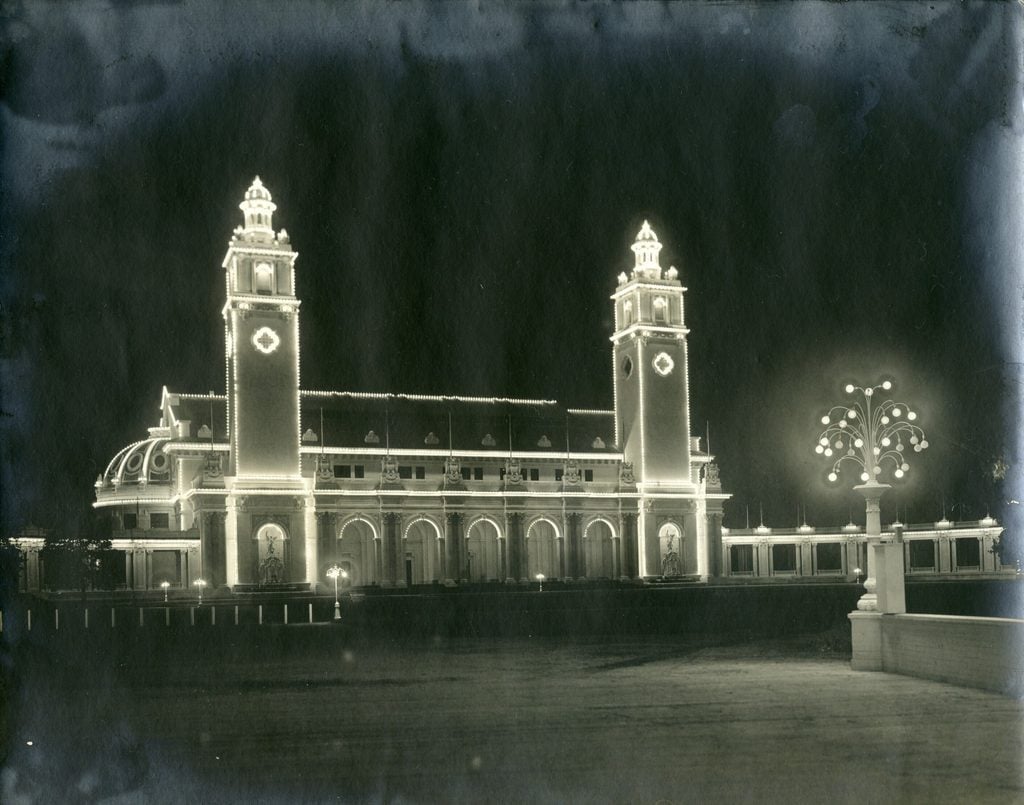
Visitors entering the grounds passed impressive architectural displays before encountering a landscape unlike anything most Oregonians had ever seen.
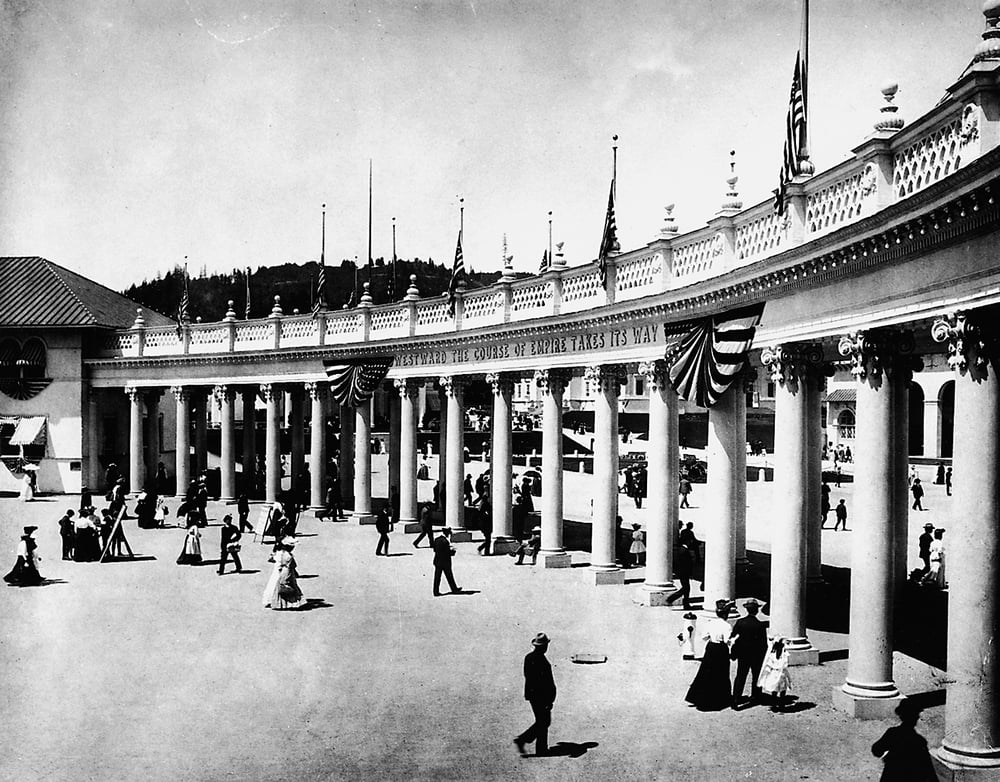
The grand buildings stood against the green West Hills, creating a striking contrast between elaborate temporary architecture and the forests beyond. The lake reflected the exhibition palaces, while the 2,000 ft. long Bridge of Nations connected the main fairgrounds with the government exhibits.
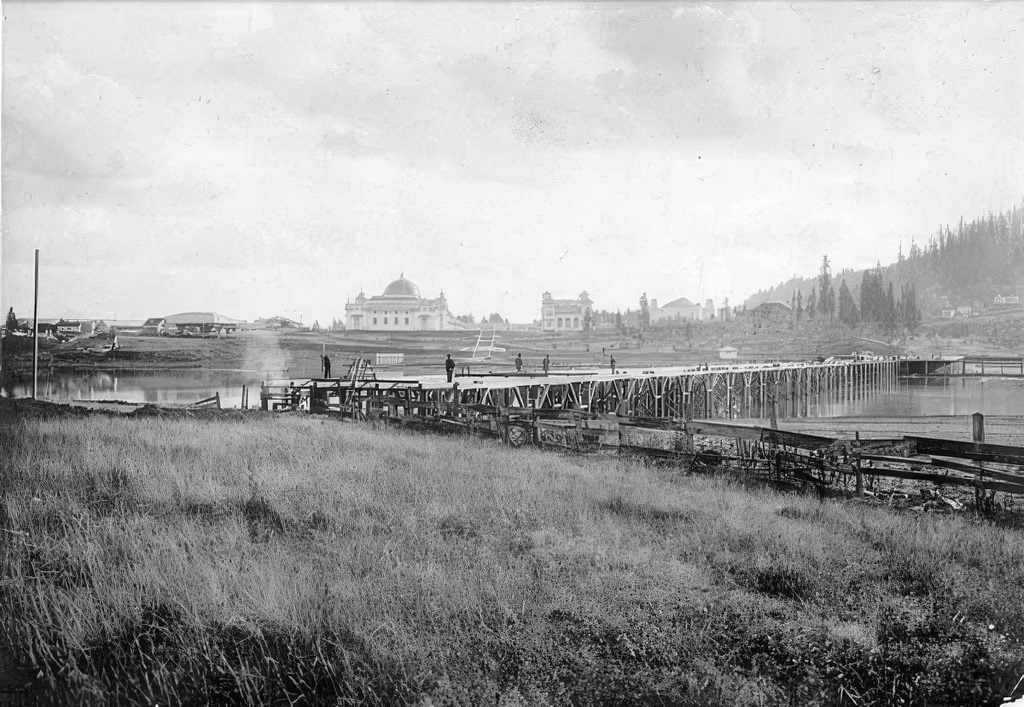
Portland Mayor George H. Williams compared the white buildings against the green hills to “a diamond surrounded by emeralds“, a description preserved in the Oregon Encyclopedia’s history of the fair.
It’s a lovely image to conjure, and looking at the original photographs, you can understand why people were so impressed.
For visitors arriving from small farming communities, logging towns, and isolated settlements throughout the Northwest, this must have felt like stepping into another world.
And the wonders weren’t limited to the architecture.
Airships, Moving Pictures, and the Wonders of Tomorrow
One of the most delightful things about exploring old photographs of the exposition is seeing what people in 1905 considered futuristic.
The photographs of airships floating above the fairgrounds are especially surreal.
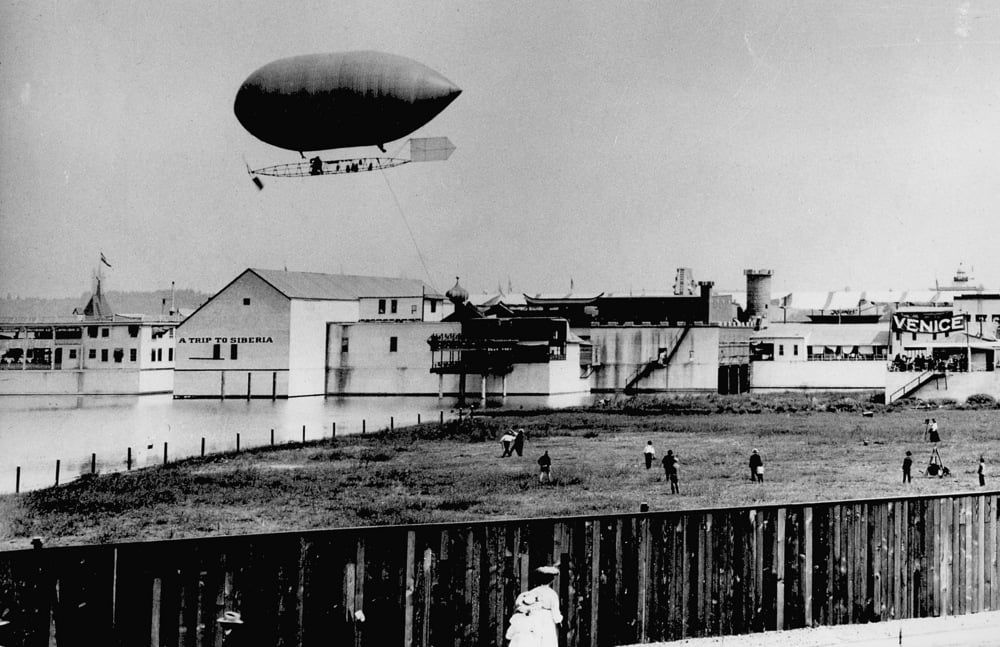
Long before commercial aviation became part of everyday life, enormous gas-filled craft floated above Portland as spectators gathered below. Their elongated shapes, exposed frameworks, and early engines made them look like inventions straight from the pages of Jules Verne.
Today, we might glance at a blimp and barely look up.
In 1905, watching a powered aircraft maneuver overhead was a genuine spectacle.
Visitors could also attend moving-picture exhibitions, examine machinery, marvel at electrical displays, and encounter technology that promised to transform transportation, communication, and everyday life.
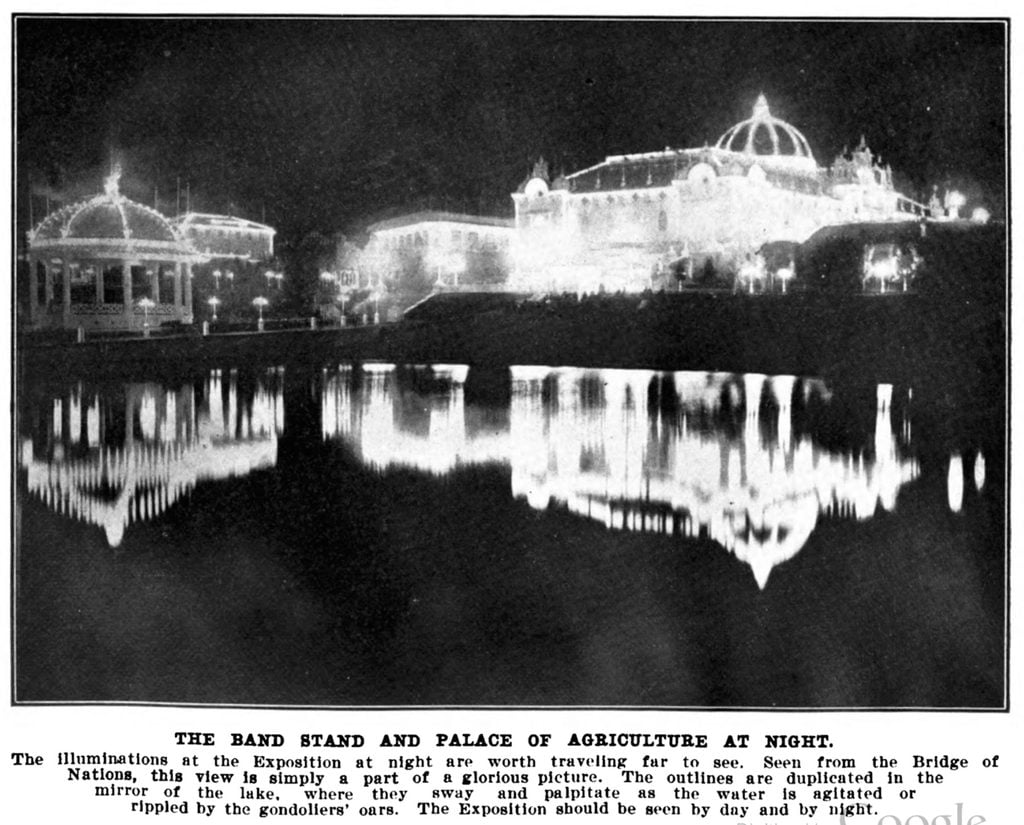
(Image: Robert A. Reid, Portland) Image and caption courtesy Offbeat Oregon
There were industrial exhibits showing the latest manufacturing techniques and transportation equipment. Agriculture displays celebrated the productivity of western farms. Oregon counties promoted their timber, crops, minerals, and other resources.
The exposition also celebrated the arrival of automobiles in an era when horses remained a familiar sight on city streets. Spectators could cheer the winner of an early transcontinental automobile race, another remarkable glimpse of how quickly the world was changing.
A giant waterslide was built, perfect for the PNW June weather.
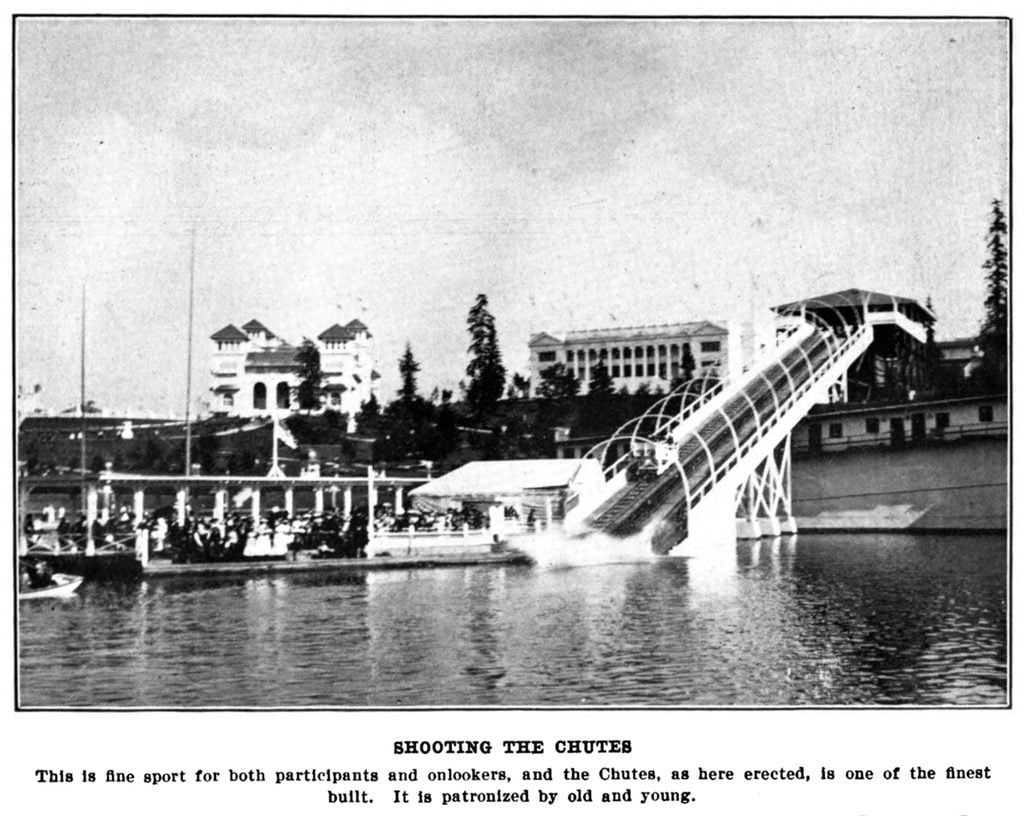
Image and caption courtesy Offbeat Oregon
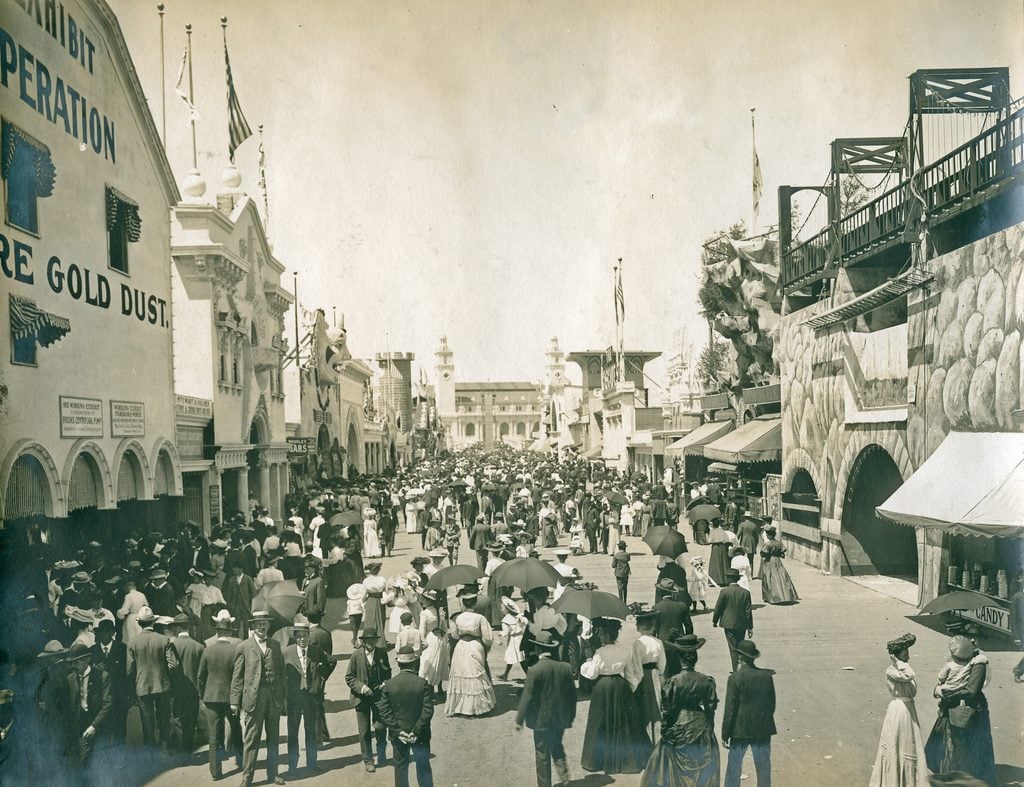
Then there was the fair’s entertainment district, known as The Trail.
This was the place for amusements, spectacles, unusual attractions, and the kind of entertainment designed to keep fairgoers exploring long after they’d finished admiring the official exhibits.
The entertainment wasn’t always as innocent as the cheerful souvenir postcards suggest. Some attractions exploited people and cultures for paying audiences, for example, a racist exhibit featuring Filipinos during the period of American colonial rule in the Philippines.
The exposition’s organizers presented the event as a celebration of civilization and progress, but the definition of progress was deeply shaped by the prejudices and imperial ambitions of the era.
That contradiction is part of the story, too.
The fair also hosted discussions about women’s voting rights, revealing how competing ideas about America’s future were unfolding within the same spectacular grounds.
Portland had created a stage for the modern world, with both its promise and its troubling assumptions on full display.
The World’s Fair Building That Looked Like a Giant Log Cathedral
Among the exposition’s most extraordinary attractions was a building that could only have come from the Pacific Northwest.
The Forestry Building was enormous.
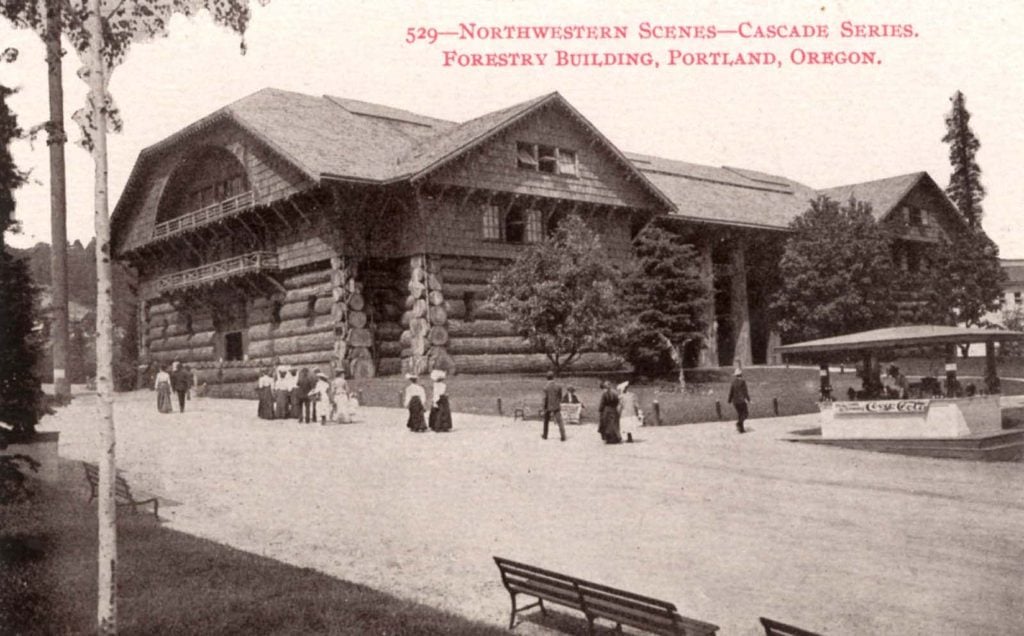
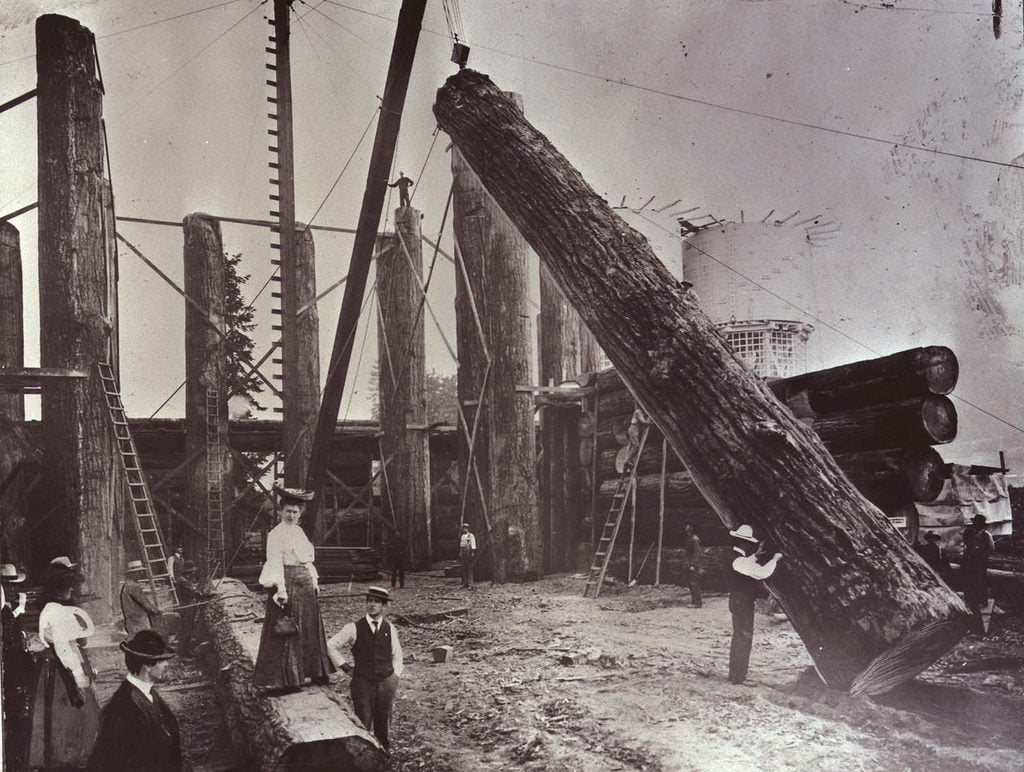
Constructed from hundreds of massive Douglas-fir logs, it stretched approximately 209 feet long and 105 feet wide. Huge trunks formed the building’s supports, while its interior resembled the nave of a cathedral, complete with soaring columns, balconies, and galleries.
It was less like a conventional exhibition hall and more like somebody had challenged Oregon’s timber industry to build the biggest log cabin anyone had ever seen.
And Oregon’s timber industry cheerfully accepted.
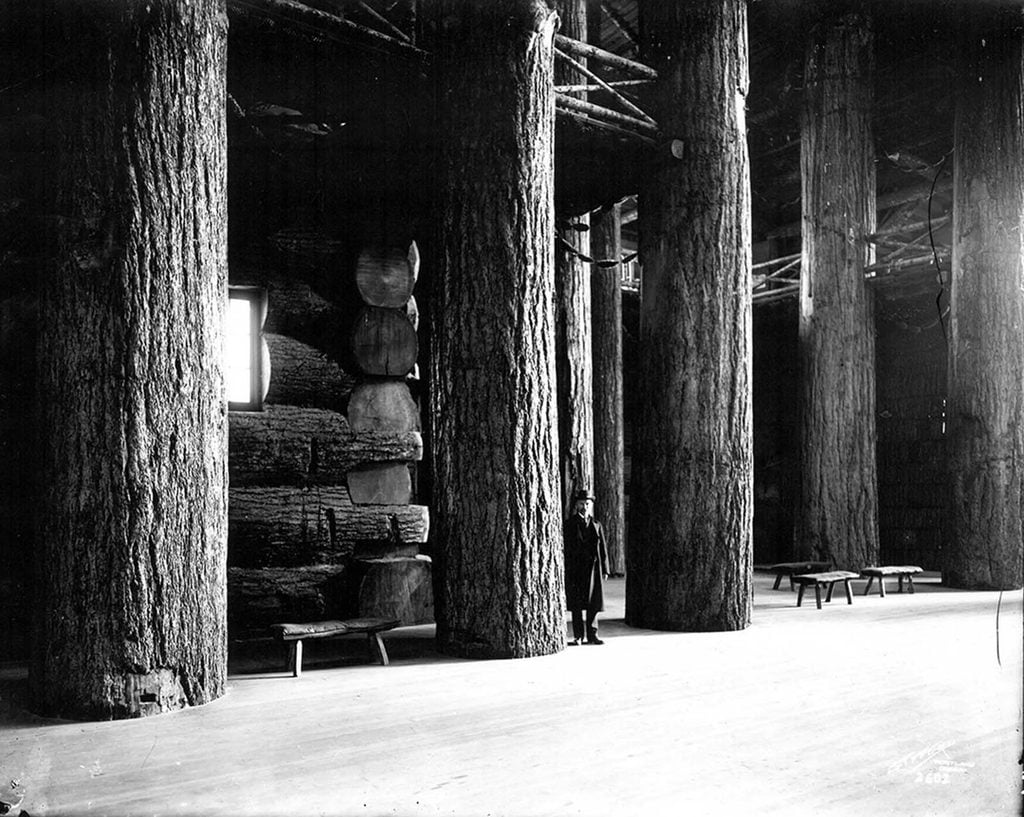
According to the Oregon History Project’s account of the Forestry Building, timber baron Simon Benson supplied the logs, which were floated along the river to the construction site.
Some of the enormous foundation logs weighed approximately 32 tons.
Inside, visitors encountered displays celebrating the region’s forests, wildlife, and lumber industry. The building wasn’t merely an exhibit about timber. The structure itself was the exhibit, a demonstration of the astonishing size of the trees growing in Oregon and the wealth that could be drawn from them.
Unlike most of the exposition’s buildings, the Forestry Building was intended to survive the fair.
And for decades, it did.
It would ultimately become one of the final architectural links to Portland’s remarkable summer of 1905.
But even this extraordinary survivor had a tragic ending.
Portland Was Home to About 120,000 People. The Fair Drew Nearly 1.6 Million Paid Admissions.
Perhaps the most astonishing detail about the exposition is the sheer scale of its attendance compared with the city hosting it.
According to historical census figures, Portland had a population of 90,426 in 1900. By 1910, that number had reached 207,214.
In between those two census years, the population was estimated at approximately 120,000 in 1905.
Now compare that number with the exposition’s approximately 1,588,000 paid admissions.
That works out to more than thirteen times the city’s estimated population.
To be clear, these weren’t necessarily 1.6 million individual people. Visitors who returned multiple times could generate multiple paid admissions. Nevertheless, the total illustrates just how astonishing the fair’s reach was for a relatively small city.
More than 400,000 visitors came from outside the Pacific Northwest, according to historian Carl Abbott. That was an extraordinary influx of tourists in an era when reaching Portland could require a long railroad journey.
Imagine the hotels, restaurants, shops, and transportation services handling those crowds.
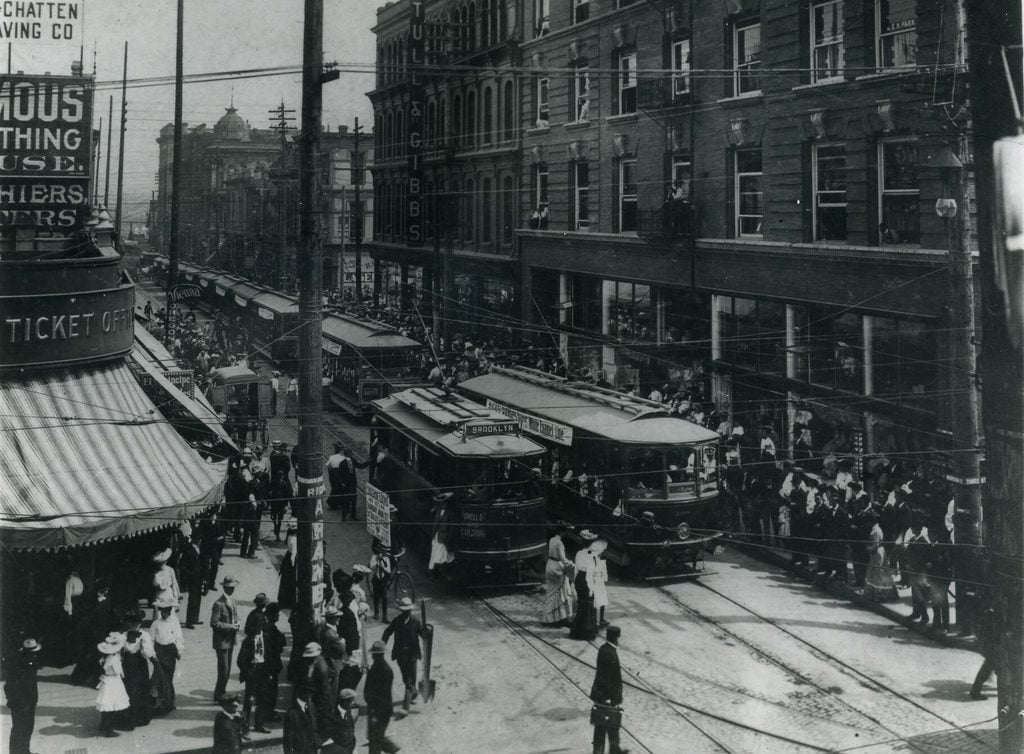
For local businesses, the exposition offered a tremendous opportunity. For city leaders, it offered a chance to showcase Portland to people who might never otherwise have considered visiting, investing, or moving there.
And the city’s growth during that decade was remarkable.
Between the 1900 and 1910 censuses, Portland’s recorded population more than doubled. The exposition wasn’t solely responsible for that growth, of course. Railroads, manufacturing, immigration, annexations, and broader economic development all played roles.
But the fair arrived at a pivotal moment, when Portland was determined to establish itself as one of the major cities of the American West.
For 137 calendar days, from June 1 through October 15, 1905, it gave the city an international showcase.
Then the gates closed.
And everything began to change.
When the Celebration Ended, the Beautiful City-Within-A-City Began to Disappear
It’s hard to look at photographs of the exposition today without wondering the same thing.
Why on earth didn’t Portland save more of it?
The buildings were magnificent. The grounds were beautifully landscaped. Guild’s Lake provided a spectacular waterfront setting. Surely there must have been some effort to preserve this extraordinary place.
There was.
But preserving the fairgrounds would have required money, long-term maintenance, and a shared vision for what the site should become. Those ingredients never came together in the way preservation advocates had hoped.
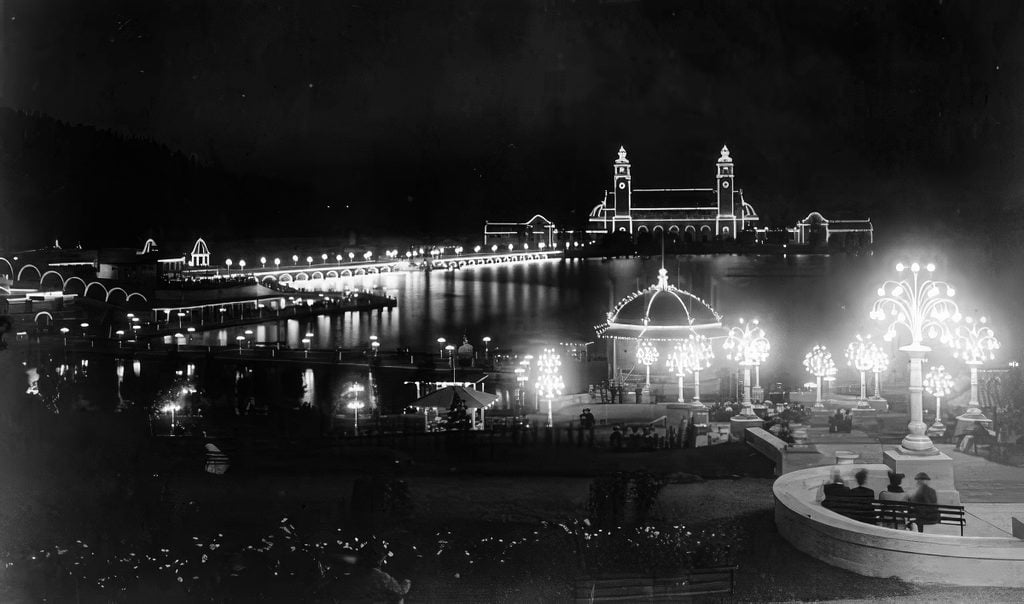
The problem was partly built into the exposition from the beginning.
Most of the buildings were temporary structures. Their elaborate plaster-covered facades had been designed to look impressive for a few months rather than withstand decades of Oregon rain.
Keeping them would have required significant investment.
Within a relatively short period after the exposition closed, the temporary palaces were dismantled or demolished. Materials were salvaged, and a few buildings found new purposes elsewhere.
But the fate of the surrounding landscape was even more dramatic.
The Mystery of Guild’s Lake: How Do You Make 250 Acres of Water Disappear?
Today, the neighborhood still carries the name Guild’s Lake, but the lake itself is gone.
There’s no sparkling waterfront surrounded by exhibition palaces. No great bridge crossing the water. No boats gliding past decorated buildings.
Instead, the lowlands became part of Northwest Portland’s extensive industrial landscape.
So what happened?
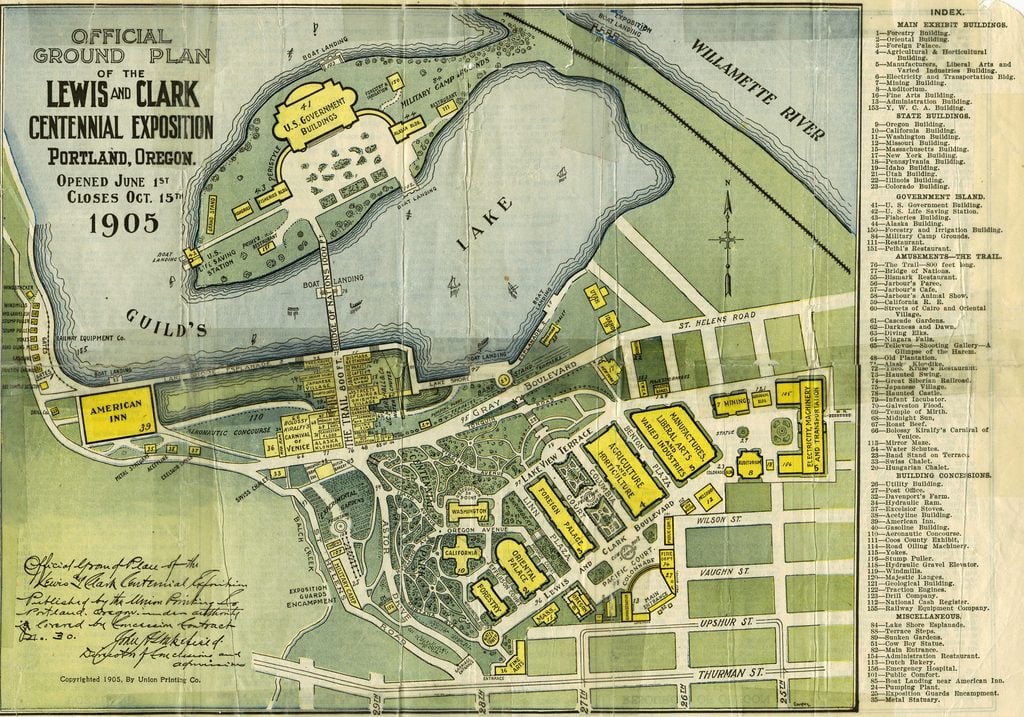
The answer is less mysterious than the photographs make it seem, although the scale of the transformation is astonishing.
Before the exposition, Guild’s Lake was a shallow wetland, not a deep recreational lake. Its appearance during the fair depended heavily on the improvements and water management that organizers had installed.
Once the exposition ended, the carefully maintained lake reverted toward its marshy condition.
The scene wasn’t quite so magical anymore.
In fact, the February 12, 1906, edition of The Oregonian described the former lakebed as a bare mudflat, according to the Oregon Encyclopedia’s history of Guild’s Lake.
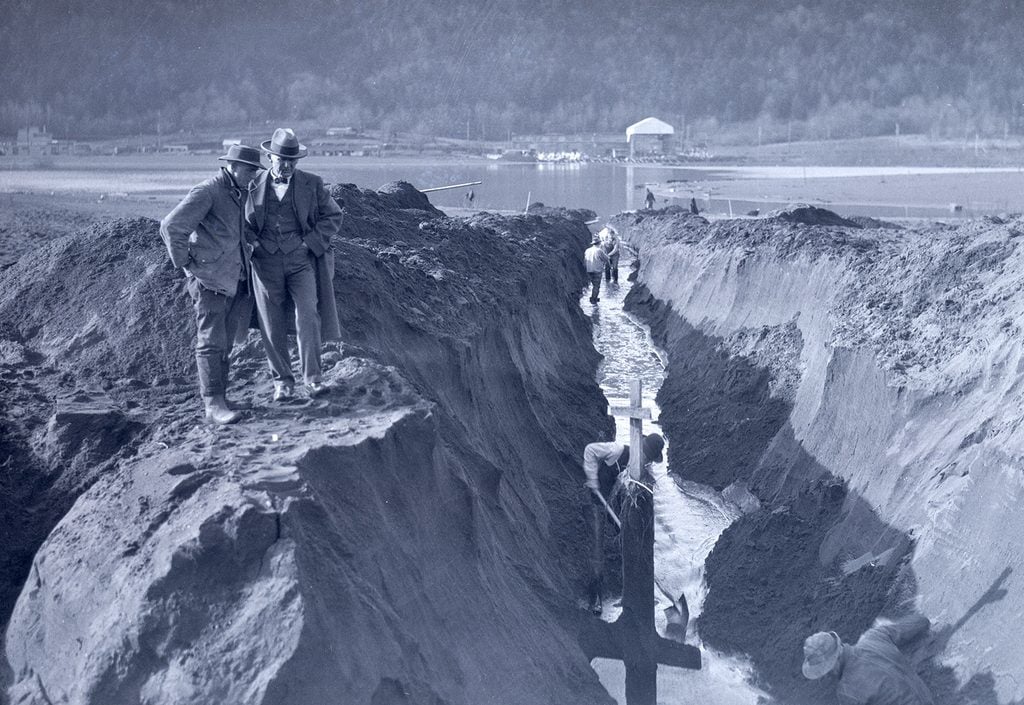
Of course, developers saw something different from the visitors who had admired the sparkling lake.
They saw land that could be filled and turned into valuable industrial property.
Beginning in 1905, developer Lafayette Pence used powerful hydraulic methods to wash soil from nearby hillsides into portions of the lowlands. Subsequent companies continued backfilling and preparing the land for development.
By 1913, a substantial industrial area had been created on reclaimed lakeshore.
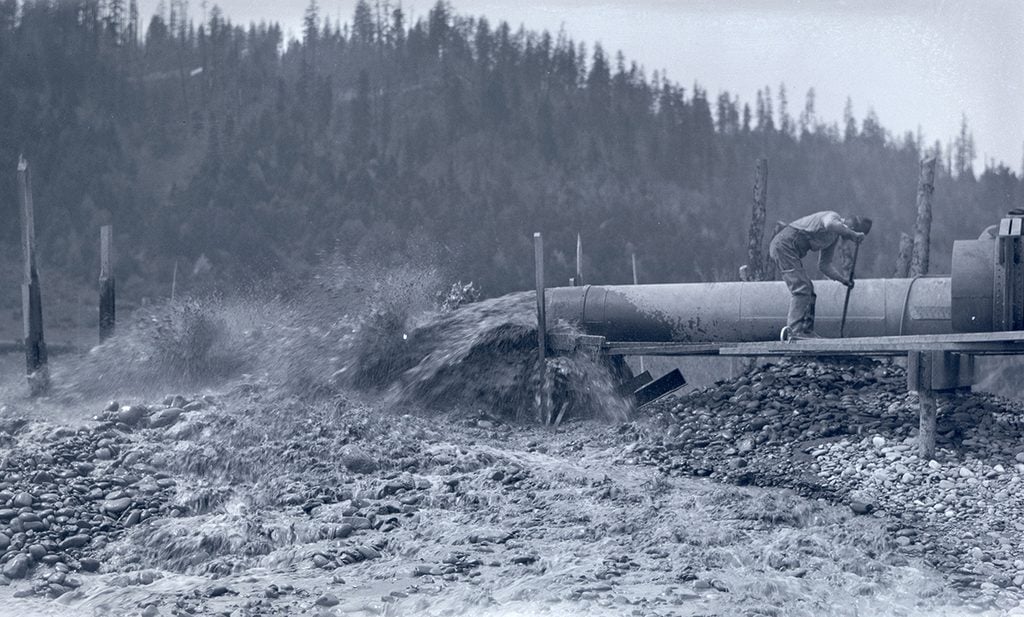
Image courtesy the Oregon Encyclopedia
During the early 1920s, the Port of Portland and landowners continued filling the lake and surrounding wetlands with sediment dredged from the Willamette River.
Gradually, the water disappeared beneath the fill.
The original shoreline became harder to recognize, the fair’s carefully shaped landscape faded away, and the new land found uses that had little connection to the grand exposition once held there.
Railroad facilities appeared. Industrial development followed. During World War II, temporary housing for wartime workers occupied parts of the former lakebed.
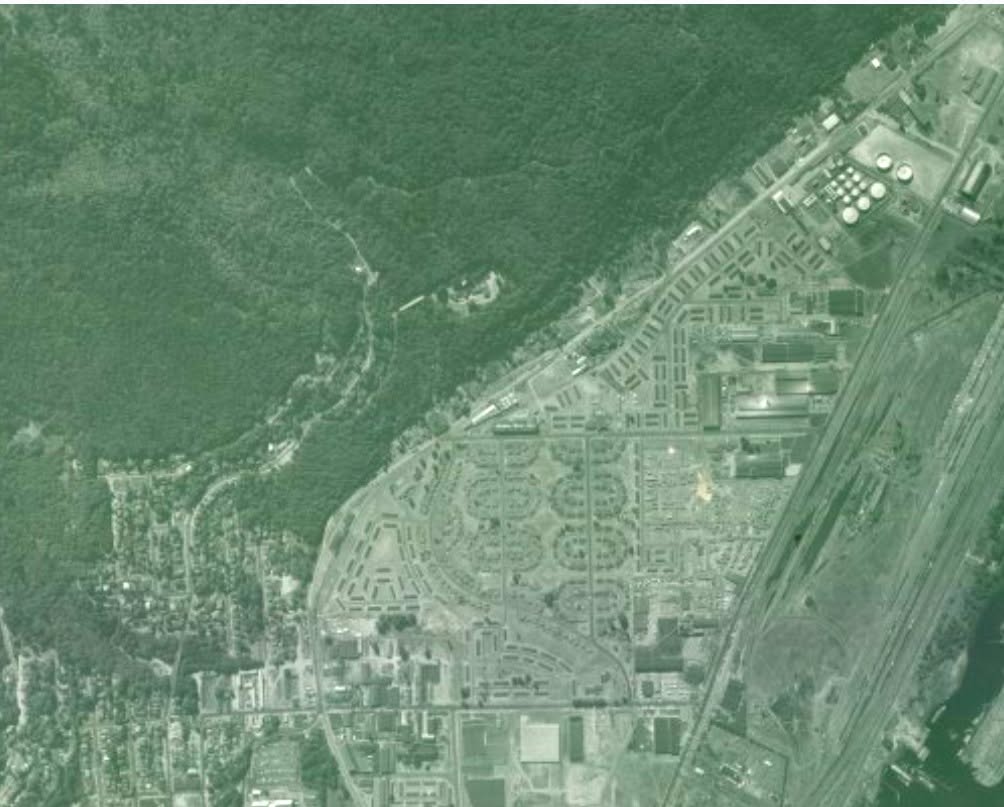
Image posted by Michael Long, Forgotten Oregon, Facebook
Eventually, the warehouses, transportation infrastructure, and other industrial uses associated with Northwest Portland replaced almost every visible trace of Guild’s Lake.
One of the strangest details is that the vanished shoreline still influences the landscape.
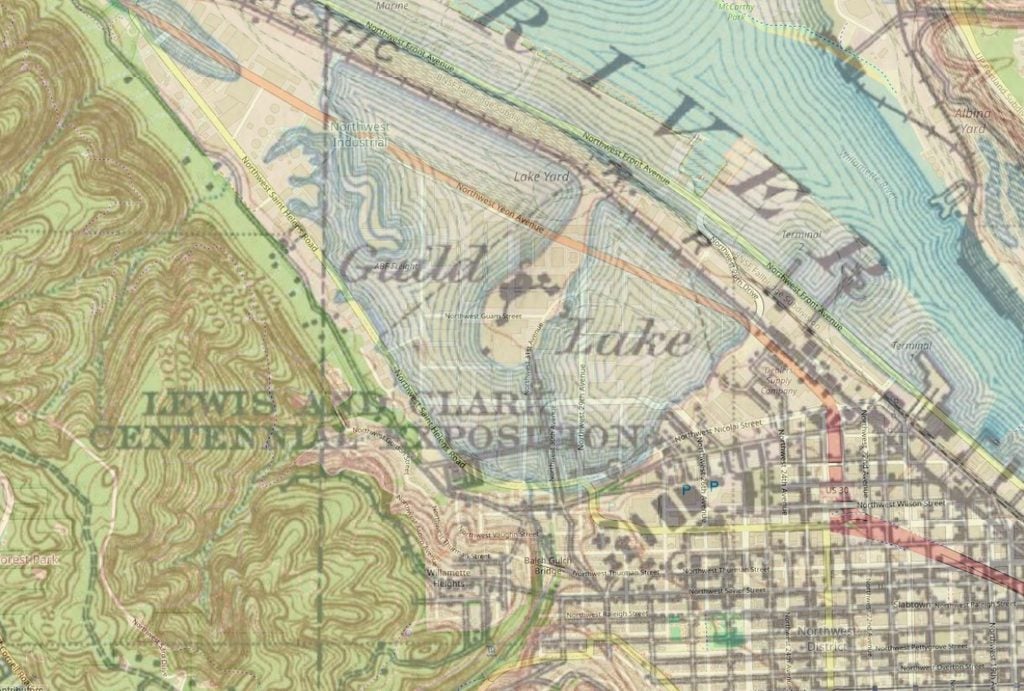
The curve of St. Helens Road roughly follows part of the old lake’s edge, a subtle reminder of a body of water that once dominated this part of the city.
Most drivers would never know it.
Where Exactly Was Portland’s 1905 World’s Fair?
The exposition occupied roughly 400 acres around Guild’s Lake in Northwest Portland, including elevated land along the West Hills and lower ground that eventually became industrial property.
One useful landmark is the approximate location of the former main entrance near NW 26th Avenue and NW Upshur Street.
From there, the exposition grounds extended across a landscape that looked dramatically different from today’s urban street grid.
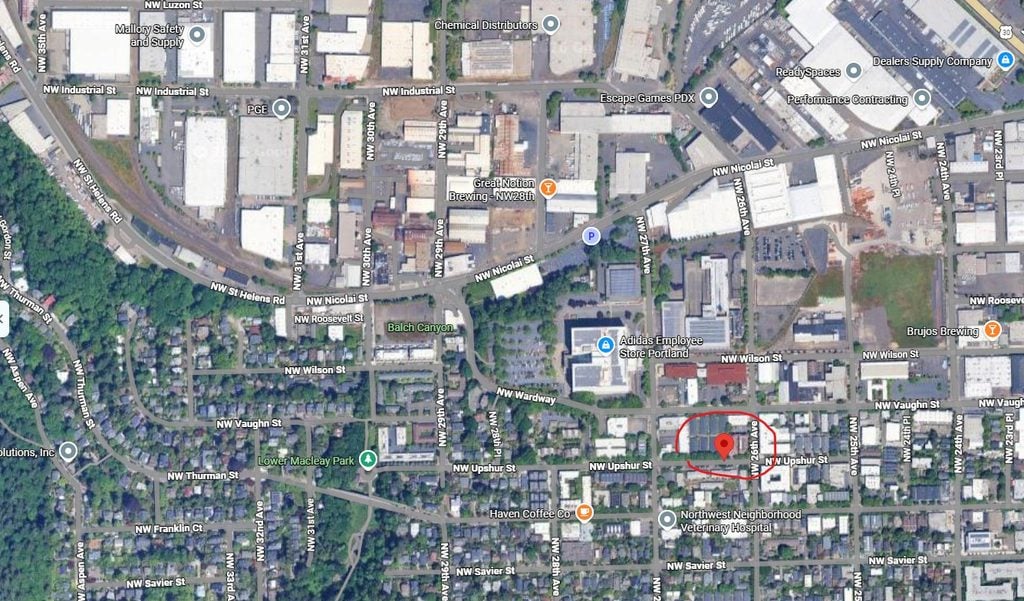
The fair’s ornate buildings, gardens, and walking paths occupied higher ground overlooking the water. The Bridge of Nations reached toward the United States Government Building, while Guild’s Lake stretched across a large portion of the lower terrain.
Much of this landscape now falls within Northwest Portland’s industrial districts.
The best way to understand the transformation is to compare a historical exposition map with a modern street map.
The Library of Congress preserves the exposition’s original 1905 official catalog, including a plan of the grounds. The Oregon Historical Society also preserves historical maps and photographs showing the buildings, lake, and surrounding hillsides.
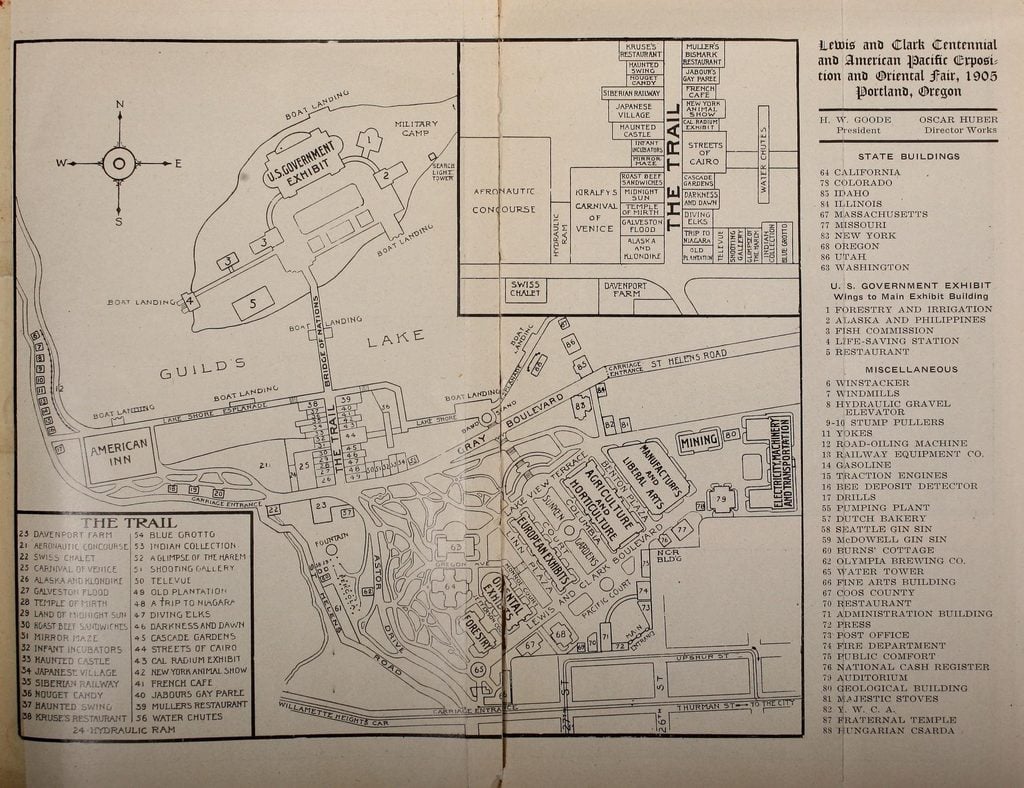
Look at the historic map first, then locate NW 26th Avenue, St. Helens Road, and the industrial district on a modern map.
It’s almost impossible to reconcile the two landscapes at first.
A lake once occupied ground that people now cross without giving it a second thought.
And those astonishing palaces? Almost all of them are gone.
But not quite everything.
What Still Remains of the 1905 Lewis and Clark Exposition?
This is where the story becomes unexpectedly wonderful.
Although almost all the exposition’s original architecture disappeared, a handful of pieces survived. Some were relocated, others were incorporated into new buildings, and several smaller artifacts found their way into museum collections.
One surviving building is particularly remarkable because Portlanders can still walk inside it today.
You Can Still Walk Into an Actual Exposition Building in St. Johns
[GPS: 45°35’19.0″N 122°45’05.7″W]
At 8203 N Ivanhoe Street in Portland’s St. Johns neighborhood stands the McMenamins St. Johns Theater & Pub.
It’s a charming old building with a rather extraordinary past.
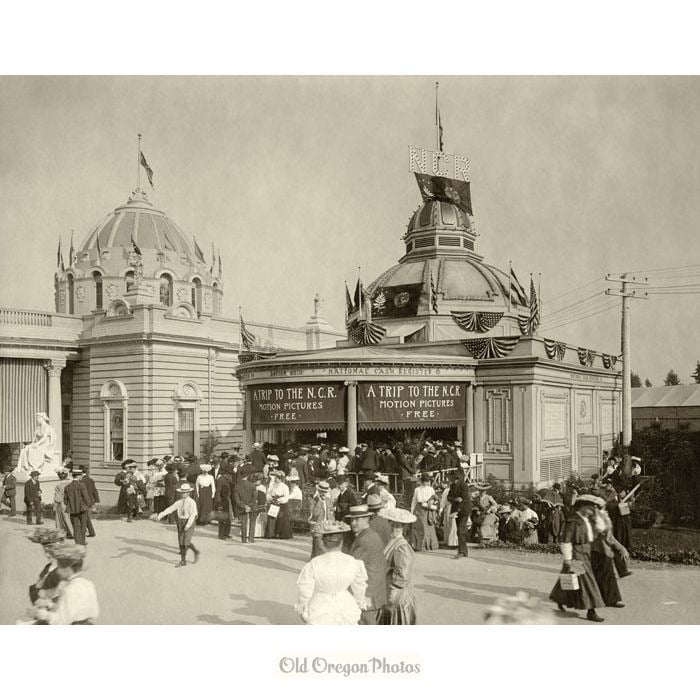
Before it became a place to watch movies and enjoy dinner, it served as the National Cash Register Company’s exhibition hall at the 1905 Lewis and Clark Exposition.
Yes, an actual building from the fair is still standing.
After the exposition closed, the structure was transported along the Willamette River to St. Johns, where it began an entirely different life.
Over the following decades, it served a variety of purposes, including religious and community uses, before eventually being purchased by the McMenamin brothers to become the theater and pub people know today.
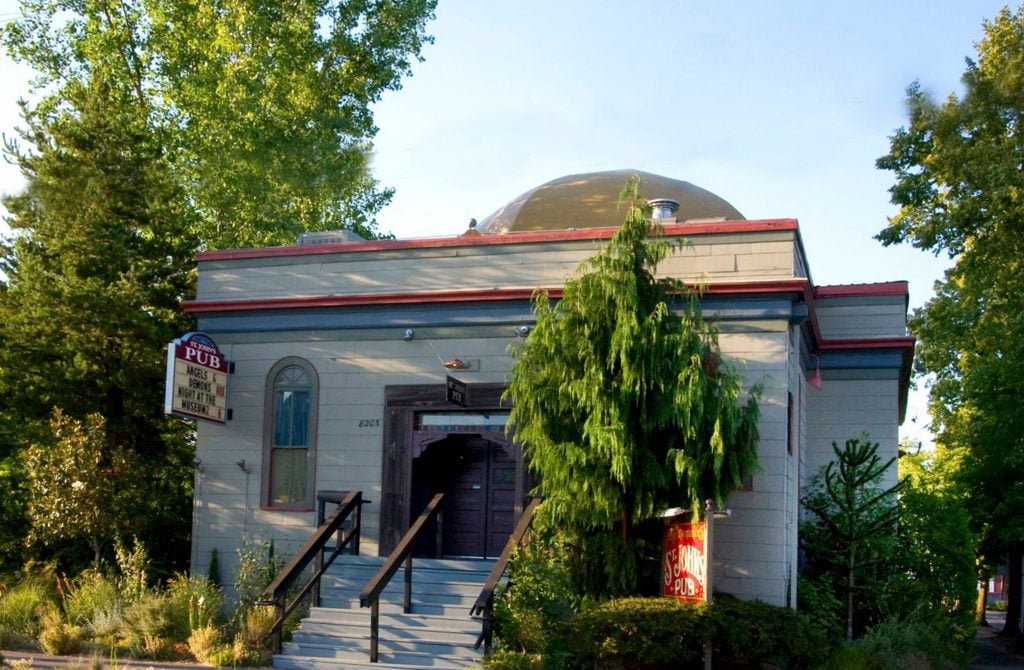
McMenamins confirms the building’s fascinating history, including its journey from the exposition grounds to its present location.
Of all the surviving physical traces of the exposition, this may be the most accessible and surprising.
Folks can actually step inside an architectural survivor from Portland’s lost world’s fair.
Considering how completely the original fairgrounds have been transformed, that’s pretty extraordinary.
The American Inn Lives On in an Unexpected Way
[GPS: 45°31’53.6″N 122°41’43.1″W]
Another surviving connection can be found in Northwest Portland.
The American Inn was the only hotel located directly on the exposition grounds, making it an important part of the temporary city built for the fair.
After the event ended, portions of the inn were salvaged and used in the construction of a residential building.
The resulting structure, now known as the American Inn Condominiums, stands at 2129 NW Northrup Street.
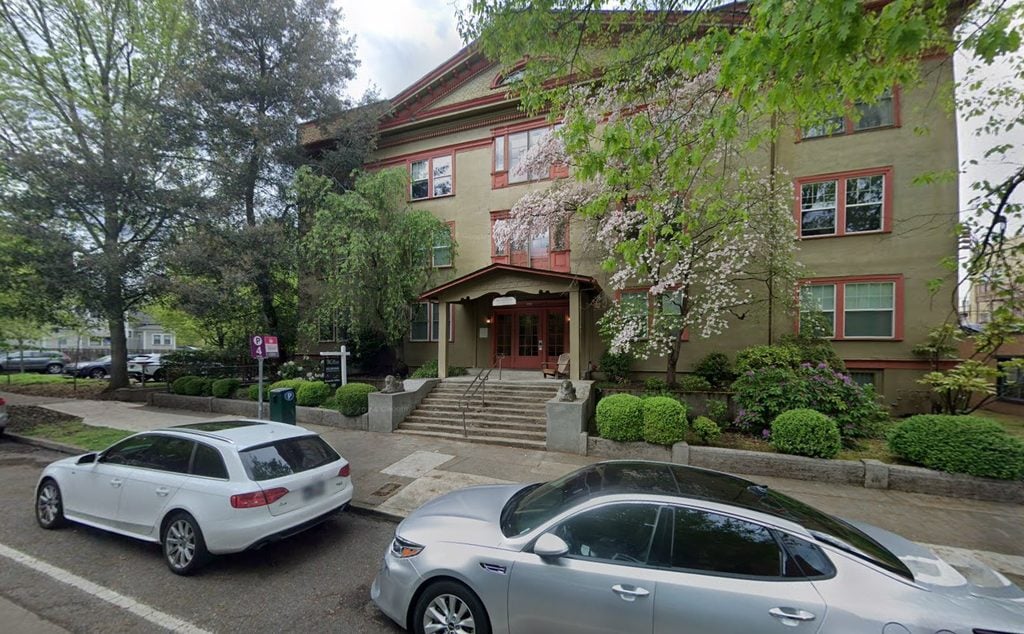
The American Inn isn’t an intact exposition building relocated wholesale. Rather, it incorporates materials reused from the original inn. Still, it’s a remarkable example of how pieces of the fair quietly became part of the ordinary city around it.
Portland didn’t preserve the exposition as a grand historical monument. In some cases, it recycled pieces of the fair into buildings people continued to use.
A Bronze Statue from 1905 Still Stands in Washington Park
[GPS: 45°31’17.2″N 122°42’08.2″W]
One of the exposition’s most important surviving works of art is hiding in plain sight in Washington Park.
The bronze statue Sacajawea and Jean-Baptiste, created by artist Alice Cooper, originally stood at the fairgrounds in 1905.
It depicts Sacajawea with her young son and was commissioned through the efforts of women who wanted to honor her historical role in the Lewis and Clark Expedition.
The statue was unveiled during the exposition on July 7, 1905.
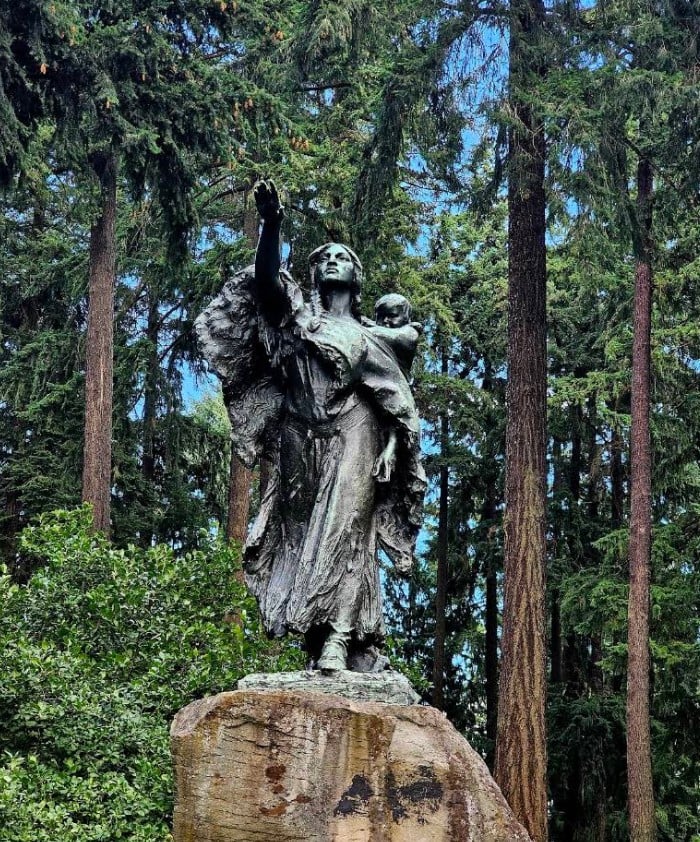
Among those present at the dedication was prominent women’s rights advocate Susan B. Anthony, along with other suffrage leaders.
That connection gives the sculpture a significance extending far beyond its artistic value. It emerged during an era when women in Oregon were still fighting for voting rights, and its creation reflected their efforts to claim a place in the public telling of American history.
After the exposition closed, the statue was moved to Washington Park, where it remains.
Unlike so many of the exposition’s buildings, this is an original piece that actually stood on the grounds in 1905.
Could Another Entire Exposition Building Be Hiding in a Portland Neighborhood?
Now here’s a particularly intriguing possibility.
In 2024, Portland historian Dan Haneckow published research suggesting that a house at 1209 NW 26th Avenue could be the exposition’s former Masonic Building.
The history is fascinating.
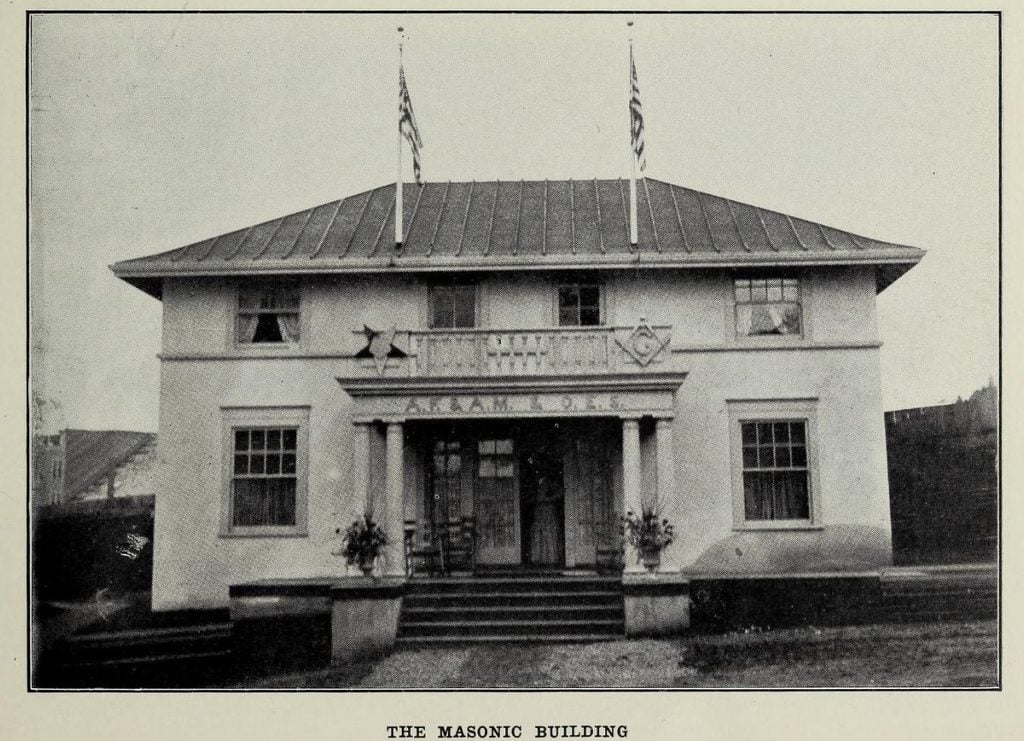
Contemporary newspaper accounts indicate that the Masonic Building was moved from the fairgrounds and repurposed as a residence after the exposition closed.
The challenge has been identifying exactly which present-day house contains that original building.
By examining old photographs, newspaper references, architectural features, and historic street locations, Haneckow found what he considers a compelling match.
His research points toward the house on NW 26th Avenue, where surviving architectural details appear consistent with the original exposition building.
The discovery is described in his fascinating article, A Little Known Survivor from the 1905 Lewis & Clark Exposition?.
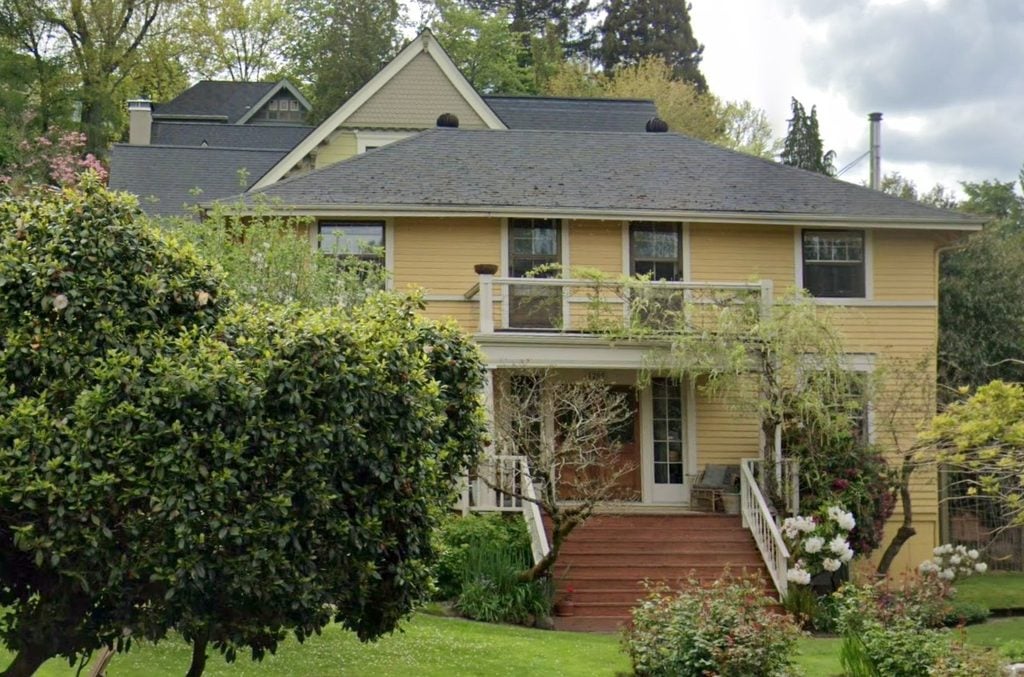
It’s important to emphasize that the identification rests on historical research and architectural comparison rather than a fully documented chain of surviving building records.
Even so, the possibility is interesting.
Could another building from Portland’s lost exposition be standing quietly on a residential street, disguised as an ordinary old house?
More than 120 years later, there may still be mysteries waiting to be solved.
The Forestry Building Survived for Decades, Until Disaster Struck
Remember that incredible cathedral made from enormous Oregon logs?
Unlike the vast majority of exposition buildings, the Forestry Building survived long after the gates closed in 1905.
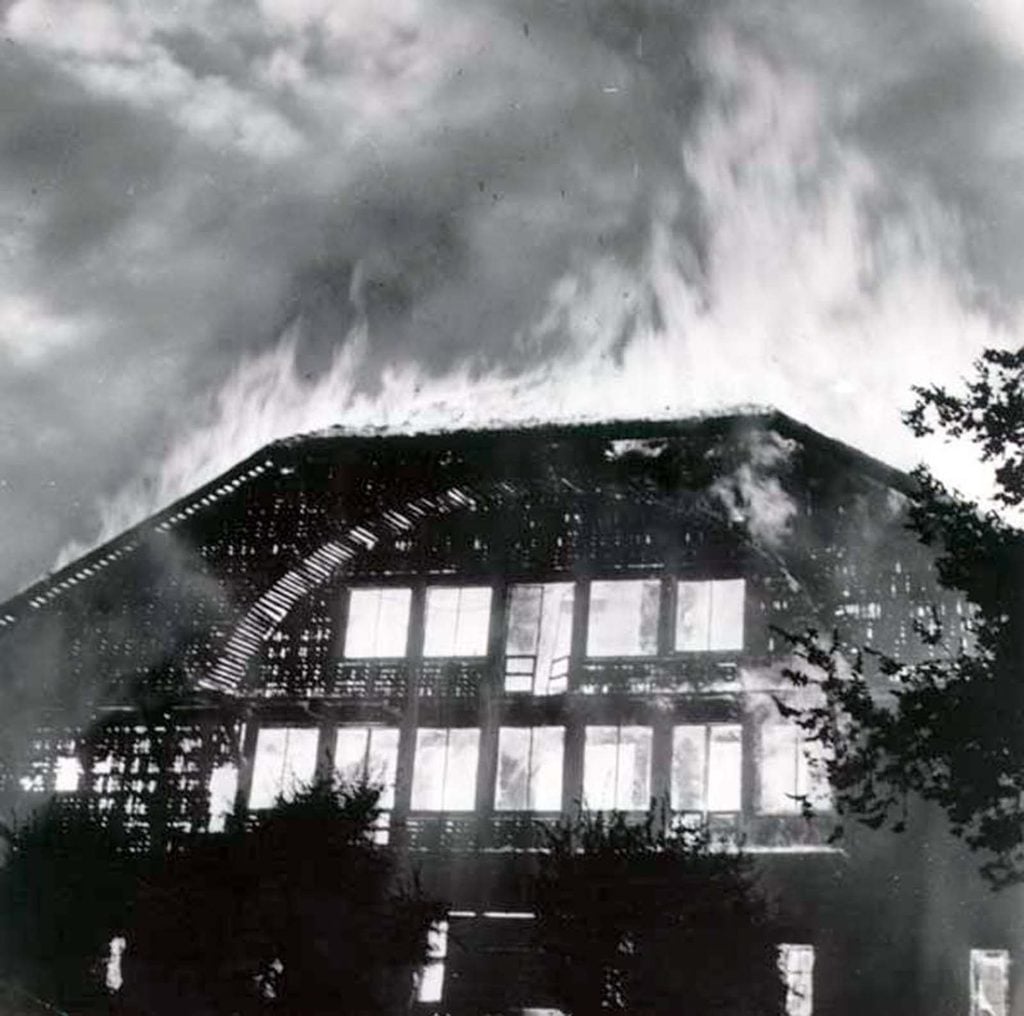
For nearly six decades, it remained a monument to Oregon’s timber industry and one of Portland’s most distinctive architectural landmarks.
Imagine being able to visit that building today, wandering beneath columns formed from trees that had grown for centuries.
Unfortunately, that possibility ended on August 17, 1964.
A devastating fire consumed the historic structure, destroying one of the last great architectural reminders of the exposition’s original grounds.
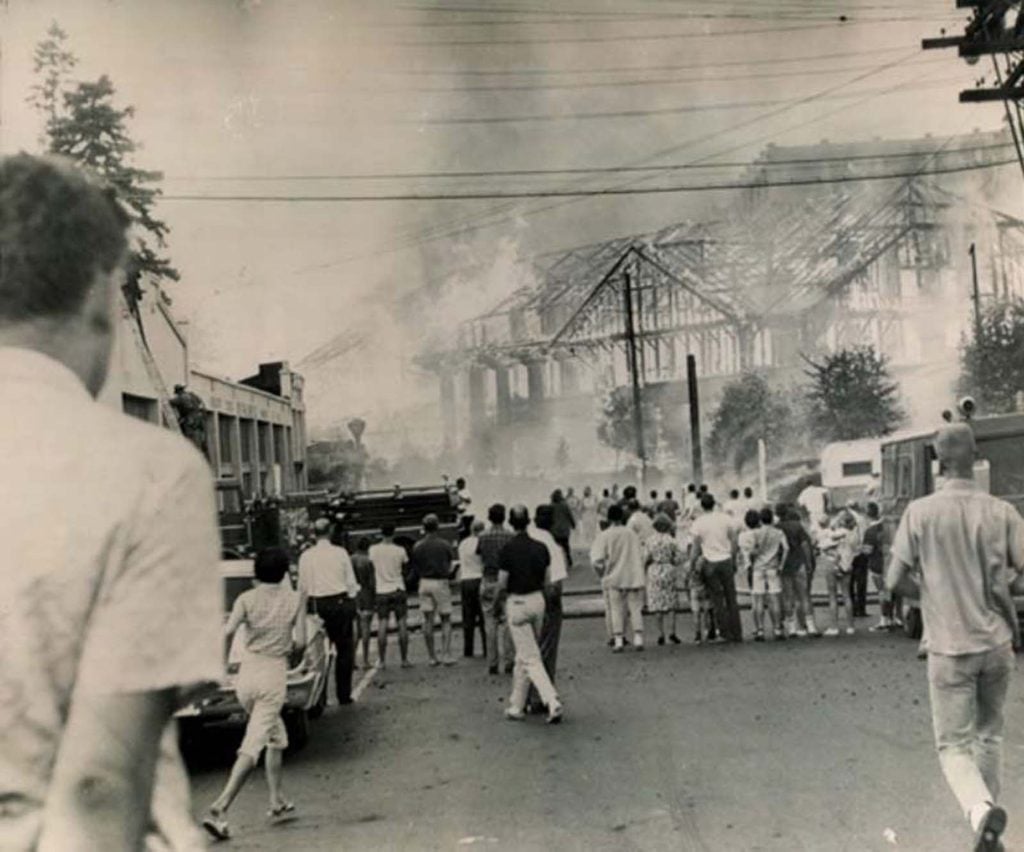
The loss was enormous, not only because of the building’s connection to the fair, but because of its remarkable craftsmanship and the immense old-growth logs used in its construction.
The historical architectural record for the Forestry Building documents both its exposition origins and its destruction in 1964.
Today, the World Forestry Center in Washington Park carries forward part of that educational legacy, although its buildings are not the original Forestry Building.
Original Souvenirs and Artifacts Are Preserved in Portland Museums
Fortunately, not everything connected with the exposition was too large to preserve.
The Oregon Historical Society has safeguarded an assortment of objects associated with the fair, including admission materials, commemorative souvenirs, ribbons, and other memorabilia.
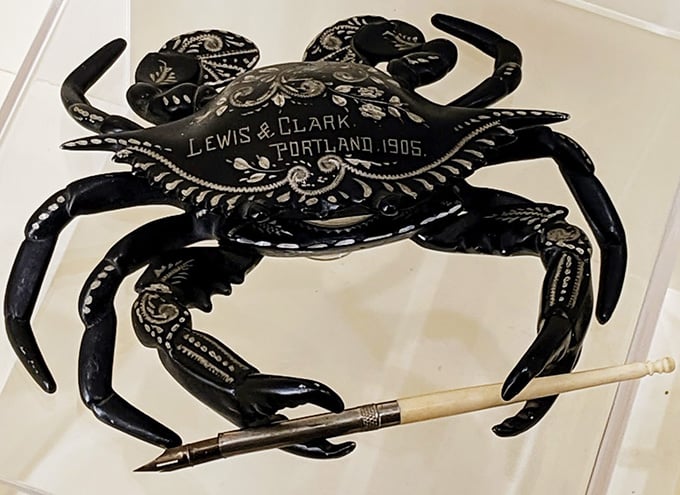
Image courtesy the Oregon Historical Society
According to the society’s guide to surviving Lewis and Clark Exposition artifacts, its Experience Oregon exhibition has featured original objects from the event, displayed alongside a reproduction inspired by the exposition’s grand entrance colonnade.
The society’s extensive photographic collections also provide an invaluable record of the grounds, buildings, crowds, and attractions.
Meanwhile, the World Forestry Center’s Discovery Museum has preserved educational material and artifacts related to the exposition and the original Forestry Building.
For anyone interested in seeing what the fair actually looked like, these archives and collections are a wonderful starting point.
Did the Exposition Change Portland Forever?
It’s tempting to look at what disappeared and conclude that the fair was simply a magnificent, temporary party.
But its impact went well beyond those 137 days.
The exposition brought national attention to Portland at a crucial moment in its growth. It introduced visitors, journalists, business leaders, and potential investors to a city eager to establish itself as a major commercial center on the Pacific Coast.
It showcased Oregon’s timber, agricultural resources, manufacturing, and transportation connections. It helped reinforce Portland’s image as an ambitious western city with enormous potential.
The remarkable population growth recorded between 1900 and 1910 reflects a much larger economic and demographic transformation, one in which the exposition played a highly visible role.
The Lost World Hiding Beneath Modern Portland
There’s something particularly haunting about looking at the photographs today.
The people captured in those images were experiencing what must have seemed like an extraordinary glimpse into the future. They stood beneath soaring buildings, watched strange flying machines maneuver overhead, and wandered through gardens overlooking a magnificent lake.
They couldn’t have known how thoroughly that world would disappear.
Within a few years, most of the exhibition palaces would be gone. Within a few decades, the lake would be filled and the surrounding landscape transformed. By 1964, even the astonishing Forestry Building had been lost to fire.
But if you know where to look, a few pieces of that extraordinary summer are still here.
And that’s what makes Oregon history so fascinating. Sometimes the most incredible places aren’t the ones still standing. They’re the ones we’ve almost completely forgotten.
For more fascinating stories from the state’s past, explore That Oregon Life’s history collection and our Portland travel guide, where we cover the city’s landmarks, neighborhoods, local history, and places worth discovering.
Frequently Asked Questions About Portland’s 1905 Exposition
When did the Lewis and Clark Exposition take place?
Portland’s Lewis and Clark Centennial Exposition ran from June 1 through October 15, 1905, a period of 137 calendar days, or approximately four and a half months.
Where was the 1905 Lewis and Clark Exposition located?
The exposition occupied approximately 400 acres around Guild’s Lake in Northwest Portland, near today’s NW 26th Avenue, St. Helens Road, and the Northwest Industrial District.
How many people attended Portland’s 1905 world’s fair?
The exposition recorded approximately 1,588,000 paid admissions. This total includes admissions rather than necessarily representing that many distinct visitors.
What happened to Guild’s Lake in Portland?
The lake was progressively filled during the early twentieth century using earth washed from nearby hillsides and sediment dredged from the Willamette River. Much of the former lakebed eventually became industrial land.
Are any original buildings from the 1905 exposition still standing?
Yes. The former National Cash Register exhibition hall survives as McMenamins St. Johns Theater & Pub. Other buildings incorporate reused materials from the exposition, and historians have identified a possible additional survivor on NW 26th Avenue.
Where can you see artifacts from the exposition today?
The Oregon Historical Society preserves photographs, documents, souvenirs, and other fair-related artifacts. The original Sacajawea and Jean-Baptiste statue from the exposition also survives in Portland’s Washington Park.
What happened to the Forestry Building?
The enormous log-built Forestry Building survived the exposition for nearly six decades but was destroyed by fire on August 17, 1964.