
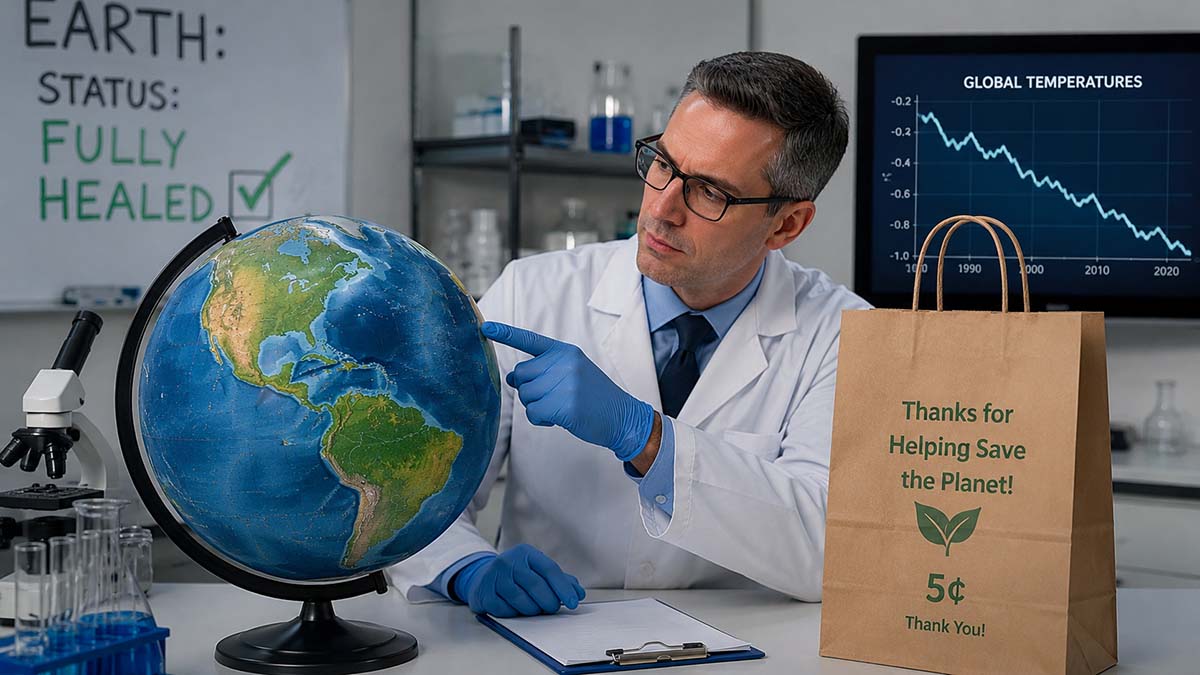
SALEM, Ore. — After decades of concern over melting glaciers, rising oceans, drought, wildfires, plastic pollution and the slow destruction of the natural world, scientists announced this week that the planet has finally been restored to perfect health thanks to Oregon’s five-cent grocery bag fee.
The breakthrough reportedly occurred after researchers noticed a sudden and dramatic improvement in global environmental conditions at the exact moment an Oregon shopper reluctantly agreed to pay five cents for a paper bag at the grocery store. Within minutes, ocean temperatures stabilized, glaciers stopped retreating, sea turtles became noticeably more optimistic, and several polar bears reportedly began celebrating after learning that another customer in Eugene had forgotten his reusable bags in the trunk.
The official That Oregon Life store
The Oregon you bring home.
Start the day with Oregon-roasted coffee, then find original gear inspired by the places, stories, and oddities that make this state ours.
Shop Oregon gear

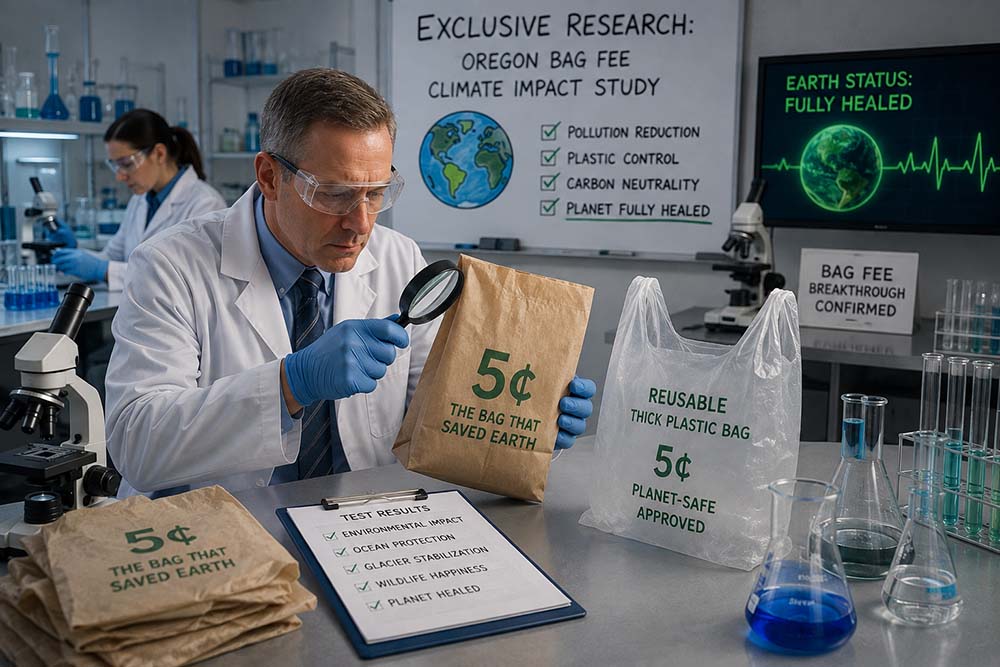
“We’ve spent decades studying emissions, industrial pollution, deforestation and energy consumption,” said Dr. Walter Brenner of the Global Institute for Earth Recovery. “Turns out we were making this way too complicated. What the planet really needed was for someone buying $187 worth of groceries to pay another nickel so they could carry them to the parking lot.”
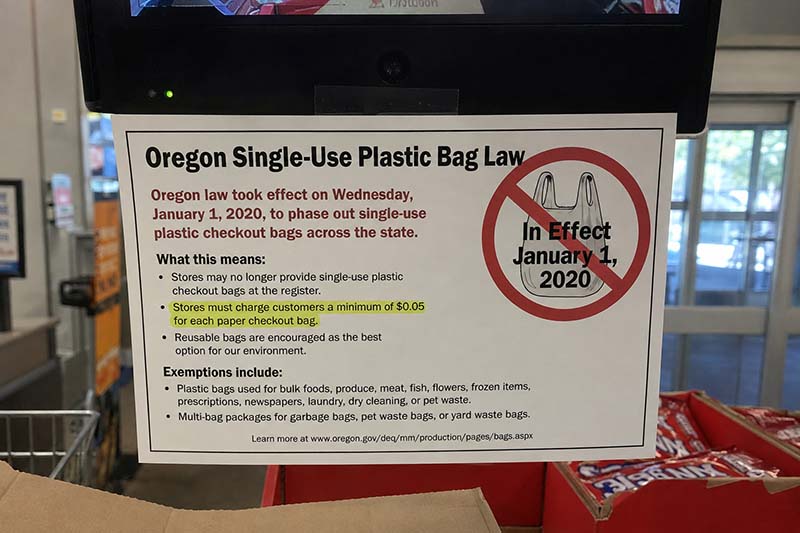
Researchers traced the historic environmental achievement back to Oregon House Bill 2509, the Sustainable Shopping Initiative passed by the Oregon Legislature in 2019. The law prohibited most single-use checkout bags and required retailers, in most situations, to charge at least five cents for qualifying recycled paper bags, reusable fabric bags and certain reusable plastic bags. It took effect January 1, 2020.
The original bill was sponsored by Democratic Representatives Carla Piluso, Janeen Sollman, Chris Gorsek and Dan Rayfield, with additional Democratic lawmakers signing on as sponsors. It moved through the Legislature and became one of those uniquely Oregon laws that passed that nobody truly fully understands, but everyone has somehow learned to participate in anyway.
The idea, at least in theory, was simple. Oregon wanted shoppers to use fewer disposable plastic bags and bring reusable ones instead. Oregon DEQ says plastic checkout bags create problems in recycling systems and contribute to plastic pollution, while the five-cent fee helps retailers recover the cost of providing alternative bags. The store keeps the money.
Simple enough.
Then you actually walk into a grocery store.
You grab a plastic container of blueberries covered with a plastic lid. You pick up a plastic bottle of orange juice, a plastic tub of yogurt, a package of chicken wrapped in plastic, a loaf of bread inside a plastic bag, cheese wrapped in plastic, tortillas sealed in plastic, salad in a plastic clamshell, frozen vegetables in plastic, lunch meat in plastic, and maybe a six-pack of bottled water wrapped together in even more plastic.
If you need produce, no problem. There’s usually an entire roll of thin plastic produce bags waiting for you three aisles away.
Grab one for the apples.
Grab another for the broccoli.
Another for the jalapeños.
Maybe another one because the cilantro is wet and you don’t want it touching anything else.
Perfectly legal.
But when you reach the checkout line with a shopping cart containing roughly four pounds of plastic packaging, Oregon draws the line.
You cannot have that plastic bag.
Scientists say this distinction is extremely important.
“The plastic surrounding the strawberries is apparently fine,” Brenner explained. “The plastic bag holding the grapes is fine. The plastic wrapped around the ground beef is fine. The plastic container holding cookies is fine. But once you place all those plastic-covered items into one final thin plastic bag and carry them to your Subaru, civilization is in danger.”
Oregon law does indeed make numerous exceptions. Bags used away from checkout for bulk foods, fruits, vegetables, nuts and grains are exempt, as are bags used for frozen foods, meat, fish, flowers, bakery goods and prescriptions. Newspaper bags, garment bags, laundry bags, dry-cleaning bags and packages of bags sold for food storage, garbage or pet waste are also excluded from the checkout-bag prohibition.
Apparently the plastic knows what department it came from.
Researchers are still working to determine exactly how a plastic bag becomes environmentally dangerous once it crosses the invisible boundary between the produce section and the cash register.
The confusion becomes even more impressive when shoppers encounter the thicker plastic bags still permitted under Oregon law. The statute defines a “reusable plastic checkout bag” as one specifically manufactured for multiple reuse and made from durable plastic at least four mils thick. Under the law currently in effect, those bags can still be provided at checkout as long as the retailer charges at least five cents for them.
This has created one of the greatest achievements in modern environmental engineering: replacing a thin plastic grocery bag with a much thicker plastic grocery bag, then charging a nickel for it.
Shoppers at stores that use the thicker reusable-style plastic bags may have experienced this remarkable breakthrough firsthand. The bag looks suspiciously like a plastic shopping bag. It feels like a plastic shopping bag. It carries groceries like a plastic shopping bag. It is made of plastic like a plastic shopping bag.
But it is thicker.
Therefore, Earth is safe.
“The old bag was bad plastic,” Brenner said. “This is responsible plastic. You can tell because there’s more of it.”
Researchers believe the difference lies somewhere around the four-mil mark, where plastic apparently undergoes a dramatic moral transformation and becomes environmentally respectable.
Below four mils: reckless.
At four mils: reusable.
Five cents later: sustainable.
The law has also given Oregonians a new ritual at checkout. After watching the cashier scan a cart full of groceries that somehow costs $200 despite containing nothing particularly exciting, the shopper eventually hears the question.
“Do you need bags?”
There is always a brief moment of silence.
The shopper remembers buying reusable bags.
The shopper remembers placing those reusable bags in the car.
The shopper remembers specifically telling themselves, “I’m going to leave these right here so I don’t forget them next time.”
The shopper then realizes those bags are still in the car.
At this point, several options are considered. You could abandon the cart and walk back outside. You could attempt to carry 27 loose groceries in your arms. You could put the avocados in your pockets and balance the eggs on top of the cereal. Or you can accept defeat and say the words Oregon’s environmental future depends upon.
“Yeah, give me two bags.”
Ten cents.
Another glacier saved.
Scientists say the effect appears to increase with every bag purchased. One paper bag may stabilize several acres of rainforest. Three bags can reverse approximately 20 minutes of global warming. Five bags reportedly provide enough environmental benefit to offset at least one celebrity flying somewhere to attend a climate conference.
The paper bags themselves appear to possess additional environmental powers once they reach the Oregon home. Most are carefully folded and placed underneath the kitchen sink alongside 34 previous grocery bags, several reusable totes and a collection of dead batteries nobody knows what to do with.
Researchers previously believed Oregonians were saving these bags because they planned to reuse them someday. They now understand the piles are actually residential carbon-storage facilities.
“Every Oregon home potentially contains a miniature climate reserve,” Brenner said. “If you open the cabinet beneath the sink and 60 paper bags explode onto the floor, congratulations. You’re basically running a national park.”
Reusable bags remain another mystery. Scientists estimate that the average Oregon household owns somewhere between 12 and 400 of them, yet nearly all are located in the wrong place at the exact moment groceries are being purchased.
Common habitats include trunks, garages, pantries, coat closets and the back seat directly underneath a jacket.
“They are extraordinarily difficult to bring into stores,” Brenner said. “People buy them for the specific purpose of carrying groceries, but once placed inside a vehicle they become essentially invisible.”
Researchers say the environmental logic surrounding packaging has opened exciting new areas of study. If a thin checkout bag threatens the Pacific Ocean but the plastic packaging surrounding nearly every product in the store does not, scientists believe it may be possible to save the planet simply by changing where plastic is located.
Instead of putting your groceries in one forbidden thin plastic bag, consumers can safely purchase 19 individually plastic-wrapped products, place the produce in several exempt plastic bags, add a plastic jug of milk, a plastic bottle of detergent and a plastic container of strawberries, and then carry everything home in a thicker plastic bag that is legally reusable.
Five cents, please.
Problem solved.
Oregon DEQ says the law was intended in part to reduce plastic debris and problems caused when plastic bags enter recycling equipment, where they can contaminate the recycling stream and create hazards for workers. Those are legitimate goals. But scientists say the implementation has nonetheless created a breathtaking environmental paradox visible every day in grocery stores across the state.
“Just stand in the checkout line and look around,” Brenner said. “You can practically hear the Earth healing beneath the mountain of plastic packaging.”
The scientific community is now exploring whether Oregon’s model could solve other global problems through similarly tiny checkout charges. Preliminary simulations suggest a 10-cent straw fee could rebuild the Great Barrier Reef. A quarter added to disposable coffee cups may restore several endangered species. A 75-cent takeout-container fee could bring rainfall back to the Sahara.
Researchers are especially encouraged by the possibility of charging customers for something that was previously included in the purchase price and then declaring an environmental victory.
“It’s an incredibly versatile model,” Brenner said. “You can apply it almost anywhere.”
Other states are reportedly studying Oregon’s success. California is considering additional fees. Washington has commissioned a task force. Idaho has reportedly announced that residents will simply carry the groceries.
Back in Oregon, scientists say residents should remain vigilant even though Earth is now officially healed. Anyone who remembers their reusable bags should still consider forgetting them occasionally so the flow of environmental nickels does not suddenly stop.
The next time you walk into a grocery store, load your cart with plastic-wrapped meat, plastic tubs, plastic bottles, plastic containers and produce sitting inside those perfectly acceptable little plastic bags, remember that the most dangerous piece of plastic in the entire building is apparently the thin one that would have carried all of it to your car.
Fortunately, Oregon solved that.
Now you can pay five cents for paper.
Or, depending on the retailer, pay five cents for a thicker plastic bag.
Either way, scientists say the planet would like to thank you.