

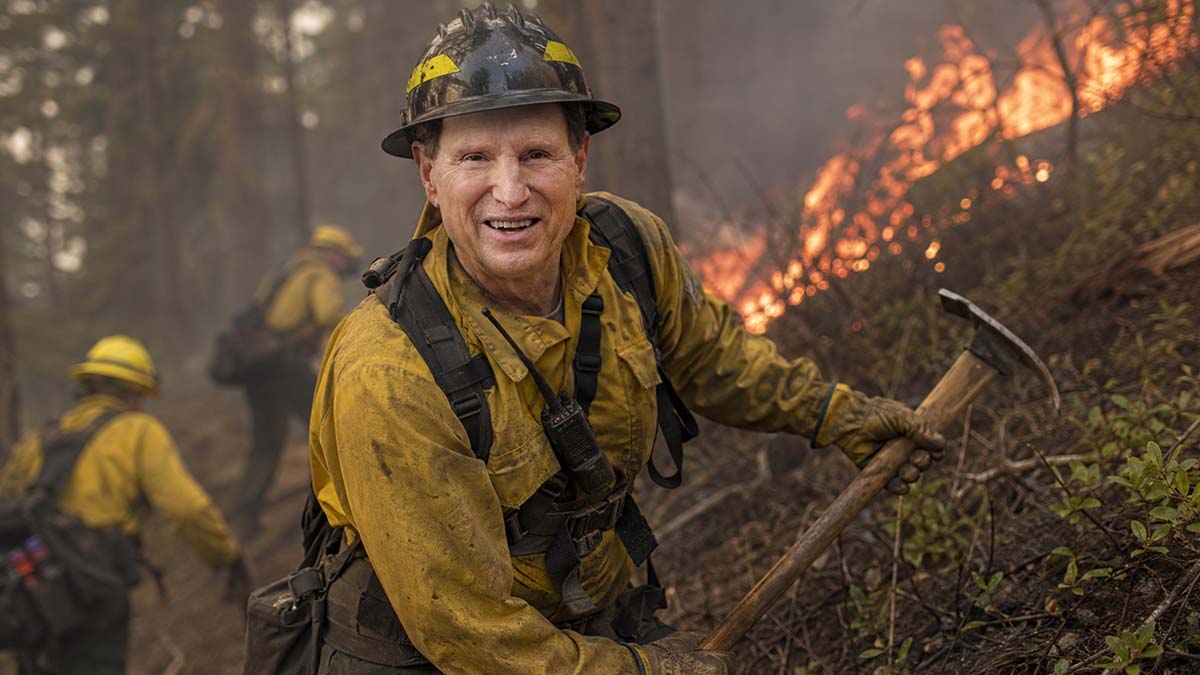
With Oregon firefighters reportedly operating with roughly half the staffing and resources they need during a record-setting wildfire season, U.S. Sen. Ron Wyden has apparently decided there is only one reasonable solution left.
He’s going in.
After meeting Monday with firefighters and officials in Central Oregon, Wyden said fire managers told him they have about half of what they need to keep up with the fires burning across the state.
Wyden criticized the federal response and said he plans to push Washington for more firefighters, support staff and other resources.
But apparently that wasn’t fast enough.
The longtime Oregon senator has reportedly traded his usual jacket for yellow Nomex, grabbed a pulaski and begun asking around to see where he should clock in.
“Look, they told me they have half of what they need,” Wyden reportedly said while tightening the straps on a suspiciously new-looking fire pack. “There are two ways to solve that problem. Congress can provide more resources, or I can start digging.”
Sources say everyone strongly preferred the first option.
Oregon Adds One Firefighter
More than 2 million acres have burned across Oregon this year as multiple large fires have stretched crews and equipment across the West.
The situation has become so strained that Oregon can’t always count on additional firefighters being sent in from other states, mostly because those states are also busy being on fire.
Wyden reportedly arrived Tuesday morning wearing full wildfire gear and asking several increasingly concerning questions, including, “So which direction are we trying to make the fire go?” and, “Is there a YouTube video for this?”
One firefighter explained that wildland firefighting involves years of training, physical conditioning and specialized experience.
Wyden nodded thoughtfully before asking whether decades in the United States Senate counted toward any of that.
It did not.
Still, officials acknowledged that technically speaking, Oregon’s firefighter shortage had now improved by one person.
“We appreciate the enthusiasm,” one exhausted crew boss reportedly said. “But if Senator Wyden really wants to help, we could probably use him back in Washington getting us some money.”
Wyden was already halfway up the hill.
Senator Discovers Firefighting Is Hard
The senator’s first assignment reportedly involved digging a section of fire line through rugged terrain.
Approximately seven minutes later, Wyden had developed a newfound appreciation for federal wildfire funding.
“Okay,” he reportedly said, leaning heavily against his pulaski. “How much did you guys say you needed again?”
“Twice what we have.”
“Write down three times.”
By midmorning, the senator had reportedly learned that wildfire crews regularly work long shifts in extreme heat, breathe smoke, haul heavy equipment over steep terrain and occasionally find themselves standing much closer to giant walls of fire than any reasonable person would prefer.
He was last seen staring toward the flames and quietly muttering, “Perhaps a strongly worded letter would also be useful.”
Unfortunately, Fire Is Fully Staffed
While Oregon may be short on firefighters, supervisors, aircraft and support personnel, the state’s wildfires appear to be experiencing no comparable staffing problems.
Fire remains fully staffed.
In fact, wildfire has been having an extremely productive year, working nights, weekends and holidays without so much as requesting a lunch break.
The flames also appear unconcerned with congressional recesses.
Wyden said Monday that the traditional concept of a defined fire season has largely disappeared, with wildfire increasingly becoming a year-round threat.
Fire, apparently, did not receive Oregon’s request that it please knock this off sometime around Labor Day.
Training Becomes Minor Problem
Sisters Mayor Jennifer Letz, who has decades of wildland firefighting experience, also noted that developing qualified wildfire managers can take years.
That revelation reportedly complicated Wyden’s plan to become an incident commander by Thursday.
The senator was disappointed to learn that being able to locate Bend on a map and owning several Columbia jackets were not among the required qualifications.
By lunchtime, he had reportedly been reassigned to filling water bottles.
Reviews were positive.
“He actually did pretty well,” one firefighter said. “We might let him organize the granola bars next.”
Back to Washington
Wyden’s actual plan, of course, is considerably less dramatic.
He intends to return to Washington and push for additional federal resources, staffing and wildfire prevention efforts rather than personally attacking the Oregon forest with a hand tool.
By Tuesday afternoon, sources reported that the senator had returned his pulaski, removed his helmet and begun making phone calls with considerably more urgency than before.
He did, however, leave Oregon firefighters with one important accomplishment.
For several hours, they officially had half the resources they needed, plus Ron Wyden.
At this point, Oregon will apparently take what it can get.