
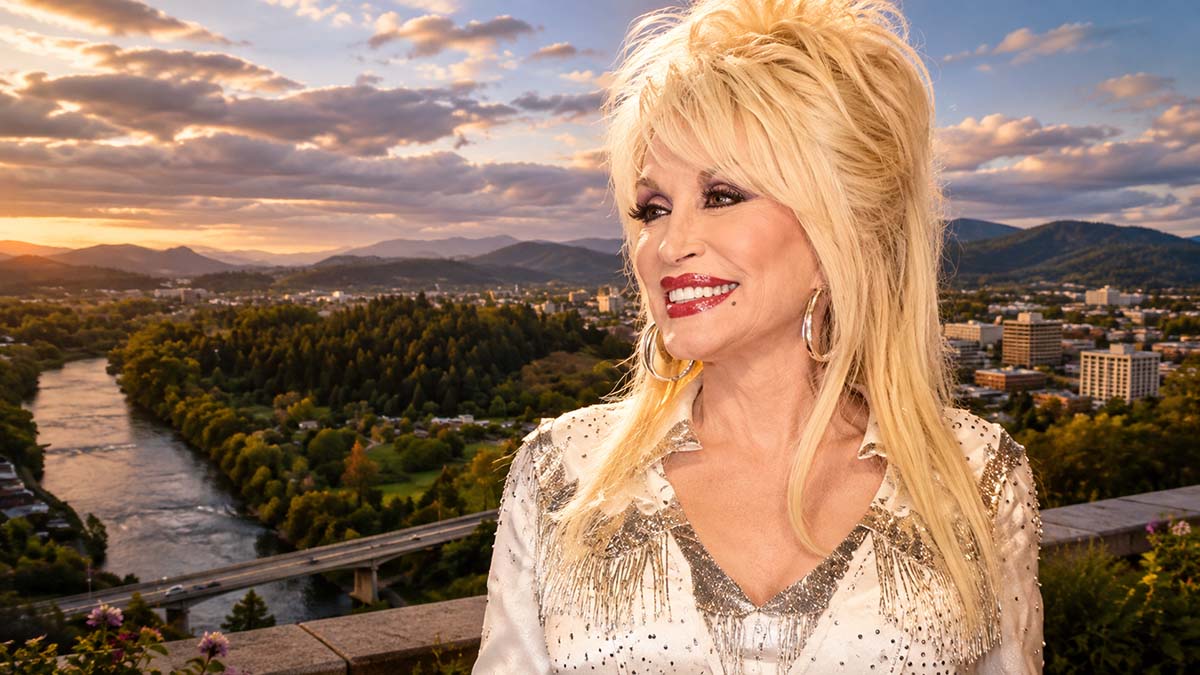
Long before Dolly Parton became one of the most recognizable voices in American music, she arrived in Eugene as a young country singer who was tired, homesick and struggling to make it through the road. It was February 1972, and Parton was touring with Porter Wagoner, still years away from the enormous solo career that would eventually make her a household name around the world.
What happened during that stop in Eugene stayed with her for decades.
The official That Oregon Life store
The Oregon you bring home.
Start the day with Oregon-roasted coffee, then find original gear inspired by the places, stories, and oddities that make this state ours.
Shop Oregon gear
As fans mourn Parton following her death at age 80 on August 25, 2026, stories from across her long career are resurfacing. Oregon has one of its own, and it is an unusually personal one. Parton once wrote an entire song about Eugene after an audience here showed her kindness during one of the most difficult nights of her early touring career.
The song was simply called “Eugene, Oregon.”
On Valentine’s Day in 1972, Parton and the Porter Wagoner Show performed at the Lane County Fairgrounds in Eugene. Roughly 1,500 people reportedly attended the show, held at a time when Wagoner remained the bigger star and Parton was still working to establish her own identity in country music.
Behind the scenes, things were not going nearly as well as they appeared from the audience.
Parton later remembered being sick and deeply homesick during that stretch of the tour. She had spent time crying on the bus and had already been forced to sit out performances because she felt so poorly. By the time the group reached Eugene, she decided she was going to try to perform, even though simply getting herself ready reportedly took much of the afternoon.
When Parton finally stepped onto the stage, she did not try to hide how she felt. She told the Eugene crowd that she was sick and asked for their patience if she could not give them the kind of performance she normally wanted to deliver.
Instead of being disappointed, the audience responded with warmth.
According to accounts Parton shared years later, the crowd gave her the first standing ovation of her career. Then, at another point in the show, they stood for her again. The reaction hit her hard enough emotionally that she later recalled having difficulty continuing because she was crying.
One of the songs she performed that evening was “Coat of Many Colors,” the deeply autobiographical song inspired by her childhood in rural Tennessee. For a young singer who was thousands of miles from home, exhausted from touring and questioning whether she could even make it onto the stage that night, the response from a room full of strangers in Eugene meant far more than ordinary applause.
It meant enough for Parton to write about it.
After the show, she wrote “Eugene, Oregon,” a song that reads less like a travel tune and more like a thank-you note. Rather than describing Oregon scenery or trying to turn the city into some romanticized destination, Parton focused on the way the people of Eugene had treated her when she was having a particularly difficult time.
The song reflected the homesickness she felt for Tennessee while also expressing genuine affection for the city that had welcomed her. Eugene had made an impression on her not because it was glamorous or famous, but because a crowd of people had shown encouragement to a struggling young performer who needed it.
There is something especially charming about the setting when viewed more than half a century later. This was not Dolly Parton arriving at a massive arena surrounded by the spectacle that would eventually follow her career. It was a relatively modest country show at the Lane County Fairgrounds, with about 1,500 people in attendance and a singer who was still finding her way.
Nobody in that audience could have known exactly what Parton would become.
Within a few years, her career would explode. Songs including “Jolene,” “I Will Always Love You,” “Here You Come Again” and “9 to 5” would help transform her from a rising country performer into an international star. She would eventually become not only one of America’s most successful songwriters, but also an actress, businesswoman and philanthropist whose influence reached far beyond music.
Yet the little song about Eugene almost disappeared.
Parton recorded “Eugene, Oregon” during the period surrounding her 1973 album My Tennessee Mountain Home, but the track did not make the original release. Instead, it remained tucked away for decades while Parton’s career grew larger and larger.
For many Oregonians, the song remained little more than an obscure piece of local music history.
That finally changed in 2009, when “Eugene, Oregon” was released as part of Dolly, an expansive four-disc collection looking back across Parton’s career. More than three decades after that Valentine’s Day show at the Lane County Fairgrounds, the song inspired by Eugene was finally available for listeners to hear.
Its eventual release gave the city an unusual distinction. Oregon has appeared in plenty of songs over the years, and Eugene itself has been referenced by a number of musicians, but very few communities can claim that Dolly Parton once sat down after a concert and wrote a song specifically because of the way the audience treated her.
The story continued to have a life of its own in Eugene. Earlier in 2026, the Eugene Symphony revisited Parton’s connection to the city while preparing for Dolly Parton’s Threads: My Songs in Symphony, which was performed at the Hult Center on May 1. The concert brought Parton’s music back into the heart of Eugene more than 50 years after the night that first inspired her to write about the city.
That history feels considerably more meaningful now.
In the wake of Parton’s death, listeners will understandably return to the enormous songs that defined her career. “Jolene” will play everywhere. So will “I Will Always Love You,” “Coat of Many Colors” and countless other songs that became part of the American soundtrack.
Here in Oregon, though, there is another Dolly Parton song worth remembering.
“Eugene, Oregon” was never one of her chart-topping hits, and it was never intended to be. Its appeal comes from something much smaller and more human. It preserves a brief moment when a young Dolly Parton was sick, lonely and thousands of miles from Tennessee, and an Oregon audience made her feel welcome enough that she wanted to remember them in music.
More than half a century later, that song now serves as a small piece of Oregon history and an unexpected reminder of the kind of connection live music can create. On one cold February evening in Eugene, before the rhinestones, movies and decades of superstardom that would follow, a crowd at the Lane County Fairgrounds showed Dolly Parton a little kindness.
She never forgot it.