
Much of Western Oregon is waking up to surprisingly clean air Tuesday morning, but cross the Cascades and the picture changes fast.
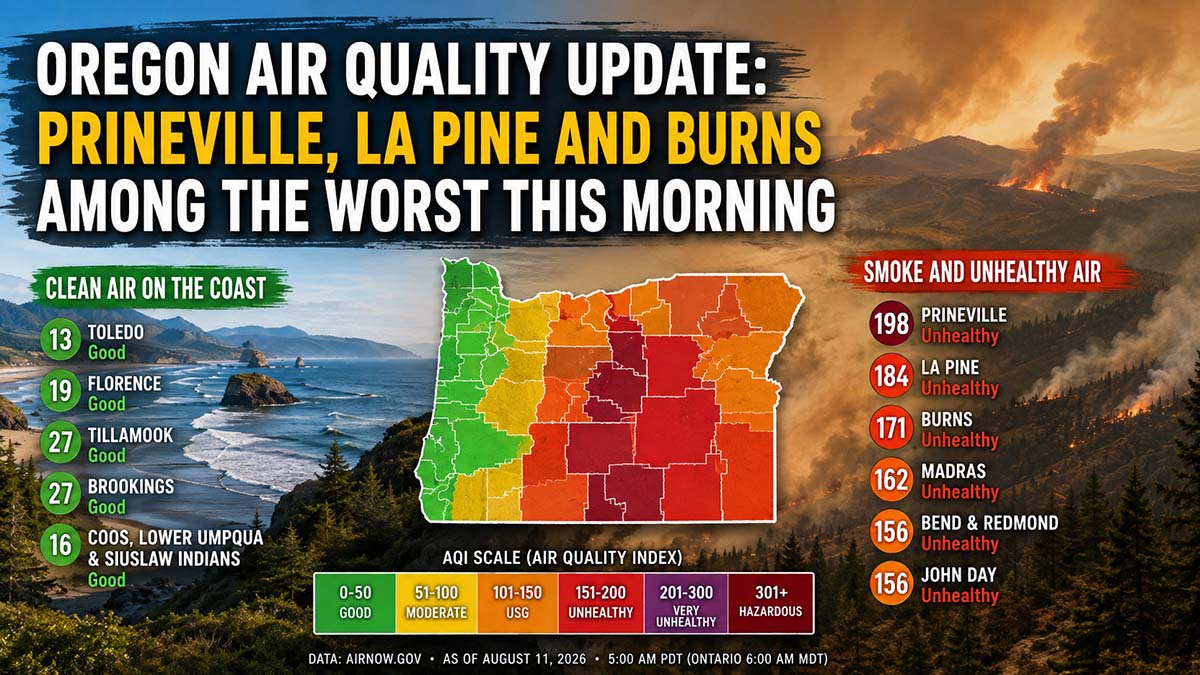
Wildfire smoke continues to hang over portions of Central and Eastern Oregon on August 11, with Prineville, La Pine, Burns, Madras, Enterprise, Bend and Redmond, and John Day all reporting air quality in the EPA’s “Unhealthy” category early Tuesday.
At the same time, Portland, Eugene, Salem, Corvallis and much of the Oregon Coast were firmly in the “Good” range.
The Oregon Department of Environmental Quality issued an air quality advisory Monday covering Crook, Deschutes, Grant, Harney, Hood River, Jefferson, southern Klamath, Lake, Union, southern Wasco, Wallowa and Wheeler counties. DEQ says smoke from multiple wildfires burning in Oregon and Washington is responsible for the ongoing problems, and the advisory is expected to remain in place until at least Wednesday afternoon.
Prineville Is Once Again Among Oregon’s Smokiest Communities
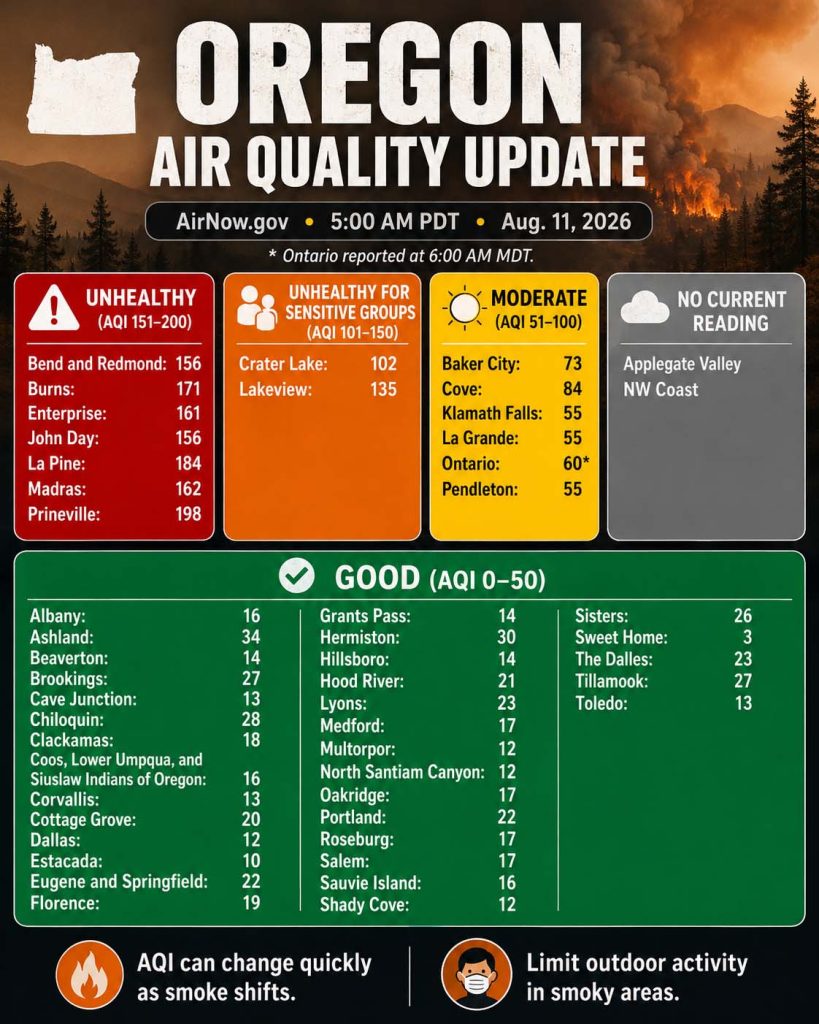
According to AirNow readings captured around 5 a.m. PDT Tuesday, Prineville had the highest AQI among the reporting areas in the data we reviewed:
Prineville: 198 — Unhealthy
That puts the city just two points below the threshold for “Very Unhealthy.”
Other communities in the Unhealthy range included:
La Pine: 184
Burns: 171
Madras: 162
Enterprise: 161
Bend and Redmond: 156
John Day: 156
Crater Lake was at 102, while Lakeview registered 135, putting both in the “Unhealthy for Sensitive Groups” category.
Conditions were somewhat better in Baker City at 73, Cove at 84, Klamath Falls at 55, La Grande at 55, Ontario at 60 and Pendleton at 55.
AirNow defines AQI values from 151 to 200 as Unhealthy, meaning some members of the general public may experience health effects while sensitive groups can experience more serious effects.
Which Fires Are Producing All This Smoke?
There isn’t one simple answer.
DEQ is attributing Oregon’s current smoke problems to multiple wildfires across Oregon and Washington, and wind can move smoke far from the fire that produced it. That means it would be misleading to say one particular fire is solely responsible for Prineville’s AQI of 198 or La Pine’s 184.
But several enormous fires are still burning in and around the regions experiencing the worst air quality.
Rowe Creek Complex and Shingle Fire Remain Major Central Oregon Incidents
The massive Rowe Creek Complex, burning about 10 miles south of Fossil, remains one of the largest fires on Oregon’s landscape.
The latest National Interagency Coordination Center situation report lists the complex at approximately 366,617 acres and 79% contained. More than 1,600 personnel remained assigned to the incident.
The fire has been burning across grass, brush and timber since lightning ignited the complex in mid-July. Its enormous footprint means interior fuels can continue producing smoke even where containment lines are holding.
Nearby, the Shingle Fire southeast of Mitchell was listed Tuesday at approximately 73,101 acres and 86% contained. Fire officials reported moderate activity including flanking, backing and creeping.
The Coyote Fire, about five miles south of Post, remained at roughly 17,448 acres and 89% contained, with minimal activity and smoldering reported.
These fires, along with other incidents around Central Oregon, are plausible contributors to the smoke being experienced around Crook, Deschutes, Grant and Jefferson counties. Exactly how much smoke reaches any particular town depends heavily on wind and atmospheric conditions.
La Pine, Bend and Crater Lake Are Also Downwind of an Extremely Active Southern Oregon Fire
One of the most concerning fires on Oregon’s landscape Tuesday morning is the Wrights Spring Fire, burning about two miles west of Sprague River in Klamath County.
Unlike many of Oregon’s older fires that are now largely contained, Wrights Spring was still showing extreme fire behavior, including crowning, running and spotting.
The latest federal situation report put Wrights Spring at approximately 33,970 acres with zero containment, after growing by more than 10,000 acres. More than 550 personnel were assigned to the fire.
Given its location and intense fire behavior, Wrights Spring is another important regional smoke producer that may be contributing to poor air across portions of south-central Oregon. DEQ’s current advisory specifically includes southern Klamath County and Lake County.
Again, smoke plumes can travel long distances, so there isn’t a one-to-one relationship between the nearest wildfire and a community’s AQI.
Burns Is Surrounded by Huge Recent Fire Footprints
Burns was sitting at an AQI of 171 Tuesday morning, and there is no shortage of wildfire activity across Harney County and the surrounding region.
The Second Flat Fire, burning about six miles northeast of Riley, remains at approximately 105,501 acres and 88% contained. Fire behavior was described as minimal, with creeping and smoldering continuing inside the perimeter.
The nearby Coleman Creek Fire has burned roughly 308,721 acres and was listed at 89% containment. It too continued to creep and smolder.
Farther southeast of Burns, the Bald Mountain Fire remained at approximately 76,160 acres and 93% contained, with backing and smoldering reported.
Even fires with high containment percentages can continue producing substantial smoke as logs, stumps and pockets of vegetation burn inside enormous fire perimeters.
DEQ’s current air quality advisory specifically includes Harney County.
Enterprise Still Dealing With Smoke in Northeast Oregon
Enterprise was reporting an AQI of 161, placing it in the Unhealthy category Tuesday morning.
Two fires remain relatively close to the Wallowa County community.
The Burnt Creek Fire, approximately 23 miles north of Enterprise, was listed at 4,169 acres and 87% contained. The Eggo Fire, about 17 miles northeast of Enterprise, stood at roughly 4,225 acres and 70% contained.
Both were still smoldering, according to the latest federal report.
Regional smoke may also come from farther-away fires depending on wind direction. Wallowa County remains included in DEQ’s current advisory.
Meanwhile, the Oregon Coast Is Breathing Some of the Cleanest Air in the State
If you’re looking at Tuesday morning’s air quality map and wondering where all the green went, much of it is sitting along the Oregon Coast.
AirNow readings at 5 a.m. showed:
Brookings: 27 — Good
Florence: 19 — Good
Tillamook: 27 — Good
Toledo: 13 — Good
The Coos, Lower Umpqua and Siuslaw Indians of Oregon reporting area was also at just 16.
AirNow did not have a current reading listed for its broader NW Coast reporting area early Tuesday, although its forecast called for Good PM2.5 conditions Tuesday and Wednesday.
And what about Newport?
Newport is not listed as its own reporting area in AirNow’s statewide Oregon table, so Toledo’s reading should not be presented as Newport’s.
However, IQAir’s satellite-derived model showed Newport at AQI 37, Good, at 5 a.m. Tuesday.
Taken together, the readings suggest the coast was one of the better places in Oregon to breathe Tuesday morning.
That can change, of course. During wildfire season, a shift in wind direction can push inland smoke toward the coast surprisingly quickly.
Portland, Eugene and Salem Have Cleared Out Dramatically
Western Oregon is also looking much better than it did during some of last week’s smoky days.
At 5 a.m.:
Portland: 22 — Good
Eugene and Springfield: 22 — Good
Salem: 17 — Good
Albany: 16 — Good
Corvallis: 13 — Good
Beaverton: 14 — Good
Hillsboro: 14 — Good
Cottage Grove: 20 — Good
Southern Oregon was also mostly clear early Tuesday, with Medford at 17, Grants Pass at 14, Cave Junction at 13 and Ashland at 34.
The sharp divide between Western Oregon and communities east of the Cascades is a reminder of just how localized wildfire smoke can become.
A city can wake up under blue skies while another Oregon community a couple hundred miles away is dealing with air considered unhealthy for everyone.
What Should You Do When AQI Is Unhealthy?
For communities currently in the red, DEQ recommends reducing exposure to smoke by staying indoors when possible, keeping windows and doors closed, avoiding strenuous outdoor activity and using HEPA filtration or portable air cleaners indoors.
Smoke can irritate the lungs and eyes and can worsen existing medical conditions. Young children, older adults, pregnant people and people with heart or lung disease are among those at greater risk.
Most importantly, check the AQI again before making plans later today.
Air quality can shift dramatically in only a few hours as winds change and wildfire activity increases.
Air quality readings cited in this report were captured from AirNow.gov at approximately 5 a.m. PDT on Tuesday, August 11, 2026. Ontario was reported at 6 a.m. MDT. Newport’s separate reading came from IQAir’s satellite-derived model. Fire information reflects the latest federal and state updates available Tuesday morning.
Current wildfire and smoke resources: Check current Oregon fire incidents, mapped evacuation areas, smoke, road conditions, and official resources on our Oregon Wildfire Map.