

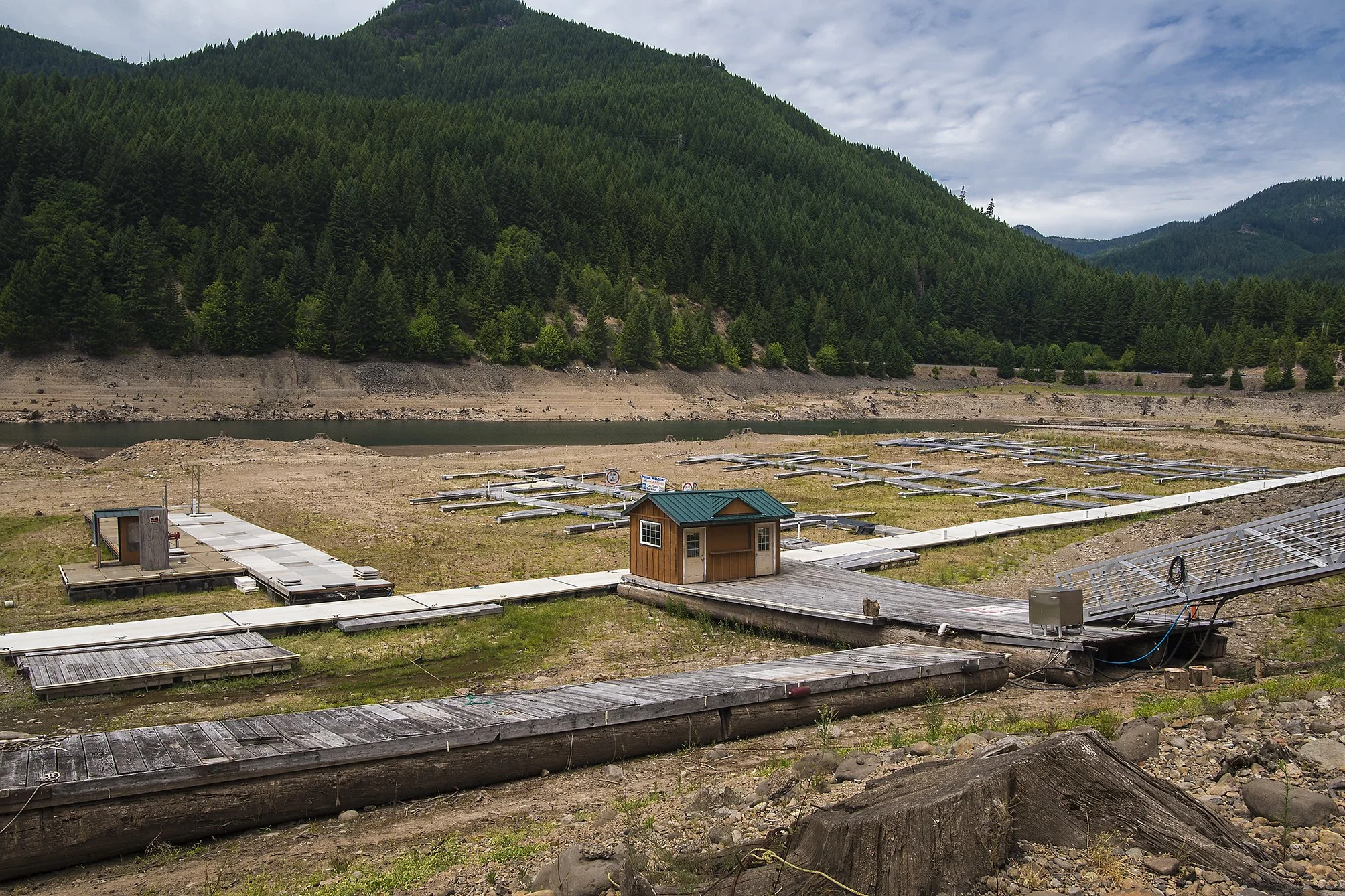
Marion County wants a federal judge to stop a planned Detroit Lake drawdown before the Army Corps of Engineers begins lowering the reservoir this fall. On October 6, the county, Salem, Stayton and the Santiam Water Control District asked the court to intervene, arguing that the operation could threaten water supplies for drinking, farming and fighting fires. According to the county’s account of the hearing, U.S. District Judge Mustafa T. Kasubhai heard the arguments and took the matter under advisement. The county said it expects a decision in the coming weeks.
The federal court’s calendar listed oral arguments in both Marion County’s case and Salem’s separate case in Eugene on October 6. The hearing ended without a ruling to stop the drawdown. The communities are seeking a pause while their lawsuits continue.
Our August article, Dead Fish, Drawdowns, Dams, and Lawsuits Muddy the Waters in Oregon’s Push to Save Salmon, traced the fish deaths at Green Peter, drinking water concerns downstream and the challenges of getting young salmon past Oregon’s dams. Tuesday’s hearing focused on Detroit Lake and whether this fall’s operation can go ahead while the lawsuits continue.
The Water Concerns Reach Well Beyond the Lake
For many Oregonians, Detroit Lake brings to mind boat docks, camping trips and a familiar stretch of the Santiam Canyon. Downstream, communities depend on the river system for their water supply. In its public explanation of the lawsuit, Salem said it supplies drinking water to about 220,000 residents, along with hospitals, schools and businesses. Its service area also includes Turner, two water districts and portions of unincorporated Marion and Polk counties.
Salem’s concern is that fine sediment released by a deep drawdown could interfere with its treatment system. The city wants a defined threshold that would require the operation to pause or stop when sediment threatens its water infrastructure. It also says it invested nearly $8 million over 18 months in backup supplies, including groundwater wells, aquifer storage and an emergency connection with Keizer. Salem’s July release said those alternatives were expected to meet demand during the initial drawdown and recovery period, even as the city challenged the plan’s long-term reliability.
Marion County’s May 13 complaint also challenged the Corps’ handling of public review. The county alleged that the agency missed a January 4, 2026 deadline for a federally required turbidity report, leaving the public without information it should have had before commenting on the plan. Turbidity measures how cloudy water becomes when particles remain suspended in it. Tuesday’s hearing did not establish that allegation as a finding by the judge.
The official That Oregon Life store
The Oregon you bring home.
Start the day with Oregon-roasted coffee, then find original gear inspired by the places, stories, and oddities that make this state ours.
Shop Oregon gear


What the Corps Plans This Fall
The Corps describes a phased operation intended to help juvenile fish travel downstream through Detroit Dam. Its July 28 explanation says the 2026 drawdown would begin sometime after November 1, with timing influenced by weather conditions, and would target an elevation of 1,425 feet. The reservoir reached that level in 2015 and 2019, according to the agency.
The agency says reaching the target could take up to two weeks, followed by roughly two weeks at that level unless a major storm changes operations. In later years, it intends to work toward 1,395 feet, which it identifies as the elevation needed for safe fish passage through a regulating outlet. The Corps says it does not expect drinking water impacts at the first year’s 1,425-foot target, citing the absence of reported impacts when that level occurred previously. Local governments are asking the court to examine whether the plan includes sufficient protections.
The Corps’ environmental review materials describe monitoring water quality in real time and coordinating with downstream providers if conditions warrant modifying, pausing or stopping an operation. Those measures are intended to address the risk that disturbed reservoir sediment could enter downstream water systems. Local governments question how the protections will work and whether communities are adequately prepared before lowering begins. The lawsuits challenge the fish passage operation, which is separate from ordinary seasonal water changes.
Why Green Peter Still Hangs Over This Fight
Local leaders have pointed to what happened during Green Peter’s 2023 drawdown, when the Corps reported that Oregon Department of Fish and Wildlife officials confirmed at least 8,000 dead kokanee. Those fish suffered barotrauma, an injury caused by rapid changes in pressure while passing through the dam. Kokanee are landlocked sockeye salmon, and the agency distinguished them from the protected native fish the operation was designed to help.
In November 2024, the Corps halted another Green Peter drawdown ahead of schedule after requests from downstream cities concerned about their drinking water systems. The agency said a response plan developed with cities and the state helped make that decision possible. Green Peter’s experience gives local officials a concrete example behind their questions about sediment and emergency protections, though it does not establish that Detroit will have the same results.
In Smoke Signals’ June reporting, Grand Ronde Tribal Council member Kathleen George described deep drawdowns as an essential tool for reversing the decline of Willamette Basin salmon. She also said drinking water and recreation concerns should be addressed through cooperation.
Kotek’s Earlier Response and the Delegation’s July Letter
The Canyon Weekly reported in February 2024 that Governor Tina Kotek wrote to the Corps on December 18, 2023, following problems at Green Peter and Lookout Point. The paper also reported a February 15, 2024 response to local elected officials in which she pushed for community costs to be factored into federal funding decisions. Those letters addressed the wider Willamette Basin dispute and its effects on local communities.
As of October 6, That Oregon Life’s searches of public news releases and recent reporting did not locate a new statement from Kotek specifically addressing this fall’s Detroit Lake drawdown or Tuesday’s hearing. That search does not establish whether she has discussed the matter privately. A July letter led by Representative Janelle Bynum, joined by Representative Andrea Salinas and Senators Jeff Merkley and Ron Wyden, urged the Corps to ensure affected water systems were prepared. The lawmakers asked the Corps to consider community readiness alongside fish recovery objectives.
The Next Development Is the Judge’s Decision
Communities around the North Santiam have opposed the plan for months. OPB reported in June that local governments and organizations had already asked the Corps to cancel the 2026 operation and reconsider future plans. Their concerns included water reliability, drought conditions, recreation and the economy around the reservoir. The Corps maintained that it had shaped the Detroit plan around lessons from earlier drawdowns.
Judge Kasubhai will decide whether to grant the requested pause while the lawsuits proceed. A ruling on that request would not resolve every claim in the cases. Marion County says it will release another update when the court decides.