


BEND, OR. — Nearly a month after a teenager opened fire inside Silver Rail Elementary School, killing three children and a teacher, investigators are still working to answer a question that could have significant legal consequences: How did the 16-year-old obtain the shotgun used in the attack, and could his mother be held responsible?
The question has taken on renewed urgency as students return to the Bend elementary school on Thursday, November 12, for the first time since the October 15 shooting. While families continue to mourn, the possibility of criminal charges against someone other than the deceased gunman remains unresolved.
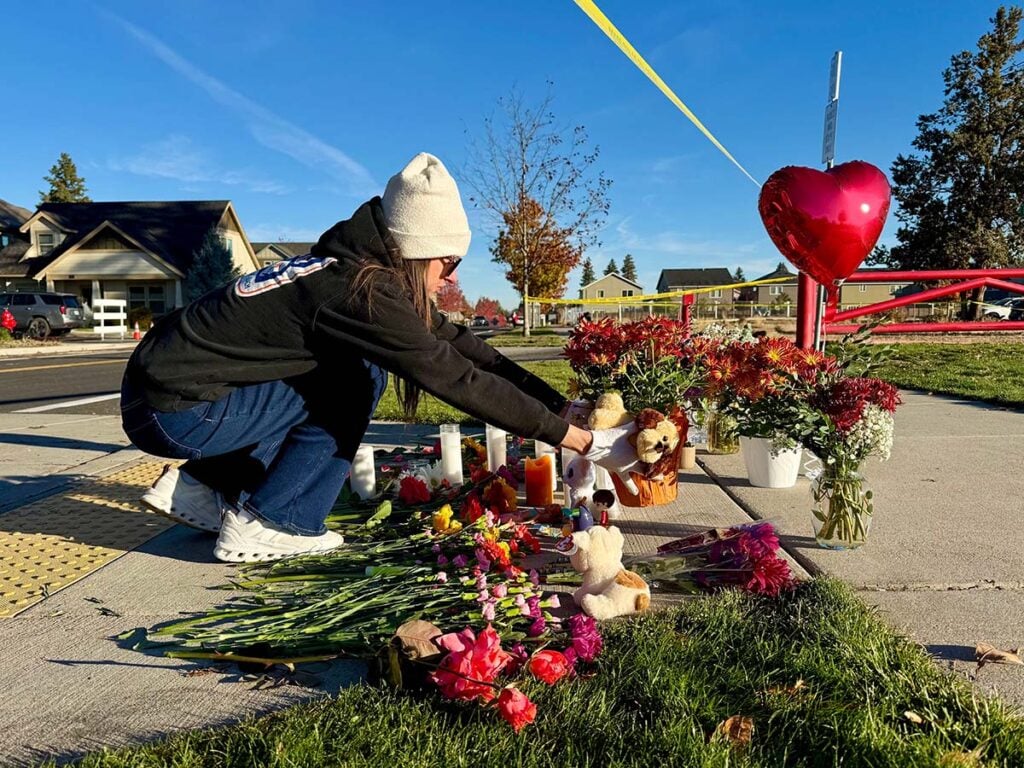
According to new reporting from FOX 12 Oregon’s Spencer Schacht, Oregon has no law specifically establishing criminal liability for parents whose children commit school shootings. However, that doesn’t necessarily prevent prosecutors from considering existing homicide statutes if the evidence supports such charges.
No criminal charges against the shooter’s mother had been announced as of FOX 12’s Thursday morning report. The investigation remains ongoing.
Frequently Asked Questions About the Silver Rail Shooting Investigation
Can the Silver Rail shooter’s mother face criminal charges?
Yes, potentially. Although Oregon doesn’t have a law specifically making parents criminally responsible for school shootings committed by their children, prosecutors could pursue charges under existing laws if the evidence supports them. Oregon attorney Steven Sherlag told FOX 12 Oregon that criminally negligent homicide or second-degree manslaughter could be considered depending on the circumstances.
Has the Silver Rail shooter’s mother been arrested or charged?
No. As of November 12, 2026, authorities hadn’t announced criminal charges against the shooter’s mother, Shauntai Nickerson. The investigation remains ongoing, and no determination of criminal wrongdoing by Nickerson has been publicly established.
Does Oregon have a law holding parents responsible for school shootings?
Oregon doesn’t have a statute specifically assigning criminal responsibility to parents when their children commit school shootings. However, existing criminal laws may apply if a parent’s own conduct meets the legal requirements for an offense. Prosecutors would need evidence of criminal negligence, recklessness or other legally relevant conduct rather than relying solely on the parent-child relationship.
What is Oregon’s gun storage law?
Under ORS 166.395, firearm owners generally must secure guns with an engaged trigger or cable lock, a locked container, or a secured gun room when the firearms aren’t under authorized control. Violations ordinarily result in civil penalties rather than criminal charges. In certain circumstances, improper storage can also establish negligence in a civil lawsuit if the firearm is later used to cause injury or property damage.
How did the Silver Rail shooter obtain his gun?
That remains a central question in the investigation. The Associated Press and OPB reported that the shotgun used in the October 15 attack had been purchased by the teenager’s mother. Bend Police confirmed that the firearm had been legally purchased but hadn’t publicly explained how the teenager gained access to it. A legal purchase doesn’t establish whether the weapon was properly secured.
Could the mother face manslaughter or criminally negligent homicide charges?
Potentially, but such charges would require substantial evidence. Under Oregon law, criminally negligent homicide involves causing a death through criminal negligence, while second-degree manslaughter can involve causing a death through reckless conduct. Prosecutors would need to establish the necessary legal elements, including culpability and causation. Neither charge automatically applies because a parent owns a firearm used by their child.
Can victims’ families sue the shooter’s mother?
Potentially. Oregon law allows civil claims under certain circumstances, including those involving negligent firearm storage. At least one Silver Rail victim’s family has retained attorneys to investigate possible legal action. According to FOX 12’s November 12 reporting, no lawsuit had been filed at the time of publication.
What happens next in the Silver Rail shooting investigation?
Investigators are continuing to examine how the teenager obtained the shotgun and whether anyone else bears legal responsibility. According to FOX 12, records involving previous police calls to the family home and the teenager’s history may be relevant to evaluating potential criminal liability. Any decision to pursue charges will depend on the evidence and Oregon law.
Could the Silver Rail Shooter’s Mother Be Criminally Charged?
Steven Sherlag, an Oregon criminal defense attorney who specializes in firearm-related cases, told FOX 12 that the question isn’t as straightforward as it might appear.
Oregon doesn’t have a statute that specifically makes parents criminally responsible when their children carry out school shootings. However, Sherlag explained that prosecutors could potentially consider charges such as criminally negligent homicide or second-degree manslaughter, depending on the circumstances surrounding the firearm and what the parent knew beforehand.

“What was the mom’s awareness of specific problems?” Sherlag asked in his interview with FOX 12.
That question could become central to any potential prosecution. Establishing that a parent purchased or owned a firearm isn’t the same as proving that the parent committed a criminal offense connected to the resulting deaths.
Prosecutors would need evidence supporting the elements of an applicable criminal charge, including the required degree of culpability and a legally sufficient connection between the parent’s conduct and the deaths.
What Oregon’s Criminal Laws Actually Say
Although Oregon doesn’t have a law tailored specifically to parents of school shooters, the state already recognizes criminal liability for deaths caused by reckless or criminally negligent conduct.
Under Oregon Revised Statute 163.145, criminally negligent homicide involves causing another person’s death through criminal negligence. The offense is classified as a Class B felony.
A separate provision, ORS 163.125, generally addresses manslaughter in the second degree when a death results from reckless conduct, along with certain other circumstances specified in the law.
The distinction matters. Under ORS 161.085, recklessness involves consciously disregarding a substantial and unjustifiable risk, while criminal negligence involves failing to recognize such a risk when that failure represents a gross departure from reasonable conduct.
Neither law automatically applies to a parent simply because their child committed a violent crime.
In the Silver Rail investigation, prosecutors would have to examine the available evidence and determine whether a parent’s own actions or failures to act satisfied the requirements of a particular offense.
Oregon Requires Safe Gun Storage, but Violations Aren’t Automatically Criminal
Oregon does have a law requiring firearms to be secured when they’re not being carried or otherwise kept under legally recognized control.
Under ORS 166.395, firearm owners generally must use an engaged trigger or cable lock, a locked container, or a secured gun room.
Violating that storage requirement is ordinarily classified as a civil violation rather than a criminal offense. The law establishes a more serious violation when a minor obtains an unsecured firearm under specified circumstances, including when the owner knew or should have known the minor could gain unauthorized access.
That means improper storage, by itself, wouldn’t necessarily result in a criminal prosecution or jail sentence.
However, there’s another important provision in the statute.
If a firearm obtained because of a storage-law violation is subsequently used to injure a person or damage property within two years, the statute can establish negligence as a matter of law in a civil damages action against the owner or possessor, subject to specific exceptions.
That provision could become relevant if future evidence establishes that the firearm used at Silver Rail was improperly secured. It does not establish that any such violation occurred in this case.
Investigators Still Have Questions About the Shotgun
One of the most consequential unanswered questions concerns the shotgun used by the teenage gunman, identified by Bend Police as Griffin J. John II.
As That Oregon Life previously reported, The Associated Press cited a law enforcement official who said the firearm had been purchased by the teenager’s mother, Shauntai Nickerson.
OPB subsequently reported that sources familiar with the investigation identified the weapon as a Mossberg Maverick 88 pump-action shotgun purchased by Nickerson.

Bend Police confirmed on October 21 that the firearm had been legally purchased, but declined to publicly identify the buyer or provide additional details about how the teenager obtained it.
However, a legal firearm purchase doesn’t establish improper storage, unlawful access or prior knowledge of an intended attack.
Nickerson previously expressed sorrow over the deaths and said she would have acted to prevent the shooting if she could have, according to comments reported by The New York Times and CNN and subsequently cited by OPB. She has not been charged in connection with the attack.
Previous Police Calls Could Be Relevant to the Investigation
FOX 12 also reported obtaining records documenting multiple calls for police service at the home where the teenager lived.
According to the station’s review of those records, the teenager was listed as the victim in two reported assault incidents. One allegedly involved his mother’s boyfriend, while another involved a friend of his sister. FOX 12 also reported that the documents described bullying at school and that no charges were filed against the individuals accused of striking him.
Those records provide additional background for investigators, but they don’t establish that Nickerson knew her son intended to commit violence or that the reported incidents contributed to the shooting.
Sherlag told FOX 12 that a parent’s awareness of specific warning signs would be an important consideration in evaluating whether criminal liability could exist.
Any prosecution would require more than public speculation about the teenager’s behavior, home life or circumstances. Investigators would need evidence connecting legally relevant conduct to the crimes under consideration.
Parents Have Faced Charges After School Shootings in Other States
The possibility of prosecuting a parent isn’t without precedent.
In Michigan, Jennifer and James Crumbley were convicted of involuntary manslaughter following the 2021 Oxford High School shooting, in which their son killed four students. Prosecutors argued that the parents ignored warning signs and failed to take appropriate precautions concerning the firearm used in the attack.
In Georgia, the father of the teenager responsible for the 2024 Apalachee High School shooting was convicted of second-degree murder and involuntary manslaughter. The case similarly involved allegations concerning access to a firearm and knowledge of potential danger.
Both cases were examined in an October 21 investigation by OPB, which included interviews with prosecutors and firearms-law attorneys about the possibility of bringing charges in Oregon.
The cases demonstrate that parents can face criminal consequences for their own conduct in circumstances involving school shootings. They don’t mean that every parent of a teenage shooter is automatically criminally liable.
Whether Oregon prosecutors could successfully pursue a comparable case would depend on the specific facts, applicable statutes and evidence available to investigators.
Civil Lawsuits Remain a Separate Possibility
Even without criminal charges, families affected by the Silver Rail shooting may have grounds to explore civil litigation.
The parents of 5-year-old Rhoam Summer, the youngest victim killed in the attack, have already retained three law firms to conduct an independent investigation.
As That Oregon Life reported on October 19, the legal team is examining potential failures involving school security, emergency procedures and the circumstances that allowed the gunman to acquire his weapon.
Criminal prosecutions and civil lawsuits involve different legal standards and objectives. A criminal conviction generally requires proof beyond a reasonable doubt, while a civil negligence claim generally requires proof by a preponderance of the evidence.
A decision not to pursue criminal charges therefore wouldn’t necessarily prevent a family from seeking damages through the civil court system.
FOX 12 reported Thursday that no lawsuit had yet been filed in connection with the family’s legal investigation.
As Silver Rail Reopens, Families Continue Seeking Answers
The legal questions are unfolding as the Silver Rail community reaches another difficult milestone.
According to KTVZ’s November 11 reporting, students were scheduled to return to Silver Rail on Thursday for a half-day, exactly four weeks after the shooting.
The attack killed three children, ages 5, 8 and 11, and 25-year-old teacher Megan Lambert. A 7-year-old student and 54-year-old educational assistant Becky Drury were also wounded.
School officials have been preparing the building for students’ return while providing opportunities for families to visit beforehand. The return to classrooms represents an important step for the school community, although the emotional effects of the shooting will extend far beyond the reopening.

For investigators, many of the central questions remain unanswered. They include how the gunman gained access to the shotgun, what warning signs may have existed and whether any other person’s conduct violated Oregon law.
For the families who lost loved ones, those answers could help determine whether criminal charges, civil litigation or other forms of accountability follow.
For now, one thing remains clear: Oregon’s lack of a law specifically targeting parents of school shooters doesn’t rule out prosecution under existing statutes. But bringing such a case would require evidence establishing criminal wrongdoing, not simply a connection to the person who carried out the attack.
This article is based on reporting by FOX 12 Oregon, The Associated Press, OPB, KTVZ and previously published That Oregon Life coverage, along with the cited Oregon Revised Statutes. That Oregon Life has not independently obtained the police records described in FOX 12’s report.