
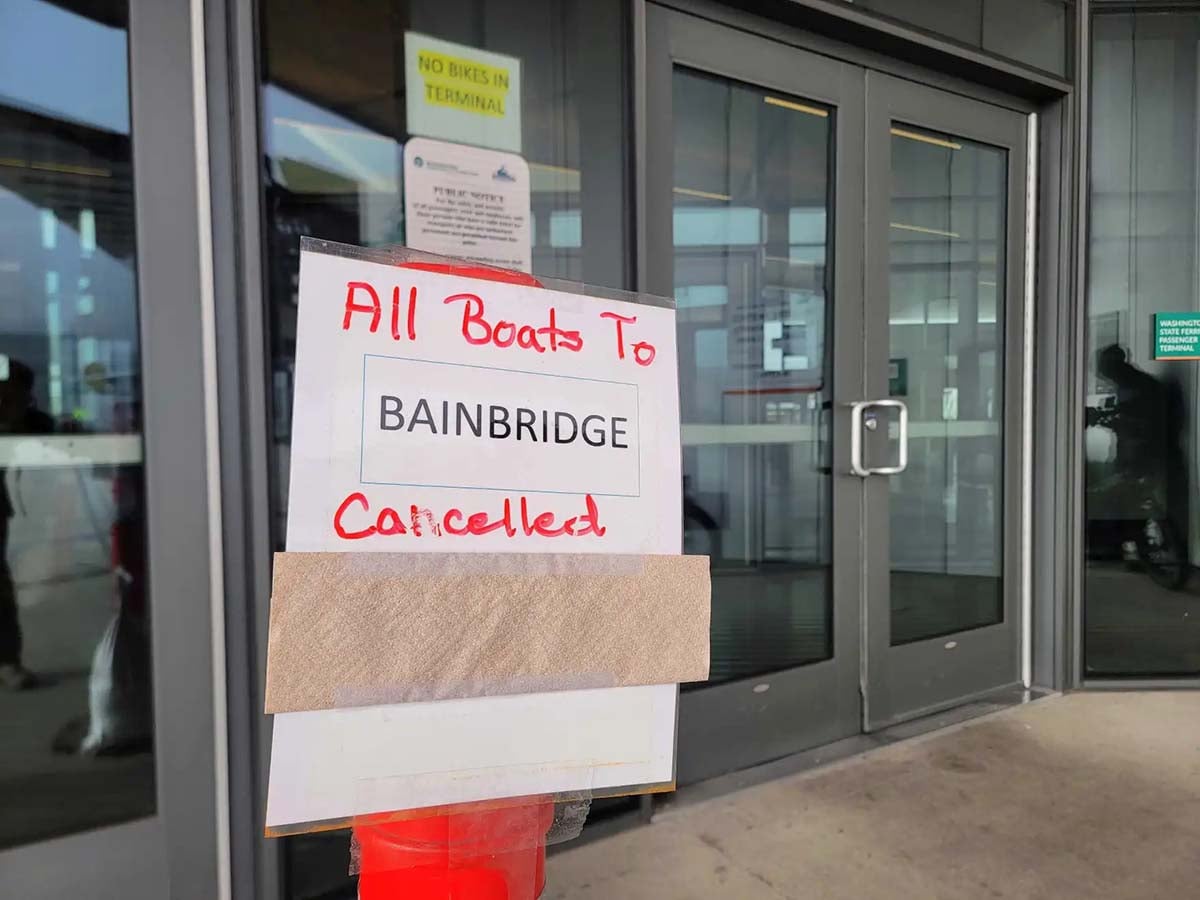
Washington State Ferries said 23 engine-room employees called in sick Monday morning and qualified replacements declined to cover their positions, leaving 13 of the 18 vessels operating that day out of service.
The disruption stopped several major routes and reduced service on others. In its Facebook statement, WSF identified the workers’ union and cited staff chief engineers’ salaries. MEBA later denied organizing the callouts and blamed understaffing, excessive overtime and wage disparities.
“We understand how disruptive this is to thousands of Washingtonians,” WSF wrote in the statement reproduced by the San Juan Islander. “We expect our employees to return to work as soon as possible.”
Major routes stop, with limited alternatives for riders
Seattle–Bainbridge Island, Edmonds–Kingston and Fauntleroy–Vashon–Southworth were among the routes suspended Monday morning. Seattle–Bremerton and Mukilteo–Clinton dropped to one-boat service, according to KUOW’s reporting.
In the San Juan Islands, WSF announced that the Chelan and Yakima were unavailable because of crew shortages. The Samish operated an all-stops schedule, and the interisland ferry Tillikum was reassigned temporarily to assist. WSF blocked new reservations and reservation changes for Monday and waived no-show fees. Kitsap Transit also added passenger-only fast ferry departures to help accommodate displaced riders, according to WSF’s official travel alerts.
Some service returned during the day. Washington State Standard reported that Port Townsend–Coupeville resumed operations in the afternoon after a vacancy was filled. Point Defiance–Tahlequah continued running despite an earlier warning that it might stop.
The official That Oregon Life store
The Oregon you bring home.
Start the day with Oregon-roasted coffee, then find original gear inspired by the places, stories, and oddities that make this state ours.
Shop Oregon gear


WSF’s salary figures prompt questions
WSF said all vessels begin their service day staffed at U.S. Coast Guard required levels. Dispatchers seek qualified replacements when employees call in sick; an unfilled required position prevents a boat from sailing.
The agency also said staff chief engineers have a base salary of $157,000 and can earn more than $350,000 annually with overtime. It listed sick leave, vacation leave and retirement accrual among their benefits.
Those figures describe a specific senior position. The Facebook post did not identify the titles or pay rates of the 23 employees who called out, say how many were staff chief engineers, or explain how much overtime would produce earnings above $350,000. WorkBoat’s coverage also distinguished staff chief engineer compensation from pay for the broader engine-room workforce.
Andrew Bernhardt questioned that choice of information in the Facebook comments:
“Washington State Ferries You told us what Staff Chief Engineers make, how much do engine room employees make?”
Rob Woodard asked about the hours and qualifications behind the salary:
“Washington State Ferries what kind of shifts and hours do these engineers work for that pay? What kind of training is required? How does that pay compare to the maritime industry?”
WSF spokesperson Justin Fujioka told KIRO 7 that licensed positions can take years of training and credentialing to fill. He said the agency has introduced workforce development programs to increase the number of qualified employees.
MEBA denies organizing the callouts
MEBA said it neither initiated nor aided Monday’s absences and learned about the disruption through media reports, according to Kitsap Sun reporting republished by AOL. The union described the callouts as a “frantic cry for help.”
In its account, WSF previously staffed engine crews with an additional employee above Coast Guard requirements, allowing boats to operate when someone called in sick. MEBA said management reduced crews to the legal minimum, leaving dispatchers dependent on emergency replacements.
The union said engineers work seven-day shifts and can accumulate more than 1,500 overtime hours annually. It also claimed deck officers earn roughly 20% more than below-deck workers and that comparable public and private maritime engineering jobs pay substantially more.
Those staffing and wage comparisons are MEBA’s claims. The union said it wanted to cooperate with WSF to keep vessels operating safely and on schedule.
Engineers raised concerns months earlier
On June 17, KIRO 7 reported that MEBA was seeking a 20% wage increase to bring engineers’ pay into line with deck workers. Union representative Eric Winge said ferry service relied heavily on employees volunteering for overtime.
The report also described a union survey in which about 60% of respondents indicated they were likely to retire or leave their positions. That finding concerned survey respondents, rather than a confirmed departure rate across the workforce.
The Washington State Standard reported Monday that the upcoming July 2027–June 2029 agreement, decided through interest arbitration, provides no scheduled wage increase but allows further bargaining over pay for its second year.
Riders express frustration and support
The selected Facebook comments included people who questioned working conditions while acknowledging the disruption.
“Eventually, quality of life and work/life balance begins to outweigh money,” Sarah Hartwell wrote. She suggested WSF examine those conditions if it is having difficulty attracting candidates.
Elaine Walker asked whether engineers have adequate relief or face excessive mandatory overtime.
Jennifer Margolis said a school ferry route had left her “really inconvenienced,” while expressing support for workers she viewed as acting together for fair wages.
These are individual readers’ reactions. Their descriptions of the callouts as collective action do not establish how the absences were arranged.
Ferguson calls for Tuesday service to resume
Governor Bob Ferguson met with local and national MEBA leadership Monday and acknowledged staffing concerns. He nevertheless said he expected “every vessel on every route” to be operating by the first sailing Tuesday, October 6, according to the Washington State Standard.
Whether Monday’s absences constituted a coordinated work stoppage remained unresolved in the reporting. KIRO Newsradio reported that WSF had not confirmed coordination.
Washington law prohibits strikes and work stoppages by ferry employees. That prohibition alone does not establish that these particular sick calls violated the law.
Ferguson’s demand was not confirmation that Tuesday’s service would be restored. WSF said it remained uncertain what staffing would look like. Riders can check the agency’s travel alerts for changes to their route before leaving for a terminal.