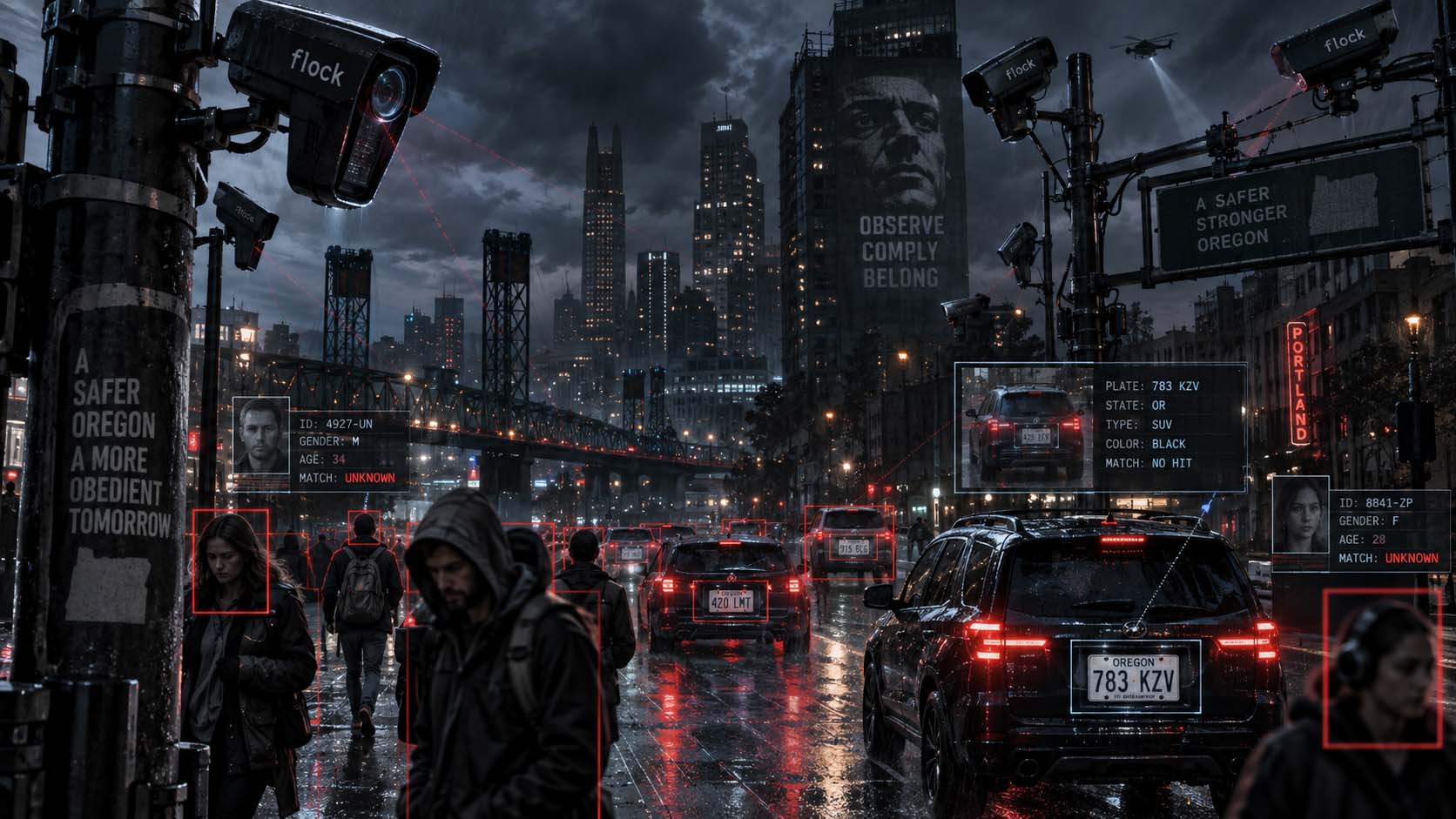
On any given morning in Oregon, thousands of us pull out of our driveways without thinking much about the trail we leave behind. We head across Springfield for groceries, merge onto Beltline for work, drive into Portland for an appointment, or take Highway 101 simply because the coast is calling. These are ordinary movements through ordinary days, and most of us don’t consider them anybody else’s business. Increasingly, however, cameras mounted along roads and in parking lots are turning those everyday trips into searchable records that can be reviewed long after we’ve driven away.
Now, two Oregon lawmakers from opposite sides of the political aisle want to put an end to that practice. The Oregonian/OregonLive reported on September 9 that Republican Rep. Alek Skarlatos of Douglas County and Democratic Rep. Willy Chotzen of Portland plan to introduce legislation during Oregon’s 2027 legislative session that would indefinitely ban Flock cameras statewide. Skarlatos has raised Fourth Amendment concerns about the accumulation of information on people who haven’t been accused of crimes, while Chotzen has framed the issue more broadly around an Oregonian’s right to go about daily life without being routinely monitored.
According to The Oregonian’s reporting, at least 524 Flock Safety cameras are currently operating around Oregon, including more than 70 in Portland. The numbers were compiled and reported by the company, and they reflect cameras located within communities rather than necessarily indicating that every device belongs to the local police department. Eugene, Springfield, and Woodburn have already taken steps to end or suspend their relationships with Flock, making the proposed statewide ban part of a debate that has been simmering in Oregon for well over a year. What once looked like a niche disagreement over police equipment has become a much larger argument about privacy, government power, artificial intelligence, and how much surveillance Americans are willing to tolerate.
I’ll be honest about my own bias here. I’m deeply uneasy with the idea that we should build a massive system capable of cataloging where ordinary people travel simply because that information could prove useful later. I want stolen vehicles recovered, missing children found, violent suspects captured, and police equipped to respond quickly when lives are at risk. At the same time, I don’t believe public safety requires transforming every innocent driver into a permanent entry in a searchable surveillance network. I’ve watched a few eye-opening videos recently that really changed how I look at this technology and made me realize just how uncomfortable I am with the rapid expansion of public surveillance. In some cases, Flock cameras are mounted inside residential neighborhoods just a few feet from people’s homes, quietly recording vehicles as residents come and go. Seeing that up close made the issue feel far less abstract and a lot more intrusive.
Flock Cameras Do Much More Than Snap a Picture of a Plate
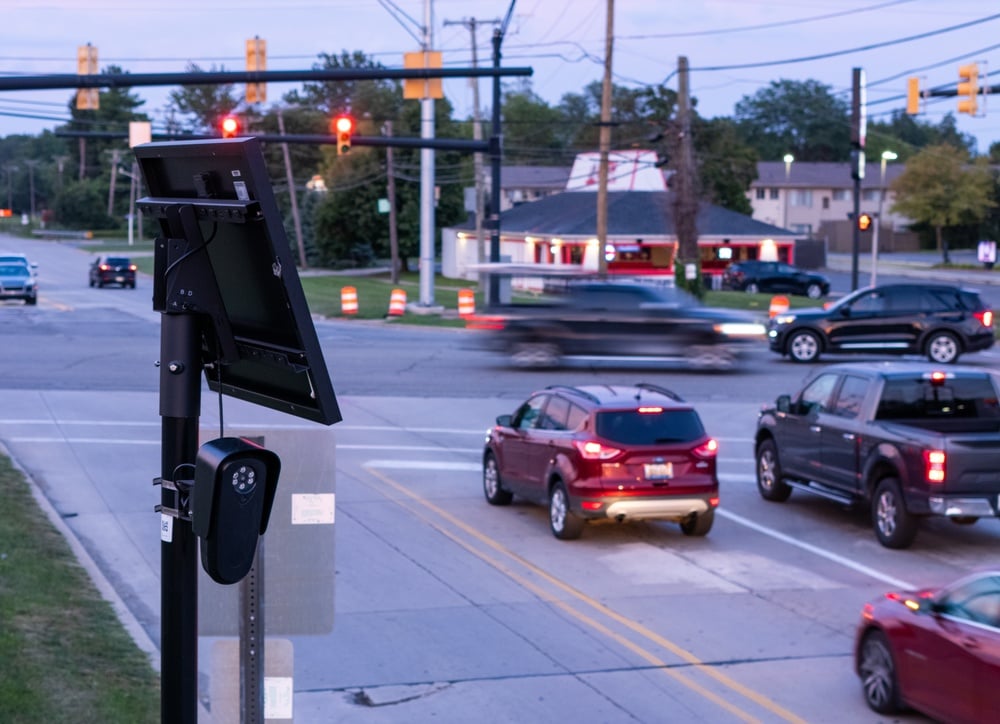
A Flock camera usually doesn’t look especially intimidating from the road. Many are relatively small devices mounted on poles beside intersections, parking lots, neighborhood entrances, and commercial properties, often with a solar panel attached above them. They’re easy to overlook, especially when surrounded by traffic lights, utility boxes, signs, and all the other hardware that has gradually become part of the modern roadside landscape. The technology behind them, however, is far more powerful than the camera’s modest appearance suggests.

Do you love Oregon?
Sign up for monthly emails full of local travel inspiration and fun trip ideas. In each newsletter we'll share upcoming events, new things to do, hot dining spots and great travel ideas.
Flock’s automatic license plate reader system records passing vehicles and can capture license plate information along with details such as vehicle make, color, body style, and identifying features. An investigator doesn’t always need a complete plate number to begin searching, because the system can help narrow results using partial information and a vehicle description. Participating agencies can also receive alerts when a vehicle associated with a designated watchlist passes one of the cameras. Used in a focused investigation, those capabilities can help police quickly locate a stolen car or identify where a suspect’s vehicle was recently seen.
The privacy concern emerges when hundreds or thousands of separate observations are connected. A single camera recording your car near a grocery store may reveal very little, but repeated sightings can begin outlining where you work, where you sleep, who you visit, and how you spend your time. A vehicle that regularly appears outside a particular medical clinic, place of worship, political gathering, recovery meeting, or residential address can produce deeply personal inferences. Those inferences may be correct, completely wrong, or somewhere in between, but the person being observed may never know the search occurred.
There’s an important distinction between being visible in public and having your movements organized into a database. Someone standing beside the road could see you drive past, but that person probably won’t remember your plate, record the exact time, compare it with sightings across town, and make the entire history available to authorized users weeks later. Technology removes the natural limits that once made widespread physical surveillance expensive and labor-intensive. It turns fleeting moments into durable records and allows a single person behind a computer to review movements that would once have required a team of people following someone around.
The scale of Flock’s network makes that capability particularly significant. By August 2026, The Guardian reported that Flock had more than 120,000 cameras operating around the country, scanning license plates billions of times each month. Law-enforcement agencies can search information beyond their immediate jurisdiction when access and sharing arrangements permit it, meaning a camera installed by one community may contribute to an investigation taking place far away. Flock says participating customers control their own data and decide who can access it, but the broader network remains one of the company’s most valuable selling points.
That network is also what makes these cameras fundamentally different from the old security camera hanging above the door of a convenience store. Traditional footage often sat on a local recorder until somebody had a reason to review it, while Flock is designed to make vehicle observations organized, searchable, and useful across a wider system. That efficiency is exactly why police departments value the technology. It’s also why critics worry that a tool marketed for specific investigations can quietly become infrastructure for tracking the general public.
The Technology Is No Longer Limited to License Plates
The term “Flock camera” can be misleading because the company now sells several kinds of surveillance technology with different capabilities. Its plate readers focus on vehicles, while its video products can be combined with a tool called FreeForm that allows authorized users to search footage using ordinary written descriptions. An investigator can enter a description of a person, clothing, accessories, vehicle damage, or another visible detail and ask the system to locate potentially relevant matches. The company describes this as a way to move quickly from incomplete information to usable investigative leads.
According to Flock’s own explanation of FreeForm, users can search enabled video feeds with phrases describing a person’s clothing or a vehicle’s appearance. The company gives examples such as a person in a particular shirt or a dark SUV with visible damage, and it says matching results can be viewed alongside information from license plate readers. Searches can also extend into participating shared-camera networks when permission has been granted. In practical terms, that means investigators may be able to search footage from public agencies, businesses, campuses, or neighboring properties through one interface.
The public got a clearer look at how those tools were being used when 404 Media reviewed police search records involving descriptions of specific people. The outlet found hundreds of searches involving visible characteristics such as clothing, tattoos, hats, sports apparel, and other identifying details. Some searches referenced race or indications of political affiliation, and certain requests reportedly examined hundreds of cameras at once. The records don’t prove that every search was inappropriate, since police may have had legitimate reasons to look for a clearly described suspect, but they demonstrate how far the technology has moved beyond simply checking whether a passing license plate belongs to a stolen car.
Flock says its people-search system does not use facial recognition or biometric person identification. That distinction is important, because FreeForm isn’t necessarily taking a face and matching it to a database of named individuals. Instead, the company says searches rely on observable details such as clothing and visible accessories captured on enabled video feeds, and it specifically notes that people searches do not operate through ordinary license plate cameras. Even with those limitations, the ability to look across numerous camera feeds for a person matching a written description deserves far more public attention than it has received.
For me, the concern isn’t eased simply because a system stops short of facial recognition. A searchable network capable of locating people by what they’re wearing, where they appear, or what symbols they display still carries enormous potential for misuse. A search for a robbery suspect in a distinctive coat may be reasonable, while a search aimed at identifying people attending a political event or protest raises an entirely different set of questions. The same technology can serve both purposes, which is why the limits placed on its use matter as much as the technology itself.
Police Have Used Plate Readers to Track Women They Knew
The most disturbing part of the Flock debate isn’t a theoretical warning about what somebody might do in the future. It’s the growing list of law-enforcement officers accused of using plate-reader systems to track wives, former partners, girlfriends, colleagues, and other people in their personal lives. These cases are especially alarming because the alleged misuse didn’t require an outside hacker to defeat the system’s protections. In many instances, the person conducting the searches already had legitimate professional access and allegedly turned that access toward someone who was never part of a criminal investigation.
A major Washington Post investigation into police misuse of plate-reader systems identified 50 officers accused or charged with improper searches, including 46 cases connected to Flock. Many involved officers allegedly looking up current or former romantic partners, family members, or people they knew personally. The cases varied widely in seriousness and legal outcome, so it would be inaccurate to describe every officer as convicted of stalking. Even so, the pattern documented by the newspaper shows that personal misuse has occurred across multiple departments rather than being confined to one isolated scandal.
One of the clearest confirmed cases came from Kansas. Former Kechi police lieutenant Victor Heiar pleaded guilty to computer crime and stalking after using Flock to monitor his estranged wife, according to reporting from KWCH. Prosecutors said Heiar exploited his police position to follow her location through the license plate reader system, while the woman told a friend she was frightened and believed she was somehow being tracked. A judge imposed a 24-month jail term but granted Heiar probation, making this more than an allegation while still requiring care in how the sentence is described.
A more recent Florida case shows how repeated searches can allegedly continue over an extended period. Haines City police officer Christopher Goodson was accused of searching for his estranged wife’s vehicle 717 times between September 2024 and June 2026. Investigators said neither the woman nor her vehicle was connected to a criminal investigation, although Goodson allegedly selected official-sounding reasons such as wanted-person, narcotics, and motor-vehicle investigations when conducting the searches. Goodson reportedly told investigators he was trying to monitor where his children were while they were with their mother, and the criminal charges against him remain allegations unless established in court.
On September 9, another case surfaced in New York involving numbers that were even more staggering. Albany County investigator Laurie Moore was charged after authorities alleged more than 4,000 unauthorized database searches, including roughly 3,000 involving a former girlfriend. The sheriff said the investigation began after irregularities were detected and later expanded as officials looked further into her search history. Moore was charged with official misconduct and falsifying business records, but her case had not reached a conviction at the time of the announcement.
These examples demonstrate why the phrase “authorized user” should never be confused with “trustworthy use.” A police officer may be authorized to enter the system while still lacking a legitimate reason to search a particular person or vehicle. Case numbers, dropdown menus, and written explanations can create records of what someone claimed to be doing, but they don’t automatically prove that the stated reason was true. In the Florida case, investigators allege that official categories were selected even though the searches were personal, which shows how a required justification can become little more than a box to check.
The threat is particularly frightening for women dealing with controlling or abusive partners. A person may change routines, avoid familiar places, seek a protection order, or carefully limit who knows where she’s staying, only to discover that someone with database access can repeatedly search her vehicle. An audit might eventually reveal what happened and support discipline or prosecution, but that comes after the privacy invasion has already occurred. No later report can erase the fear of realizing that someone may have been quietly following your movements through a system intended for public safety.
Security Failures Have Raised a Different Set of Alarms
The word “hacked” is often used broadly in discussions about Flock, but several distinct problems have been documented. Some cases involve authorized officers abusing access, while others involve camera feeds exposed online, researchers finding weaknesses in acquired hardware, or agencies discovering that outside users accessed data in ways local officials didn’t expect. Those situations aren’t technically identical, and combining them into one sweeping claim can make the reporting less accurate. Each one, however, raises legitimate questions about whether governments should entrust vast amounts of location and video information to a privately operated surveillance platform.
One of the most serious public exposures came to light in December 2025, when 404 Media found at least 60 Flock Condor cameras accessible on the open internet. The exposed systems reportedly allowed people with the correct links to view live streams without a password, access archived video, inspect administrative information, and in some cases alter settings or perform diagnostic functions. Journalists traveled to camera locations and confirmed that they could watch themselves appear in real time on the publicly accessible feeds. The affected devices were Condor pan-tilt-zoom video cameras rather than ordinary roadside plate readers, but that distinction doesn’t make the exposure insignificant.
The cameras involved in that investigation were capable of following people and vehicles through their field of view. Reporters described feeds showing pedestrians, drivers, people using trails, and children in public spaces, all captured through cameras that could automatically adjust their view. Flock later described the incident as a limited configuration problem that had been corrected. That response deserves inclusion, since a repaired exposure shouldn’t be portrayed as an open vulnerability that anyone can still exploit today, but the fact that such sensitive feeds were available without credentials in the first place remains deeply concerning.
Security researchers have also examined Flock hardware they legally acquired and reported weaknesses involving device access, stored credentials, and local camera controls. The Guardian detailed demonstrations involving purchased camera equipment, while also reporting that Flock disputed whether those tests reflected the security of properly installed, internet-connected systems. The company said some findings had been fixed and argued that other demonstrations wouldn’t apply to normal production deployments. That disagreement doesn’t establish that every roadside camera is vulnerable, but it reinforces the need for independent testing rather than relying solely on assurances from the vendor selling the system.
Another controversy involved access rather than a conventional hack. In 2025, Flock paused pilot programs with federal agencies after questions arose over how federal users accessed locally collected plate data. The Associated Press reported that an Illinois audit found Customs and Border Protection had accessed information collected in the state, where the law restricts sharing plate-reader data for certain immigration and out-of-state abortion investigations. Flock said the federal pilots were intended to address human trafficking and fentanyl distribution, while acknowledging that permissions and protocols hadn’t been made sufficiently clear.
That episode matters because local communities often evaluate Flock as though they’re deciding whether their own police department should have another investigative tool. Residents may not realize that the value of the system partly comes from its ability to connect data across jurisdictions and agencies. Once sharing expands, a city may have less practical control than the public assumed when the cameras were approved. A local promise about how information will be used is only meaningful when the technology reliably enforces that promise.
The larger security concern is simple: valuable databases attract attention. A network that helps police locate suspects could also interest stalkers, criminals, corrupt insiders, federal agencies, private investigators, or anyone else seeking location information. The more detailed and interconnected the system becomes, the greater the consequences when permissions fail or someone abuses legitimate access. Surveillance advocates often emphasize the danger of failing to collect enough information, but communities should also consider the danger of collecting information they can’t fully control.
The Backlash Has Included Cameras Being Destroyed Across the Country
Public anger over Flock has moved well beyond policy papers and city council testimony. Cameras have been damaged, painted over, obstructed, taken down, and apparently shot in communities across the United States. In July 2026, The Guardian documented at least 33 apparent anti-surveillance vandalism incidents across 23 states. Some people responsible for those acts left messages criticizing mass surveillance, while others posted videos or celebrated the destruction online.
The incidents have included allegations against people accused of damaging multiple cameras in Virginia, New Mexico, Tennessee, and other states. One New Mexico man was accused of destroying 13 cameras, while authorities in Tennessee arrested a man they said had shot four automatic plate readers. In another case, a roadside-safety advocate who had publicly raised concerns about camera installations stopped discussing the devices after cameras he had featured were badly damaged. He said he feared the escalating hostility could eventually lead to someone being injured.
I don’t support destroying cameras, shooting equipment beside a public roadway, or encouraging anyone else to do it. Aside from the obvious legal consequences, firing weapons or damaging roadside infrastructure can endanger workers, drivers, and bystanders who have nothing to do with the surveillance debate. There are legitimate ways to fight government overreach through public records, lawsuits, legislation, journalism, elections, and sustained civic pressure. Privacy concerns don’t become more persuasive when somebody creates a new safety hazard in the name of opposing surveillance.
Still, dismissing the entire backlash as vandalism would be equally dishonest. The physical destruction represents only the most visible and reckless edge of a much broader movement that includes residents, civil-liberties attorneys, local officials, conservatives, progressives, and even some current and former law-enforcement officers. By August, at least 56 municipalities had deactivated, canceled, or rejected Flock contracts during 2026. Many of those decisions followed public meetings, audits, petitions, privacy investigations, and ordinary democratic pressure rather than damaged equipment.
The governmental pushback has also intensified. Florida transportation officials ordered automatic plate readers removed from state highways, citing rapid expansion alongside concerns about misuse, privacy, and surveillance. Texas froze state spending connected to the cameras, while communities in several states suspended or ended their contracts. In Ohio, Columbus paused its Flock program after another alleged misuse case, stopping the collection of new data while officials launched an audit.
What makes the backlash especially notable is its bipartisan character. Skepticism about Flock has attracted people on the left who worry about immigration enforcement, reproductive privacy, and protest monitoring, along with people on the right who see warrantless vehicle tracking as a threat to constitutional liberty. Those groups may disagree about nearly everything else, but both recognize the danger of creating a system that can be repurposed as laws, administrations, and political priorities change. Surveillance power rarely remains confined forever to the original justification used to create it.
Some cities have responded to the controversy by replacing Flock with another automatic plate-reader company rather than ending the surveillance itself. That may resolve concerns about a particular vendor’s security practices, data-sharing terms, or contract language, but it doesn’t answer the underlying question of whether every passing vehicle should be recorded. A different logo on the camera doesn’t necessarily create a different relationship between citizens and the government. Oregon lawmakers will have to decide whether their concern is specifically Flock or the wider practice of building searchable databases of innocent drivers.
Eugene and Springfield Already Walked Away
For residents of the southern Willamette Valley, this debate isn’t taking place somewhere far away. Eugene and Springfield both spent much of 2025 confronting concerns over Flock cameras, data security, federal access, and the tracking of people who weren’t suspected of crimes. Local activists organized, attended meetings, examined company policies, and pressed city officials for answers about what the cameras collected and who could search the information. The controversy became one of Oregon’s clearest examples of residents pushing back against a surveillance system after learning more about its reach.
In December 2025, Eugene and Springfield announced that they were ending their Flock arrangements after months of public opposition. Eugene police cited vulnerabilities and limitations involving operational needs, data security, and community expectations. The city’s cameras had already been operating before officials asked Flock to turn them off, while Springfield’s planned system had not been formally activated for normal use. Springfield said its equipment would be covered and removed because officials no longer had confidence that the system provided the control and assurance they required.
Springfield’s decision did not amount to a permanent rejection of automatic license plate readers in every form. Police officials indicated they might consider another system if it offered stronger security, transparency, and local control. That distinction is important because a city can lose confidence in Flock without abandoning the broader technology. It also shows why Skarlatos and Chotzen’s proposed bill will need precise language explaining whether it targets one vendor, a type of camera, or the larger practice of collecting and searching vehicle-location information.
Woodburn has also moved away from Flock amid the statewide concern, and other Oregon communities are likely to face similar discussions as residents become more familiar with the technology. Camera contracts are often approved as routine public-safety purchases, long before the average person understands the scale of the network or the ways information can be shared. Once the equipment is installed, communities may discover that removing it is more complicated than approving it was. In several cities around the country, deactivated cameras remained physically mounted for months, sometimes forcing local governments to cover the devices while waiting for their removal.
Law enforcement has legitimate reasons for resisting a blanket ban. Eugene police reported that stolen vehicles were recovered about 30 percent faster while its plate readers were operating, and departments across the country credit the technology with helping locate missing people and suspects in serious crimes. The Oregonian also reported that plate-reader information helped authorities locate the man suspected of killing five people in Forest Grove in August 2026. When officers are urgently looking for a dangerous suspect in a known vehicle, the ability to receive a rapid location alert can clearly save time and potentially save lives.
Acknowledging those benefits doesn’t require us to accept every possible use of the technology. Wiretaps can help solve serious crimes, but that usefulness doesn’t justify listening to everyone’s phone calls. Search warrants help investigators find evidence, but the value of a search doesn’t mean police should be able to enter every Oregon home without legal justification. The question isn’t whether Flock can assist police, because it plainly can; the question is whether its benefits justify continuously recording vehicles belonging overwhelmingly to people who aren’t suspected of anything.
The danger of overreliance became visible in a Colorado case involving a woman wrongly accused of stealing an Amazon package. Police used Flock sightings to connect Chrisanna Elser’s vehicle to the area, then treated that location information as support for accusing her of the theft. CBS Colorado reported that Elser spent weeks assembling her own vehicle footage and timeline to prove she was innocent. The plate-reader information may have accurately shown that her vehicle passed through the area, but an accurate sighting became part of an inaccurate conclusion.
That case is a useful reminder that a camera hit isn’t proof of a crime. A vehicle can be driven by a spouse, child, friend, employee, mechanic, or anyone else with access to the keys. A car can pass near an address without stopping, and someone can visit a neighborhood without knowing a crime occurred there. Technology may create an aura of certainty, but the data still requires careful human investigation and a willingness to consider evidence pointing away from the first suspect.
Flock Says It Is Adding Stronger Safeguards
Flock has responded to the growing criticism by announcing new privacy, security, and accountability measures. In August 2026, the company said it was reducing its default and recommended plate-data retention period from 30 days to seven. It also announced an Evidence Mode that would allow investigators to preserve specific records connected to active cases. The company said its analysis showed that most searches conducted without a complete plate happened within the first week.
The seven-day change is less universal than it may sound at first. Existing customers can retain the storage periods already approved by their communities, meaning records in some jurisdictions may remain available longer. Agencies that adopt the shorter period can still preserve selected information for legitimate investigative needs. Those exceptions may be practical, but they also mean residents need to examine their own local policies rather than assuming every Flock record disappears after one week.
Flock has also said it will require case codes for law-enforcement searches, make audit-assistance tools mandatory, use automated systems to flag suspicious behavior, and impose stronger account protections. Emergency searches may bypass normal case-code requirements, but the company says those searches will be flagged for administrative review. Flock has also emphasized that customers own their data and control sharing permissions. On paper, those changes address several of the weaknesses highlighted by recent scandals.
The ACLU remains skeptical that Flock’s new guardrails can reliably prevent abuse. The organization argues that requiring officers to choose or enter a reason for a search doesn’t ensure the reason is truthful, particularly when earlier controls could be bypassed with vague or false explanations. It has also noted that the effectiveness of Flock’s automated audit system hasn’t been independently evaluated. Detecting more misconduct than before doesn’t tell the public what percentage of all improper searches the system actually catches.
There’s also an unavoidable difference between prevention and accountability. An audit log may help prove that an officer searched an ex-partner thousands of times, and that evidence can be essential for discipline or prosecution. It doesn’t prevent the officer from learning where the person traveled before anyone notices the pattern. Strong auditing is worthwhile, but it shouldn’t be treated as a substitute for asking whether so many people should have access to such detailed information in the first place.
Oregon Should Decide Before Surveillance Becomes Invisible
The proposed 2027 bill gives Oregon an opportunity to ask these questions before the technology becomes so common that it fades into the background. Lawmakers will need to define exactly which systems are covered, whether private cameras facing public roads are included, and how the law would treat technologies sold by companies other than Flock. They’ll also need to consider narrowly tailored emergency uses, active criminal investigations, stolen vehicles, Amber Alerts, and other circumstances where rapid access could be justified. A serious debate should address both the documented benefits and the documented abuses rather than pretending either side of the record doesn’t exist.
At a minimum, Oregonians deserve to know where cameras are located, what information they capture, how long it is stored, which agencies can search it, and how often searches occur. Communities should also know whether a warrant, active case, or reasonable suspicion is required before someone examines a person’s past movements. Policies shouldn’t be buried in vendor contracts that can change after local approval. Oversight should come from people accountable to the public, not solely from a company whose financial interest depends on expanding the system.
Location privacy matters because movement reveals so much about a person’s life. A list of places someone visits can expose medical concerns, religious beliefs, political involvement, romantic relationships, financial hardship, or participation in a support group. It can show where children attend school, where a former partner moved, or which relatives someone regularly visits. None of that requires facial recognition when a vehicle is already closely associated with the person driving it.
Here in Oregon, driving has always carried its own sense of freedom. We take back roads through the Coast Range, cross mountain passes toward Central Oregon, follow the Columbia through the Gorge, and pull over at little diners or trailheads simply because something caught our eye. Not every trip has a purpose worth explaining, and not every stop belongs in a government-accessible history. The ordinary freedom to move around without being cataloged is part of the larger freedom we rarely notice until it begins disappearing.
Public safety and privacy don’t have to be treated as enemies, but striking a balance requires more than trusting everyone involved to behave responsibly. The cases involving officers tracking women they knew show what can happen when access is abused, while exposed feeds and unauthorized sharing show that even formal controls can fail. The camera destruction and nationwide contract cancellations reveal how quickly public trust has deteriorated. Oregon’s lawmakers now have to decide whether additional rules can restore that trust or whether the state should step away from Flock entirely.
The technology’s supporters are right that these cameras can help solve crimes. Its critics are right that the system records enormous numbers of innocent people and can be turned toward purposes they never approved. Both things can be true at the same time, which is why the decision shouldn’t be reduced to being either pro-police or anti-police. The real question is how much surveillance a free society should build before convenience and efficiency begin costing us something we can’t easily get back.
The fact that government can collect a record of our movements doesn’t mean it always should.