
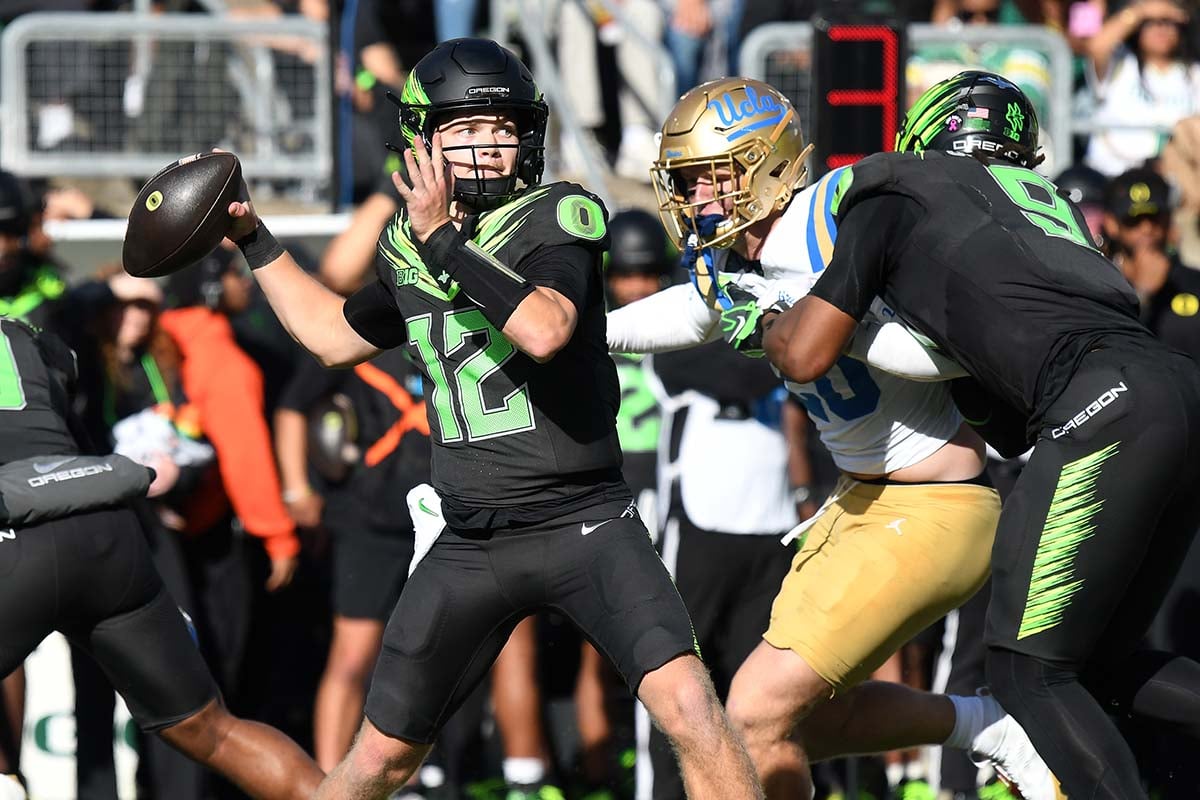
Seven turnovers are difficult enough to stomach on an Oregon football Saturday. Learning afterward that the officials also mishandled the Ducks’ best opportunity to pull even makes a 17-15 loss to UCLA considerably harder to accept. With 2:16 remaining, Oregon lined up for a two-point conversion that could have tied the game. The Big Ten has since acknowledged that the Ducks were asked to cover more ground than the rules required.
For those of us who love this program, that admission brings very little comfort. Oregon had spent much of the afternoon making its own life miserable, yet still reached a moment when one successful run could have brought the teams level. Jordon Davison took the handoff, UCLA stopped him, and the Bruins protected their two-point advantage. Now we know the play began a full yard farther from the end zone than it should have.
The mistake followed a UCLA facemask penalty on Oregon’s first attempt at the conversion. Davison had advanced to the 1-yard line, which meant the penalty should have placed the ball halfway between that spot and the goal line. Instead, officials calculated the enforcement from the original 3-yard line. Oregon consequently snapped the ball from the 1½-yard line when the correct location was the half-yard line, as the conference’s statement explained.
That distinction matters enormously when the entire assignment is to get across the goal line. Oregon should have needed 18 inches; the officials required 54. A shorter distance can influence the play selection, the blocking approach and how a defense positions itself. Nobody can promise Davison would have scored from the proper spot, but the Ducks were entitled to attempt the conversion under the correct conditions.
What makes the ending so aggravating is that acknowledging the officiating failure still leaves plenty for Oregon to answer for. The Ducks finished with seven turnovers when the fumble recovered by UCLA on the final desperation play is included. That is a staggering amount of possession to surrender in a game decided by two points. A team with Oregon’s ambitions cannot keep handing an opponent opportunities and expect a late rescue to make everything right.
There was also a coaching decision from much earlier in the game that became increasingly uncomfortable as the afternoon unfolded. After UCLA opened with a field goal, Dan Lanning opted for a two-point attempt following Oregon’s first touchdown. The conversion failed, leaving the Ducks ahead 6-3. By the time Oregon scored its final touchdown, that missing point had helped create the need for another two-point try.
Had Oregon kicked and made the extra point after each touchdown, with the rest of the scoring unchanged, the teams would have been tied 17-17 approaching the two-minute warning. That does not make either kick automatic, and hindsight makes every unsuccessful gamble easier to criticize. Still, aggression carries a price when it fails, especially in a game where points are scarce. We can appreciate Lanning’s willingness to press an advantage and still wonder why Oregon passed up a conventional kick so early.
UCLA deserves credit for taking advantage of the openings Oregon provided and making the defensive stop the game required. The Bruins did not place the football incorrectly, and their victory cannot be reduced to an officiating explanation. But Oregon’s mistakes do not excuse the conference’s mistake, either. Playing poorly does not mean a team forfeits its right to have a crucial penalty enforced properly.
The broader frustration is that this season has already supplied other reasons to question Big Ten officiating. Michigan’s 13-12 victory over Western Michigan in the opener hinged on a second being restored to the clock before the Wolverines completed the winning Hail Mary. The conference defended its timing determination, while the handling of the review drew criticism for failing to follow the replay handbook’s procedures. Following those procedures would have ended the game before Michigan’s final touchdown, which is why the dispute went well beyond an ordinary disagreement over a close call.
Another penalty-enforcement problem surfaced in Nebraska’s 25-point victory over Maryland in Week 5. Following a missed extra point and a Maryland penalty, Nebraska should have received another attempt, but officials moved the penalty to the ensuing kickoff instead. Matt Rhule accepted responsibility afterward while explaining that an official had told him the kick was successful when discussing his enforcement choice. Several members of that crew also worked the disputed Michigan finish, according to Yahoo Sports’ reporting.
For Oregon, the consequences extend beyond an unpleasant weekend in Eugene. The Ducks are 3-2, and their College Football Playoff prospects have become considerably more precarious. Winning every remaining game may be necessary to rebuild their case, with No. 4 Ohio State still waiting on the schedule. The conference can acknowledge the error, but that acknowledgment cannot restore Saturday’s opportunity.
Around here, loving the Ducks has never meant enjoying every decision or pretending every performance meets the standard. This one leaves us frustrated with Oregon’s execution, skeptical of the early conversion gamble and stunned that the conference got the late enforcement wrong. The Ducks have to protect the football and make better use of their scoring chances as they try to recover. The Big Ten has its own work to do before another team reaches a decisive snap with the ball in the wrong place.