
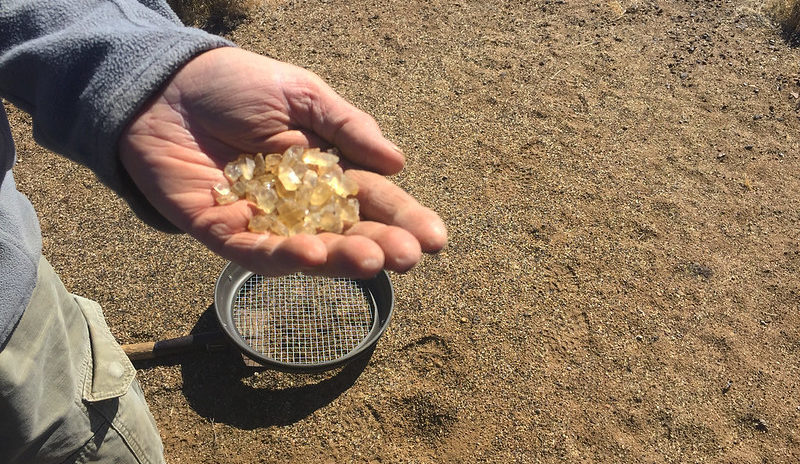
Oregon sunstone is real, beautiful, and possible to collect legally—but “free” needs an important asterisk. The Oregon Sunstone Public Collection Area near Plush is open for casual collecting on marked public land. It is also remote high desert, and private mining claims surround the area and occur within it. A sunstone trip starts with knowing exactly where you are, not with a shovel.
What makes Oregon sunstone special?
Oregon sunstone is the state gemstone: a feldspar crystal weathered from ancient lava flows in south-central Oregon. Some stones are clear or pale champagne; others show flashes of red, orange, green, or coppery shimmer. The variety is part of the fun. Most first-time collectors find small, subtle stones rather than jewelry-grade gems, but that makes a good find feel even better.
For geology background, the Oregon Department of Geology and Mineral Industries identifies sunstone as Oregon’s state gemstone and confirms that it may be collected on BLM land near Lakeview—subject to the limits and land-status rules that apply.
Where can you collect Oregon sunstones?
The most dependable public starting point is the Oregon Sunstone Public Collection Area in Rabbit Basin near Plush. Its boundaries are marked by orange posts and BLM boundary markers. Stay inside the marked public collection area and confirm the current map, access, weather, and fire restrictions before leaving pavement.
This is not permission to collect throughout “sunstone country.” The BLM specifically warns that private mining claims surround the public area and that several claims are within it. Do not collect from a private claim without the claimant’s permission. If a boundary is unclear, leave the material where it is and verify it with the BLM rather than guessing.
What does “free collecting” actually mean?
On eligible BLM land, casual noncommercial collecting of a reasonable amount of common rocks and minerals generally does not require a fee or permit. The current BLM guide describes that as material that fits in a car trunk or partial pickup load, weighs less than 250 pounds, and is for personal—not commercial—use. Larger amounts, commercial use, power equipment, or other intensive activity require authorization.
Those general rules do not override a mining claim, a closure, a posted restriction, private property, tribal lands, state parks, or a different land manager’s rules. Read the BLM Oregon and Washington Rock Collecting Guide before you go and treat it as the decision-maker when an older article, map pin, or social post disagrees.
Plan for a real high-desert outing
Rabbit Basin is remote. Carry more drinking water than you think you will need, fuel up before leaving the main highway, download offline maps, bring a full-size spare and basic tire gear, and tell someone your route and expected return. Cell service can be unreliable. Conditions on unpaved roads can change quickly after rain, snow, or heavy use.
Pack eye protection, gloves, a hand lens, a small scoop or hand tool, containers for your finds, sun protection, and layers. Avoid creating pits, damaging vegetation, or leaving a scarred collection site. A responsible collection trip leaves the place looking as though you were never there.
Fee digs and private mines are a separate plan
Several private sunstone operations in the Plush area have offered fee-dig experiences over the years. Their season, reservations, prices, road access, and rules can change, so do not assume an older article or social listing is current. Contact an operator directly before driving out, and do not cross onto a claim simply because a fee-dig business exists nearby.
How to make the trip worthwhile
Go expecting a day in remarkable Oregon high desert, not a guaranteed pocket of gem-quality stones. Look slowly in loose material, learn what raw feldspar crystals can look like, and save your best pieces for a closer inspection in good light. A lapidary club, rock shop, or experienced collector can help you identify and cut material after the trip.
For a broader trip-planning map, see our Rockhounding Oregon guide. If you are sorting out geodes, thundereggs, crystals, and gemstones, start with our Oregon geodes and gemstones guide. Both resources should be paired with the current land-manager rules for the exact place you intend to collect.