
A four-day effort off the Oregon Coast ended with a young humpback whale finally swimming free after becoming trapped in thousands of feet of fishing gear, but the rescue came with a heartbreaking complication. Marine mammal experts say the whale suffered a severe injury to its jaw during the entanglement, and the damage may leave it unable to feed normally.
The whale was discovered July 23 roughly 20 miles west of Newport, where the Pacific drops quickly into deep water beyond Oregon’s central coast. What began as an unusual sighting from the air soon turned into a complicated rescue operation involving researchers, marine mammal specialists, Coast Guard support and a Newport fishing crew willing to help haul an enormous amount of gear from the ocean.
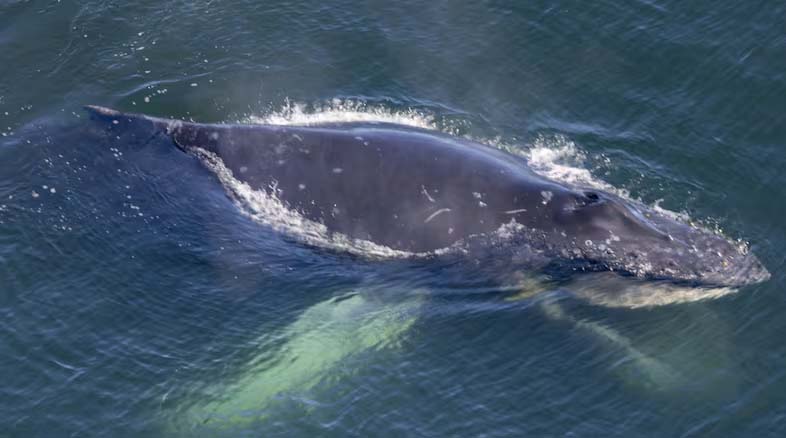
Oregon State University research assistant Craig Hayslip first spotted the whale while aboard a U.S. Coast Guard helicopter during a survey focused on whales and fishing equipment along the coast. From above, it was clear the animal was in trouble. The whale appeared to be restrained by heavy gear extending below the surface, rather than simply carrying a loose rope or buoy.
The condition of its mouth immediately raised alarm. Jim Rice, who manages Oregon State University’s Oregon Marine Mammal Stranding Network, told OPB that the whale’s jaw was opened far beyond what responders would expect to see naturally. The angle alone suggested something was badly wrong.
Investigators later determined that a line passed through the whale’s mouth and extended roughly 400 feet downward. The gear appeared to be connected to the seafloor, effectively anchoring the humpback in place while placing tremendous pressure on its jaw.
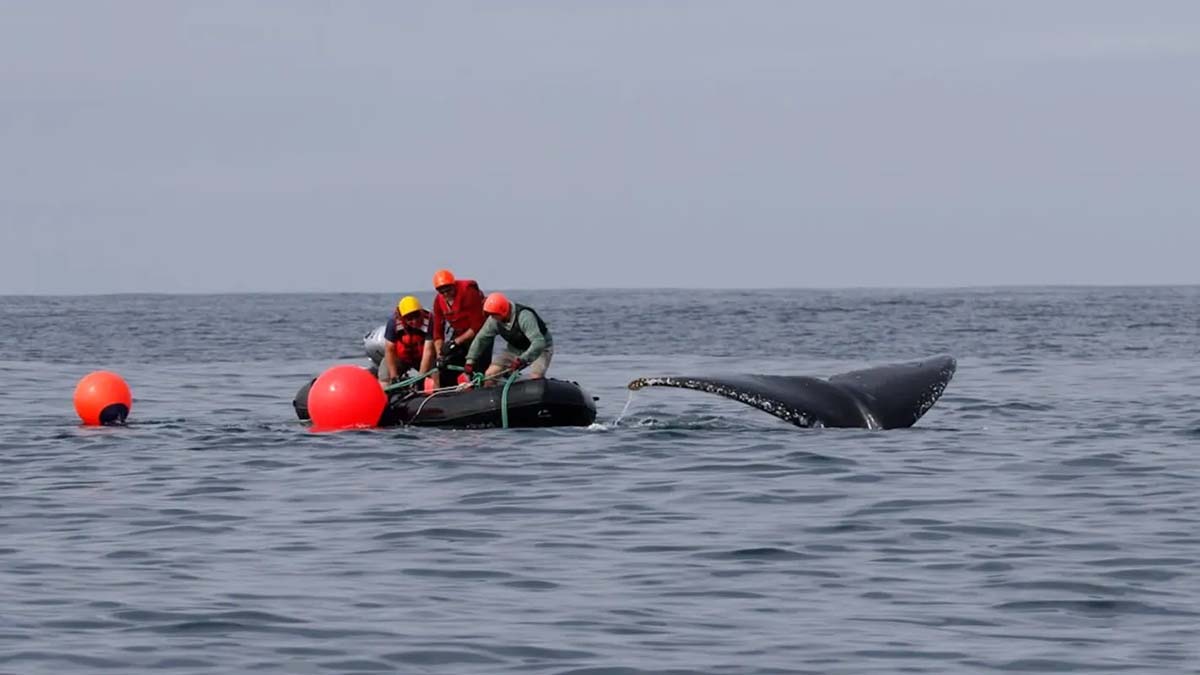
Freeing an animal that large from that kind of entanglement is dangerous work. Humpback whales can weigh tens of thousands of pounds, and crews must maneuver close enough to cut ropes without becoming tangled themselves or being struck by a suddenly moving whale. Heavy fishing gear beneath the surface adds another layer of risk, particularly when crews cannot immediately see how the lines are wrapped around the animal.
The response ultimately stretched over four days and brought together personnel from Oregon and Washington. Responders associated with Oregon State University’s Marine Mammal Institute and the Oregon Coast Aquarium had previously trained with Cascadia Research Collective for situations like this, while funding from the Oregon Wildlife Foundation helped provide specialized safety and response equipment.
A local fishing crew also became essential to the operation. Newport fisherman Poggy Lapham and the crew of the F/V Michele Ann helped lift the submerged gear from their larger vessel, giving responders in a smaller boat the access they needed to reach the lines trapping the whale.
On July 26, after days of work, rescuers were finally able to cut the humpback free.
The success, however, was immediately tempered by concern over the whale’s condition. NOAA Fisheries said the animal’s jaw remained permanently open after the gear was removed. If the whale cannot close or properly use its mouth, it may be unable to eat enough to survive.
That is particularly serious for a humpback whale, which depends on consuming large quantities of small fish and krill during its feeding season. Humpbacks typically open their enormous mouths to engulf prey and seawater before pushing the water back out through their baleen. A major jaw injury could interfere with that process and leave the animal unable to take in the calories it needs.
After the whale was released, the Michele Ann’s crew continued pulling equipment from the water. By the time the recovery effort was finished, more than 3,000 feet of line had been brought aboard along with five sablefish pots and Dungeness crab traps associated with Oregon and Washington.
NOAA officials said the condition of the equipment suggested that some or all of it may have been lost or abandoned gear rather than equipment that fishermen were actively tending at the time of the entanglement. The agency is now working to identify and contact owners connected to the recovered gear.
Lost fishing gear presents a particularly difficult problem because it can remain in the ocean long after it disappears from the people who originally deployed it. Lines can break during rough weather, buoys can become separated from traps, and equipment can snag on the bottom or be moved by currents. Once that happens, the gear may continue drifting or sitting beneath the surface where marine animals can encounter it.
Determining exactly where lost gear came from can also be difficult. Some types of equipment do not carry identification that makes ownership immediately obvious, particularly after gear has been damaged or separated from its original configuration.
The incident off Newport comes amid broader concern over whale entanglements along the West Coast. According to OPB, more than 30 humpback whales were confirmed entangled in fishing gear in 2025. The actual number of whales affected is likely difficult to know because many incidents happen far offshore and are never seen.
For Oregon, the issue is especially complicated because some of the richest feeding grounds for humpback whales overlap with productive commercial fishing areas. Whales are a familiar summer sight along the coast, sometimes appearing just offshore from places such as Depoe Bay, Cape Foulweather and Cape Perpetua as they follow schools of fish through nutrient-rich coastal waters.
Those same waters are also part of Oregon’s working coast. Commercial fishing has supported generations of families in communities from Astoria to Brookings, making the search for solutions less about choosing one side over another and more about finding ways to reduce the risk to whales without ignoring the livelihoods tied to the ocean.
Many humpbacks feeding off Oregon during the summer belong to the mainland Mexico population, according to NOAA spokesperson Michael Milstein. Those whales travel north to feeding areas along Oregon, Washington and California before returning south to breeding grounds near Mexico.
That population remains listed as threatened under the Endangered Species Act. NOAA estimates roughly 7,000 humpback whales are part of the broader coastal group found off Oregon, California and Washington.
The Newport rescue is also expected to become part of the ongoing effort to understand how entanglements occur and how they might be prevented. NOAA Fisheries created a West Coast Take Reduction Team in 2025 that includes commercial fishermen, tribal representatives, scientists, conservation organizations and fishery managers.
The group is working on recommendations aimed specifically at reducing humpback whale entanglements involving sablefish pot gear. The Newport case will be examined alongside another incident from July 7 in which a humpback whale died off Oregon after becoming entangled in sablefish equipment.
Lapham, whose fishing crew played such an important role in freeing the Newport whale, said the situation should prompt serious discussion within the industry about improving the tracking and recovery of lost gear. Better incentives for retrieving equipment, along with improved methods of identifying and locating gear that disappears, could potentially reduce the amount of dangerous equipment left in the water.
For NOAA responders, the rescue was both a success and a painful reminder of how much damage can occur before anyone realizes a whale is in trouble. Lauren Saez, who helped coordinate the response for NOAA Fisheries, described the case as heartbreaking because of the animal’s injuries while also emphasizing how much could be learned from the recovery of the gear and the cooperation between scientists, responders and fishermen.
That cooperation may ultimately be one of the most important parts of the story. The whale was freed because researchers spotted it, trained responders were able to mobilize, and a working Oregon fishing crew provided the equipment and experience necessary to bring thousands of feet of heavy gear back to the surface.
Whether the young humpback survives its injuries remains uncertain. What crews do know is that without the rescue effort, the whale would have remained trapped offshore with little chance of escaping on its own.
For anyone who has stood on the Oregon Coast and watched a humpback surface beyond the breakers, sending a burst of mist into the air before slipping beneath the Pacific again, stories like this are a reminder of how much is happening just beyond what we can see. Somewhere beyond Newport, one young whale was given another chance to swim free. Now the hope is that what responders learned from its rescue can help keep others from becoming trapped in the first place.