
There are places in Oregon where the scenery is beautiful, and then there are places where you step out of the car and briefly wonder whether the road has somehow carried you off the planet.
Dee Wright Observatory is absolutely that second kind of place.
Sitting high in the Cascade Range, the observatory rises from an enormous field of black volcanic rock along the historic McKenzie Highway. There are no green lawns, neatly planted flower beds, gift shops, or crowds lining up for tickets.
Instead, there is lava.
Miles and miles of jagged, dark, frozen lava.
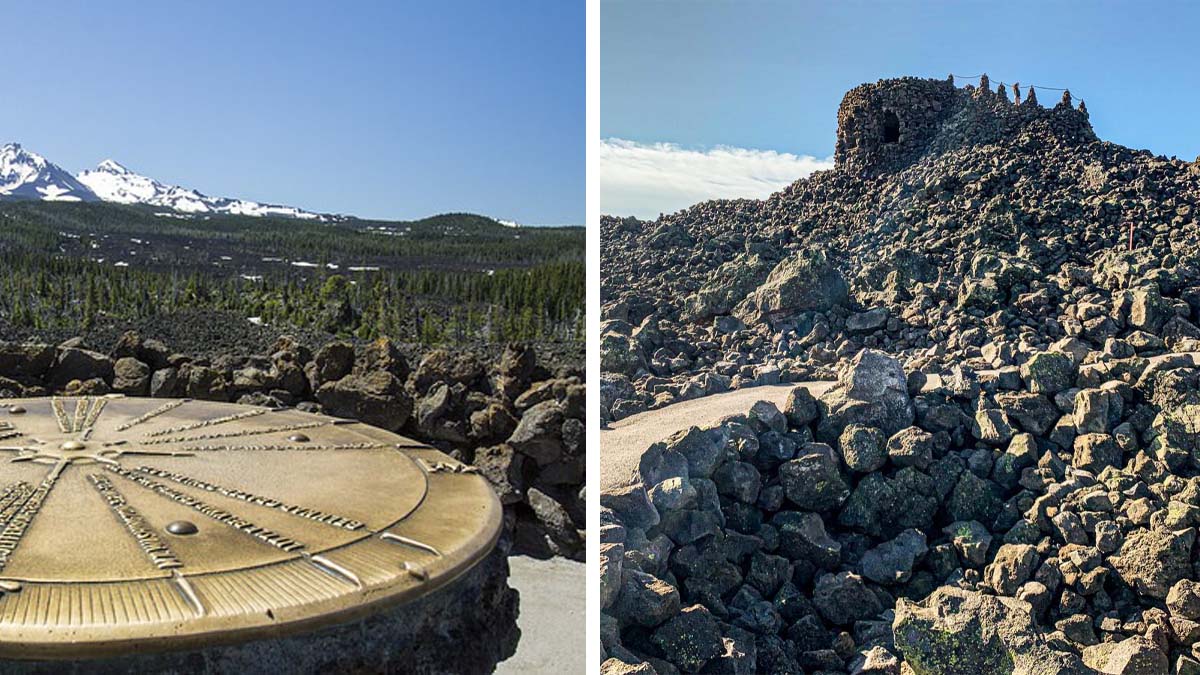
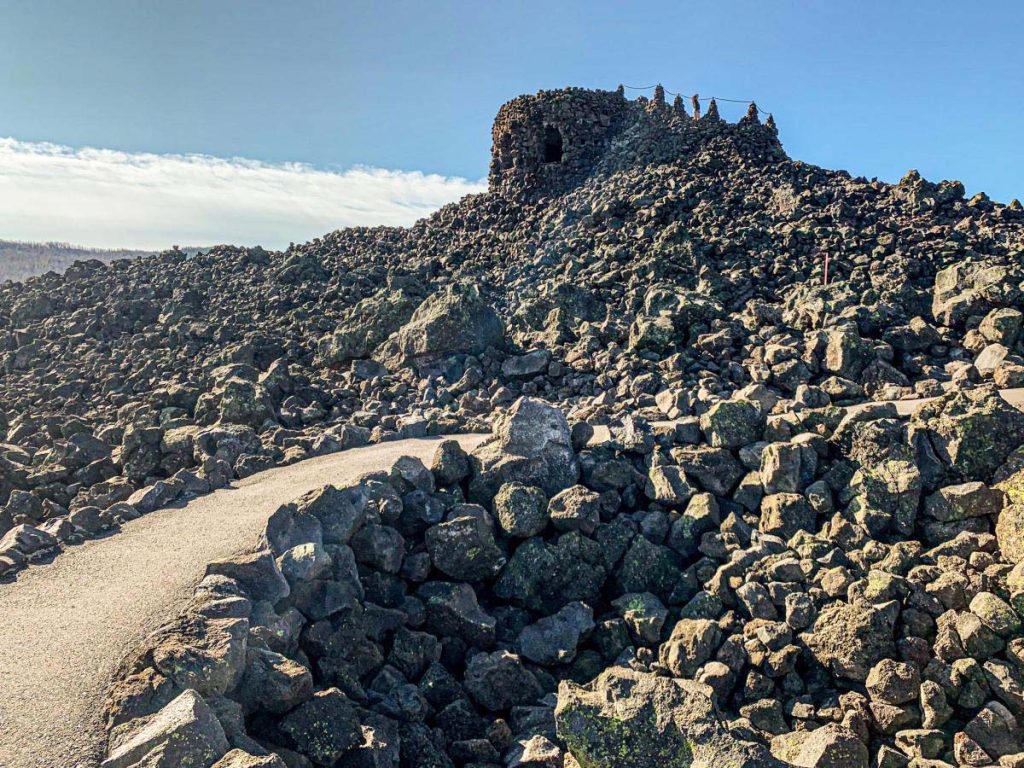
In the middle of it all stands a circular stone tower that looks like something between an ancient fortress and a castle built on the moon.
The observatory was constructed from the same rough lava covering the surrounding landscape, which makes it seem as though it grew directly out of the volcanic field. Small openings in its thick walls frame distant mountains, while a staircase leads to the roof and a panoramic view of some of Oregon’s most recognizable Cascade peaks.
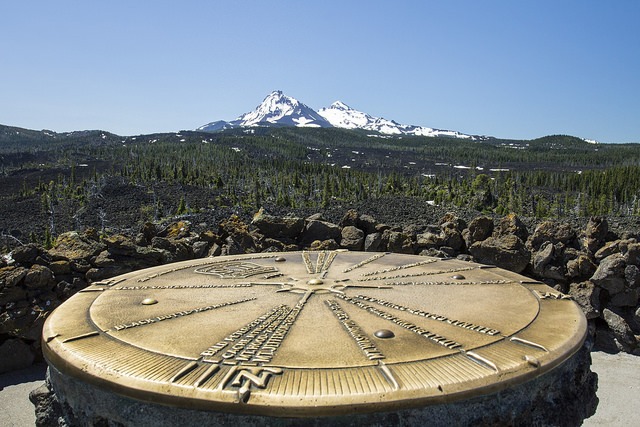
On a clear day, visitors may see Mount Washington, Mount Jefferson, North Sister, Middle Sister, South Sister, and even Mount Hood far to the north.
It is one of those rare roadside stops where the attraction is impressive, but the landscape around it is even bigger.
And after spending the winter behind locked gates, Dee Wright Observatory is once again accessible for the 2026 summer travel season.
McKenzie Pass Is Officially Open For The 2026 Season
Oregon’s historic McKenzie Highway, also known as Oregon Route 242, reopened to vehicles on June 15, 2026.
That matters because Dee Wright Observatory cannot normally be reached by car during the winter. Snow, rapidly changing mountain weather, steep terrain, tight curves, and the cost of maintaining the old highway force the Oregon Department of Transportation to close the route every year.
The highway typically closes sometime in the fall and does not reopen until June, or occasionally later if snow and road conditions cause delays.
When the gates finally swing open, the road becomes one of Oregon’s most extraordinary seasonal drives.
The highway passes through dense forest before suddenly emerging into a volcanic world where black lava stretches toward the horizon. The change is so abrupt that it feels like crossing an invisible border between two completely different landscapes.
For the 2026 season, the route is currently open to traffic. Visitors should still check TripCheck before leaving home because weather, wildfire activity, maintenance work, or other unexpected conditions can affect access.
This is a high-elevation mountain road, and conditions can change surprisingly quickly even in summer.
The official That Oregon Life store
The Oregon you bring home.
Start the day with Oregon-roasted coffee, then find original gear inspired by the places, stories, and oddities that make this state ours.
Shop Oregon gear


A Roadside Stop That Feels Nothing Like A Roadside Stop
Dee Wright Observatory is easy to underestimate when looking at it on a map.
It may appear to be a simple viewpoint beside a scenic highway, somewhere to stretch your legs, take a quick photo, and continue toward Sisters or the McKenzie River.
But the moment you arrive, it becomes clear that this is much more than another pullout.
The parking area sits within a landscape covering roughly 65 square miles of lava rock. The field appears almost endless in places, rolling away in dark waves broken only by a few stubborn trees and distant volcanic peaks.
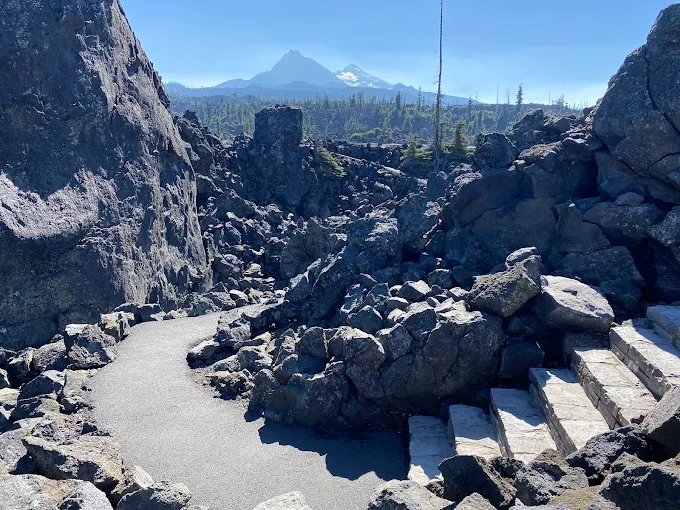
The lava is sharp, uneven, and chaotic. Some sections look like heaps of broken glass turned black. Others resemble a river that froze in place while tumbling across the mountains.
Then you look up and see the observatory.
Built from dark volcanic stone, the structure blends into the landscape so completely that it can initially be difficult to separate the walls from the surrounding rocks.
It does not feel like a building placed in nature.
It feels like part of the eruption.
A paved path winds upward from the parking area, passing interpretive panels that explain the landscape, the people who crossed it, and the volcanic forces that created it.
As you approach the tower, the views begin opening in every direction.
This is where most visitors slow down.
The observatory is not huge, but it rewards curiosity. Walk inside. Look through the openings in the walls. Climb to the top. Read the peak finder. Then turn around and look back across the lava.
Every few steps seem to reveal a different mountain.
The Windows Were Designed To Frame Oregon’s Mountains
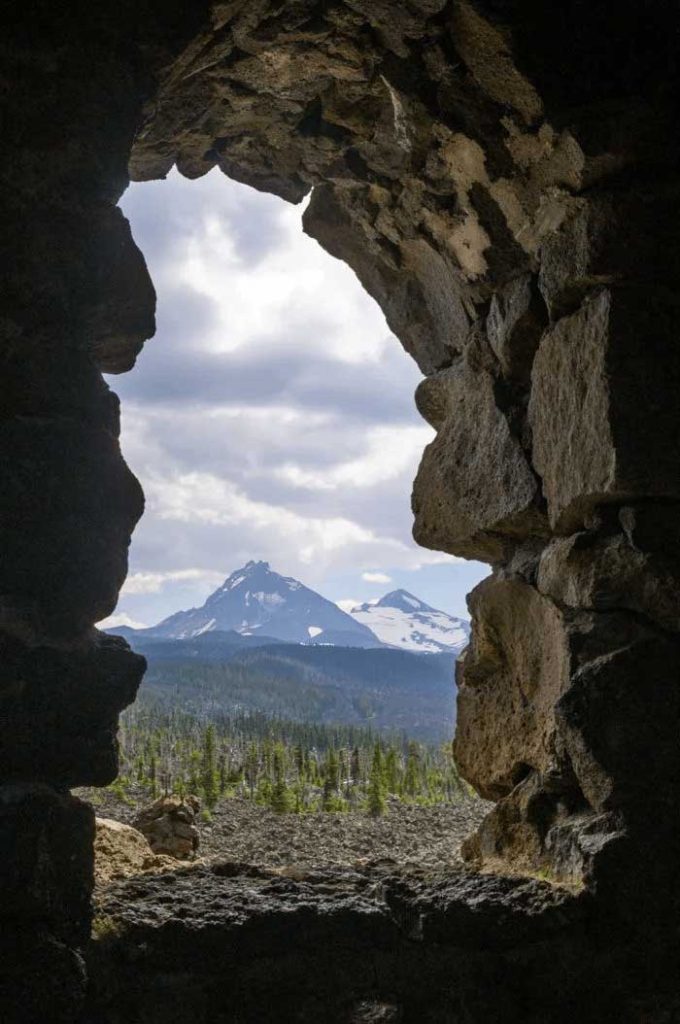
The openings inside Dee Wright Observatory are not random holes in an old stone wall.
They were intentionally positioned to frame specific mountains and geographic features.
Standing inside the dark, cool structure and looking through one of these openings is almost like viewing Oregon through a stone picture frame.
One window may reveal Mount Washington. Another points toward one of the Three Sisters. On especially clear days, visitors may be able to spot Mount Hood nearly 80 miles to the north.
The contrast is part of what makes the experience so memorable.
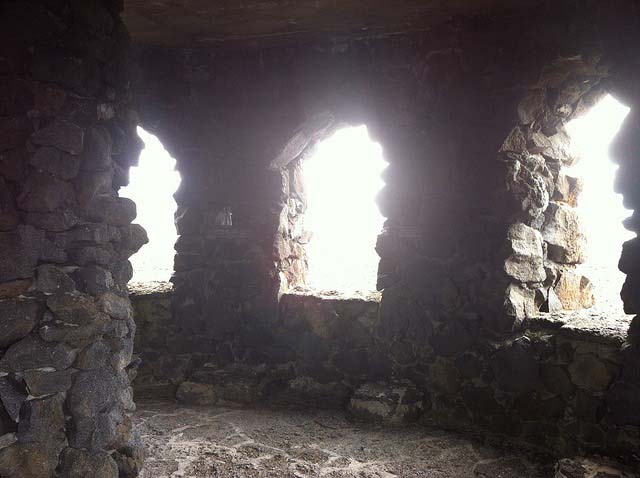
Inside, everything is dark, rough, and close. Beyond the windows, bright mountain peaks rise above a seemingly endless volcanic landscape.
Continue up the stairs and you will reach the roof, where a bronze peak finder identifies the surrounding mountains, buttes, craters, and other features.
The roof offers the widest view, but the framed windows inside may be the most memorable part of the observatory.
They turn the surrounding Cascades into individual portraits.
It is also worth remembering that visibility here can change dramatically. Clouds, wildfire smoke, haze, and passing storms may hide mountains that would otherwise dominate the view.
Even when the highest peaks disappear, the lava field alone makes the stop worthwhile.
The Lava Is The Real Star Of The Show
The observatory gets most of the attention, but the lava beneath it is the reason this place exists.
Dee Wright Observatory stands on a flow associated with Yapoah Cone, one of the many volcanic features scattered across this section of the Cascades. The flow is believed to be roughly 2,000 to 3,000 years old and overlaps older lava from the Little Belknap area.
Geologically speaking, that makes this a relatively young landscape.
The type of rock found here is commonly described as a’a lava, pronounced “ah-ah.” It forms when the outer surface of a lava flow cools and breaks apart while hotter material continues moving underneath.
The result is exactly what visitors see today: a rough, jagged surface filled with sharp fragments and broken blocks.
Looking at it, you can almost imagine the lava moving.
It is easy to think of mountains as permanent and unchanging, but Dee Wright Observatory offers a reminder that Oregon is still a volcanic place. The Cascades were shaped by eruptions, glaciers, water, fire, and time, and much of that history remains visible from this single roadside stop.
The lava has barely begun to soften.
Lichens add patches of color to the rocks. Small trees rise from unlikely cracks. Plants survive in tiny pockets where soil has slowly collected.
Life is returning, but it is doing so on volcanic time.
That struggle between black rock and new growth is one of the most fascinating things to watch while walking around the observatory.
The Observatory Was Built During The Great Depression
Dee Wright Observatory was completed in 1935 by workers from the Civilian Conservation Corps.
The CCC was one of the most recognizable programs created during the Great Depression. Young men were put to work building trails, campgrounds, roads, shelters, fire lookouts, and other public projects across the country.
Many of the structures they built remain standing in Oregon today, but few are as immediately recognizable as Dee Wright Observatory.
The tower was designed by William N. Parke, a Forest Service landscape architect who believed recreation facilities should fit naturally into their surroundings.
That philosophy is easy to see here.
Rather than importing polished stone or building a wooden viewing platform above the lava, workers used volcanic rock gathered from the site. The result is a structure that seems inseparable from the landscape.
Its thick walls, irregular stones, narrow openings, and circular shape give it the appearance of something far older than it really is.
It feels medieval.
It feels prehistoric.
It feels as if someone discovered it rather than built it.
The craftsmanship becomes even more impressive when you consider the conditions faced by the crew. This is a high mountain pass with harsh weather, rough terrain, and a short construction season.
The builders were not working beside a modern highway filled with supply trucks and heavy equipment. They were creating a lasting public landmark in a remote lava field during one of the most difficult periods in American history.
Nearly a century later, people still pull over every summer to walk through their work.
Who Was Dee Wright?
The observatory was named in memory of Dee Wright, a longtime Forest Service employee, packer, guide, and Civilian Conservation Corps foreman.
In the Forest Service’s early years, packers played a critical role in getting supplies, tools, food, firefighting equipment, and building materials into remote mountain country.
Much of that work depended on horses and mules.
Dee Wright reportedly spent more than two decades working in Oregon’s forests. He helped move supplies into difficult terrain, worked on trails and remote structures, and became known for the stories he shared with younger workers.
He died in 1934, one year before the observatory was completed.
Naming the tower for him turned the project into something more personal than a scenic viewpoint. It became a memorial to one of the people whose work helped make Oregon’s remote forests accessible.
Visitors often focus on the dramatic building and mountain views, but Wright’s story adds another layer to the place.
The observatory honors the people who did the difficult, largely unseen work behind Oregon’s trails, lookouts, roads, and mountain camps.
NASA Once Brought Astronauts To This Oregon Lava Field
The landscape surrounding Dee Wright Observatory looks so much like another world that NASA once used the area for astronaut training.
In 1964, astronauts conducted field exercises in Oregon’s volcanic terrain while preparing for future missions to the moon.
That detail sounds almost too perfect to be true until you stand among the lava.
The ground is dark, broken, exposed, and nearly treeless in places. Sharp rocks cover the landscape. Mountain weather can change quickly, and the open terrain offers little protection from sun or wind.
With the observatory rising from the lava like a small stone outpost, the entire scene can feel more like the setting of a science fiction movie than a location in the Oregon Cascades.
The NASA connection has become one of the most repeated stories about Dee Wright Observatory, and for good reason.
Children love it.
Adults love it.
Even people who normally skim interpretive signs tend to stop when they see the words “NASA” and “astronauts.”
It also gives families a fun way to talk about geology. This is not simply a pile of old rocks beside a highway. It is a landscape that helped scientists and astronauts study volcanic terrain before humans traveled to the moon.
That makes Dee Wright Observatory one of the few places where Oregon history, natural history, and space exploration all meet in the same lava field.
Walk Through The Lava On The Interpretive Trail
Visitors who have a little extra time should walk the Lava River National Recreation Trail beside the observatory.
The paved interpretive route travels for approximately half a mile through the volcanic landscape.
It is short enough to fit easily into a road trip, but long enough to provide a much closer look at the lava formations.
From the parking area, it is easy to view the lava as one massive black field. On the trail, the details become more noticeable.
You begin seeing the different shapes in the rock.
You notice tiny patches of lichen.
You find trees growing from places where survival appears impossible.
Interpretive signs explain the geology and help visitors understand how lava moved, cooled, cracked, and created the strange formations visible along the route.
The trail also creates a sense of scale that is difficult to appreciate from the observatory alone.
The stone tower may look dominant from the parking area, but once you walk farther into the lava, it becomes a small object surrounded by an enormous volcanic landscape.
The paved surface makes the route approachable for many visitors, although the Forest Service notes that grades and drop-offs can make portions difficult for wheelchair users. A short section near the back of the route is not barrier-free.
This is also not a place to wander freely across the rocks.
The lava is sharp, unstable, and capable of causing serious injuries. Stay on designated paths, keep children close, and resist the urge to climb across loose formations for a photo.
Accessibility Has Improved Since The Observatory Was Built
The observatory was renovated in 2003 to improve accessibility.
A paved route connects designated parking with interpretive panels and the main level of the structure. Visitors can enter the observatory and experience the framed mountain views without climbing the stairs.
The roof, however, is only accessible by staircase.
The nearby Lava River Trail is paved, but the Forest Service classifies it as challenging for some wheelchair users because of grades, drop-offs, and the non-accessible hiker loop near the far end.
Conditions may also feel more difficult because the landscape is completely exposed.
There is very little shade. Wind can be strong. Summer sun reflects from the rocks, and temperatures may feel warmer than expected even at higher elevation.
Visitors with mobility concerns should take their time and decide how far they are comfortable traveling.
The good news is that some of the best views begin almost immediately. You do not have to complete the full trail or climb to the roof to appreciate the place.
The Drive Is Half The Experience
Dee Wright Observatory sits along the McKenzie Pass-Santiam Pass National Scenic Byway, one of Oregon’s most dramatic mountain drives.
The full byway travels through an extraordinary range of landscapes.
On the western side of the Cascades, the road passes beneath towering Douglas fir and western red cedar. The forest feels deep, green, and damp.
As the highway climbs toward McKenzie Pass, the trees begin to thin.
Then the lava appears.
The change is startling.
One moment you are driving through dense forest, and the next the road twists between massive black volcanic flows with mountains rising in the distance.
On the eastern side, the landscape becomes drier as the highway descends toward Sisters.
It is one of the best examples in Oregon of how quickly climate and geography change across the Cascade crest.
The road itself is historic, narrow, and winding. It follows the path of an early wagon route and later became one of Oregon’s first automobile routes across the mountains.
Modern travelers should not expect a fast highway.
There are tight corners, limited shoulders, cyclists, pedestrians, scenic pullouts, and sections where slowing down is part of the experience.
Vehicles longer than 35 feet are prohibited, and the highway is not suitable for trailers or large recreational vehicles.
This is not the road for rushing.
It is the road for rolling down the windows, watching for bikes, stopping at overlooks, and letting the landscape unfold slowly.
Turn The Stop Into A Full Oregon Day Trip
Dee Wright Observatory can be enjoyed as a quick roadside visit, but the surrounding area makes it easy to build a full day around it.
Travelers approaching from Central Oregon can begin in Sisters, pick up coffee or breakfast, and then follow Highway 242 west into the mountains.
The observatory is approximately 15 miles from Sisters, but the winding road and frequent views make the drive feel like an adventure of its own.
After visiting the observatory, continue west toward the McKenzie River corridor. Depending on trail conditions and available time, travelers may add a stop at Proxy Falls, explore the upper McKenzie River, or visit waterfalls and lakes along Highway 126.
Proxy Falls is one of the most popular hikes along Highway 242, but the trailhead has limited parking and requires a separate day-use fee or an accepted recreation pass.
Travelers coming from the Eugene and Springfield area can approach from the opposite direction, driving east along the McKenzie River before turning onto Highway 242.
This route builds slowly from river country into forest and eventually reaches the open lava fields at the pass.
Another option is to make a loop by traveling over McKenzie Pass, continuing through Sisters, and returning by way of Santiam Pass.
The complete scenic byway is approximately 82 miles and deserves several hours, especially when stops, hikes, waterfalls, food, and photographs are included.
The Best Time To Visit Dee Wright Observatory
The observatory’s season is controlled almost entirely by the highway.
In most years, vehicle access begins around the middle of June and continues until fall snow causes ODOT to close the gates again.
July through early October generally provides the most reliable window, but every visit is different.
Early summer may bring lingering snow on distant peaks, cool mornings, wildflowers in surrounding forested areas, and powerful contrasts between black lava and white mountains.
Late summer often brings warmer weather and clearer roads, although wildfire smoke can reduce visibility.
Early fall can be especially beautiful. The air is often cooler, crowds begin thinning, and autumn colors appear in the forest below the pass.
Weekday mornings are usually a good choice for visitors hoping for a quieter experience.
Sunrise and early morning light can be beautiful, but mountain temperatures may be surprisingly cold. Afternoon light can bring out the texture in the lava, although the exposed rocks can become hot under direct summer sun.
Cloudy weather should not automatically ruin the trip.
You may lose some distant mountain views, but fog and low clouds can make the observatory look even more mysterious. The stone tower emerging from dark lava beneath a gray sky has an entirely different mood than it does on a bright summer afternoon.
What To Know Before Visiting In 2026
Dee Wright Observatory is free to visit. No reservation is required.
Vault toilets are available, but there is no potable water at the site. There are also no picnic tables, restaurants, stores, or fuel stations at the observatory.
Bring drinking water before heading up the pass.
Cell service can be unreliable or nonexistent, so download maps and save important information before leaving town.
Dogs are allowed in the developed recreation area but must be physically controlled or kept on a leash no longer than six feet.
Weather can change quickly at the pass. Even when Sisters or the McKenzie River valley feels warm, the observatory may be windy, cold, cloudy, or wet.
Bring a layer.
Use sun protection. The lava field provides almost no shade, and sunlight reflecting from the open rock can be intense.
Wear sturdy shoes, especially if you plan to walk the interpretive trail. The main route is paved, but the surrounding volcanic terrain is unforgiving.
Drive slowly and watch carefully for cyclists. McKenzie Pass is part of a designated scenic bikeway, and riders frequently use the narrow highway.
Most importantly, check TripCheck and Forest Service alerts before your trip. The highway is open for the 2026 season, but wildfire closures, severe weather, maintenance work, or other hazards can change conditions.
Quick Visitor Information
Location: McKenzie Pass on Oregon Route 242
2026 road status: McKenzie Highway reopened to vehicles on June 15, 2026
Elevation: Approximately 5,187 feet at the observatory
Admission: Free
Reservations: Not required
Restrooms: Vault toilets
Drinking water: Not available
Picnic tables: Not available
Dogs: Allowed under physical control or on a leash no longer than six feet
Accessibility: Paved route to the main observatory level; stairs are required to reach the roof
Nearby walk: Half-mile Lava River National Recreation Trail
Vehicle restrictions: Vehicles longer than 35 feet are prohibited; trailers and large recreational vehicles are not recommended
Season: Generally mid-June through fall, depending on snow and highway conditions
Ranger station: McKenzie River Ranger Station, 541-822-3381
Why Dee Wright Observatory Still Belongs On Your Oregon Bucket List
Dee Wright Observatory does not need a thrill ride, guided tour, expensive ticket, or elaborate visitor center to make an impression.
The landscape does all the work.
You arrive by way of an old mountain highway.
The forest suddenly falls away.
Black lava stretches toward the horizon.
A stone tower rises from the rocks.
Inside, small windows frame snow-covered mountains. Above, a bronze marker points toward peaks, craters, buttes, and a volcanic history much older than Oregon itself.
Then there are the human stories.
The Civilian Conservation Corps workers who built the observatory during the Great Depression.
The Forest Service packer whose name it carries.
The early travelers who struggled across McKenzie Pass.
The astronauts who came to this Oregon lava field while preparing for the moon.
All of those stories exist together in one extraordinary roadside stop.
That is what makes Dee Wright Observatory special.
It is historic without feeling trapped in the past.
It is accessible without feeling overly developed.
It is strange, beautiful, harsh, and unmistakably Oregon.
You may arrive expecting to spend 15 minutes.
Then you walk through the tower, look through one of the stone windows, follow the trail into the lava, and realize an hour has disappeared.
Some Oregon attractions impress you because of what people built.
Others impress you because of what nature created.
Dee Wright Observatory gives you both.
And for a few brief moments, standing above a black volcanic landscape with the Cascade peaks lining the horizon, it may feel as though Oregon has carried you somewhere far beyond Earth.