Short answer: Polybius was almost certainly never a real 1981 arcade game. No verified cabinet, game file, manufacturer record, contemporary news report, or credible firsthand witness has ever surfaced. The legend appeared online roughly two decades later—but several real and unusually eerie events in Portland’s 1981 arcade scene may explain why the story still feels believable.
The famous version of the story says a black arcade cabinet called Polybius appeared in a handful of Portland-area arcades. Players supposedly suffered nightmares, memory loss, nausea, seizures, and an irresistible urge to keep playing. Mysterious men in dark suits visited the machines to collect data, then every cabinet vanished.
It is a terrific Oregon mystery. It is also, based on all available evidence, an internet-age urban legend assembled from real history, gaming culture, and Cold War paranoia.
Polybius at a glance
- What it is: An urban legend about a secret, psychologically dangerous arcade game.
- Alleged place and date: Portland-area arcades in 1981.
- Alleged manufacturer: Sinneslöschen, a company for which no credible record has been found.
- Alleged effects: Addiction, nightmares, amnesia, hallucinations, nausea, headaches, and seizures.
- Evidence an original game existed: None that has been independently verified.
- Earliest commonly cited trace: A Coinop.org listing carrying a 1998 date, although researchers dispute when that page actually appeared publicly.
- Most likely explanation: Modern folklore that blended real Portland arcade incidents, a federal gambling investigation, fear of new technology, and older government mind-control stories.
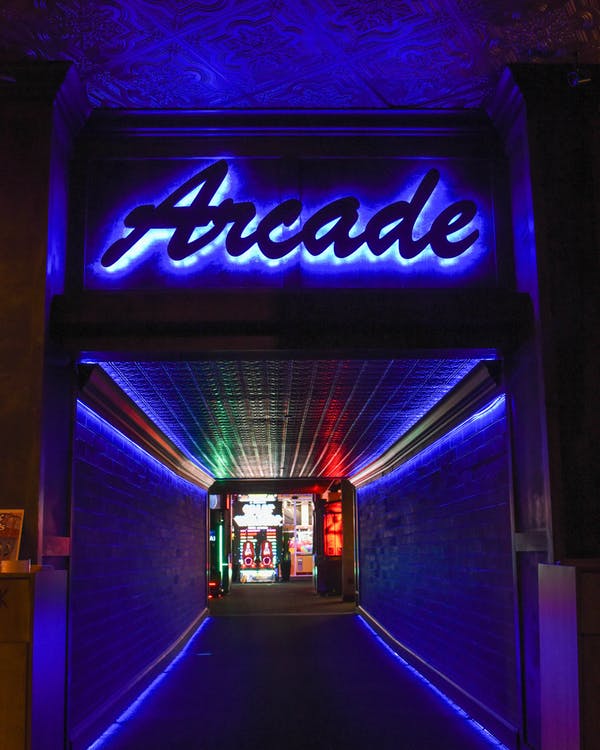
A neon-lit arcade entrance. Portland’s early-1980s arcade culture gave the Polybius story a believable setting.
The official That Oregon Life store
The Oregon you bring home.
Start the day with Oregon-roasted coffee, then find original gear inspired by the places, stories, and oddities that make this state ours.
Shop Oregon gear


What is the Polybius legend?
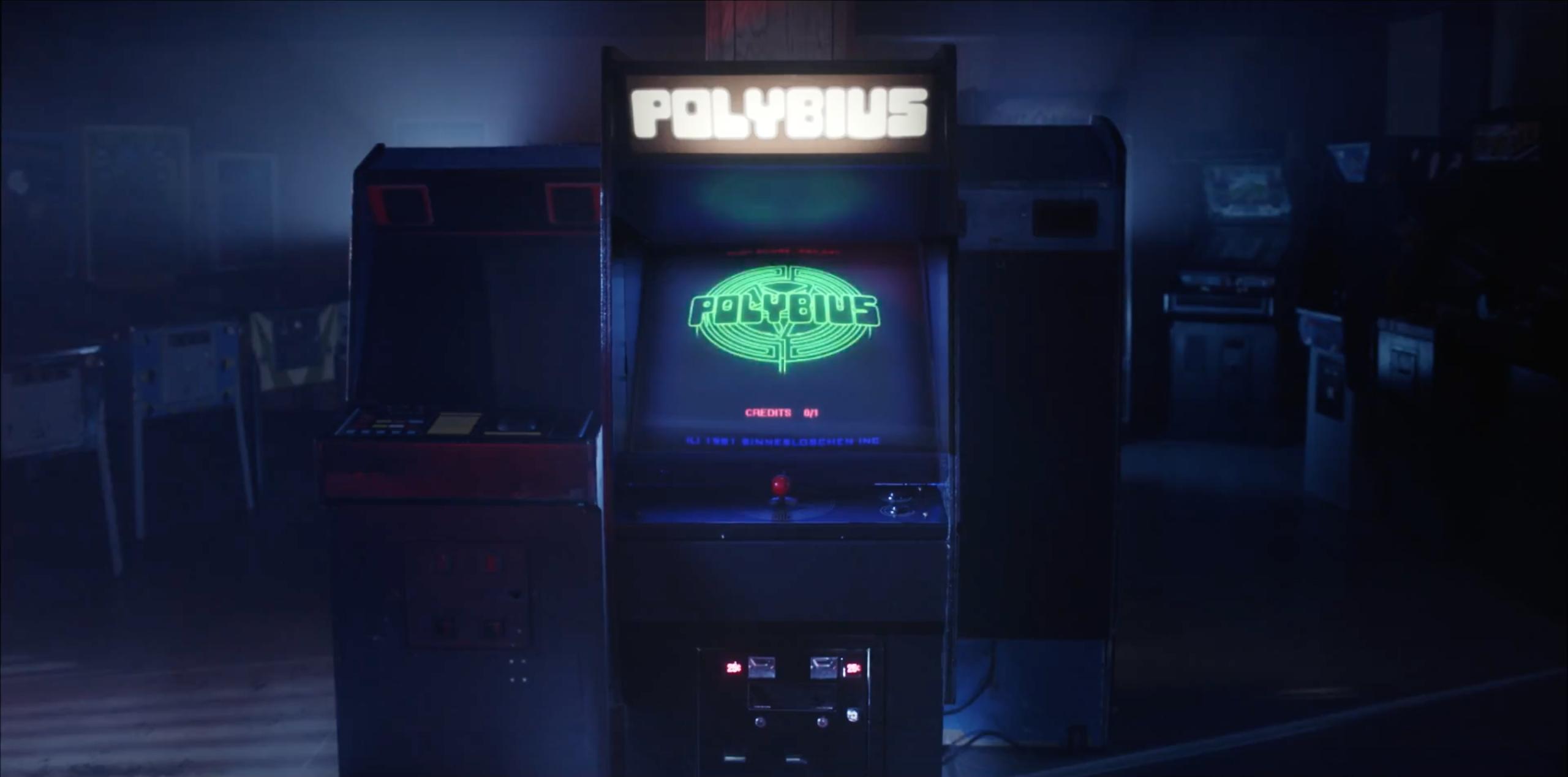
According to the story, Polybius appeared without warning in one or more suburban Portland arcades in 1981. The cabinet was usually described as plain and black, with little more than the name Polybius across its marquee.
No two accounts agree on what the game looked like. Some describe a fast vector shooter resembling Atari’s Tempest. Others remember mazes, puzzles, tunnels, flashing geometric shapes, or subliminal messages. That inconsistency eventually became part of the mythology: players supposedly could not remember the game clearly because it had altered their minds.
The alleged side effects grew more dramatic as the story spread. Players were said to experience headaches, nausea, insomnia, nightmares, memory loss, hallucinations, seizures, suicidal thoughts, or total psychological collapse. Meanwhile, unsmiling men in black supposedly visited the cabinet—not to collect its quarters, but to retrieve information recorded by the machine.
After operating for only a few weeks, every Polybius cabinet reportedly disappeared. No owner kept one. No technician saved a board. No photograph from 1981 survived. No playable ROM later reached collectors.
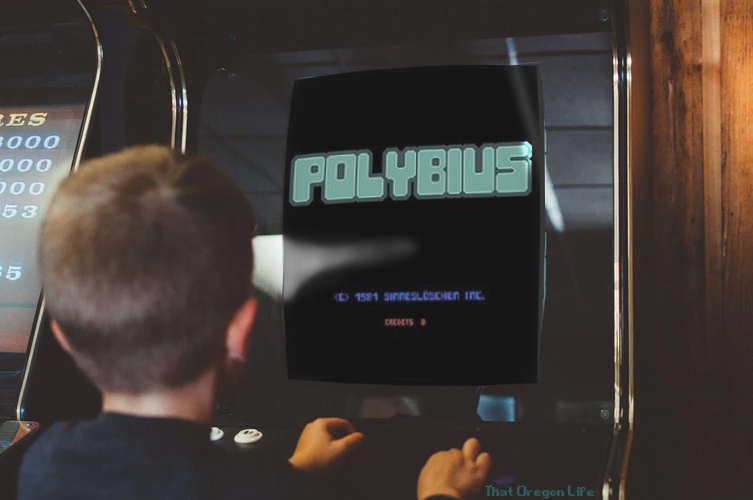
A staged image of a recreated Polybius cabinet. No verified original machine has ever surfaced.
Was Polybius a real arcade game?
There is no credible evidence that the original Polybius existed. A commercial or experimental arcade machine should leave traces: hardware, software, manufacturing records, operator paperwork, advertisements, trade coverage, repair manuals, copyright filings, photographs, or reliable testimony from people who handled it. Polybius has none of those.
The supposed manufacturer, Sinneslöschen, has not been verified as a 1981 arcade company. The well-known title-screen image is not proof of a machine; it is simple artwork that could have been created long after 1981. Cabinets photographed at conventions, bars, museums, and modern arcades are recreations or jokes inspired by the legend.
Most importantly, researchers have found no contemporary mention of Polybius in Portland newspapers, arcade trade publications, gaming magazines, or surviving discussions from the period. The story becomes visible only after the internet made it easy for fragments of folklore to spread and acquire new details.
Where did the Polybius story come from?
The earliest commonly cited source is an entry on the arcade database Coinop.org. The listing carries a 1998 date and describes a rare 1981 game from outside Portland. However, internet researchers have questioned that date because surviving web archives do not confirm the page that early. The first traceable public discussions appear around 2000.
The legend reached a much larger audience when GamePro included it in a 2003 feature about gaming myths. Later retellings added locations, secret programs, deaths, coded messages, and eyewitnesses. By the time Polybius appeared as a background gag on The Simpsons, it had become one of gaming’s most recognizable urban legends.
That timeline matters. If Portland teenagers had really encountered a dangerous government arcade game in 1981, it is difficult to explain the absence of any verifiable record for nearly 20 years. It makes far more sense as a modern legend looking backward at a strange period in arcade history.
The real 1981 Portland events behind the myth
Polybius may be fictional, but the Portland backdrop was not invented from nothing. Several documented events occurred close together in late 1981, and they contain many of the ingredients that later appeared in the legend.
Two young players became ill at a Portland-area arcade
In November 1981, 12-year-old Brian Mauro attempted an Asteroids endurance run at the Malibu Grand Prix arcade in the Portland area. After approximately 28 hours, he stopped because of painful physical symptoms. The incident received local news attention.
At the same arcade, 14-year-old Michael Lopez reportedly became seriously ill after playing Atari’s visually intense game Tempest. Later accounts describe a severe headache, nausea, disorientation, or collapse. The exact descriptions vary, but the central event—a teenager becoming ill after playing a bright, fast arcade game—was real enough to become part of Portland arcade lore.
Those stories resemble the later claims about Polybius players, but neither incident involved a mysterious game. The known titles were Asteroids and Tempest.
Federal agents really did investigate Portland arcades
Within days of those incidents, federal and local authorities raided Portland-area arcades while investigating illegal gambling. Some arcade machines had allegedly been altered or used in ways that violated gambling laws. Agents examining cabinets in an arcade would have looked suspicious to young players who did not know why they were there.
Over time, ordinary investigators checking machines could easily become the legend’s “men in black” collecting secret behavioral data. The real investigation does not prove Polybius existed. It helps explain how that particular detail could have entered the story.
Arcade games could genuinely make some players feel sick
Bright flashes and high-contrast visual patterns can trigger symptoms in some people. The Epilepsy Foundation explains that visually provoked seizures affect a small portion of people with epilepsy, while other people may experience headaches, nausea, or dizziness without having a seizure.
That medical reality makes the legend sound plausible, but it is not evidence for a secret mind-control machine. Long play sessions, fatigue, stress, dehydration, and visually intense games provide much simpler explanations for the documented illnesses.

The Polybius legend claims the cabinet was a government experiment, but no evidence connects it to any real program.
Was Polybius connected to the CIA or MKUltra?
No evidence connects Polybius to the CIA, FBI, military, or any government behavior-control program.
Project MKUltra was real. Declassified CIA records document research into drugs, interrogation, and human behavior during the 1950s and 1960s. That history gave later conspiracy stories a disturbing foundation.
But MKUltra’s existence does not authenticate every later mind-control claim. The program is part of the cultural atmosphere surrounding Polybius, not proof that the arcade cabinet existed. No released document mentions Polybius, Sinneslöschen, or a Portland video-game experiment.
What about photographs and playable Polybius cabinets?
Every known Polybius cabinet was built after the legend became popular. Arcade owners and fans have placed the name on converted cabinets, sometimes leaving them switched off as an inside joke. Other recreations run fan-made software based on descriptions from the story.
In 2007, Rogue Synapse released a free game inspired by the myth and built a matching cabinet. In 2017, designer Jeff Minter and Llamasoft released a completely different game called POLYBIUS for PlayStation 4 and later Windows. It is a real psychedelic action game, but it was openly inspired by the fictional cabinet and is not a recovered 1981 original.
If you encounter a Polybius machine today, you have found a tribute, recreation, art piece, or prank—not evidence that a vanished Portland cabinet survived.
Why the Polybius legend refuses to die
Polybius is unusually durable because the story combines several fears that were already present in American culture:
- Parents in the early 1980s worried that arcades were addictive or dangerous.
- New games sometimes appeared in unfinished or unfamiliar cabinets.
- Real players became sick after long or visually intense sessions.
- Real investigators entered Portland arcades during a gambling probe.
- Americans had learned that genuine secret behavior-control experiments existed.
- The alleged game disappeared, making the central claim almost impossible to disprove completely.
Portland is essential to the story. The city had the right arcade culture, the right documented incidents, and just enough real strangeness to make the impossible sound half remembered. Readers interested in the city beyond the legend can explore our complete Portland, Oregon guide and more stories from Weird Oregon.
Polybius in documentaries, games, and popular culture
Polybius has inspired podcasts, films, television references, novels, fan games, and custom-built cabinets. Its fame now creates a feedback loop: people see a modern recreation, assume it proves the old story, and share a new “sighting.”
The documentary below traces the legend’s internet history, the people associated with its spread, and the real events that may have helped shape it.

Real arcade machines helped inspire the look and atmosphere of later Polybius recreations.
Frequently asked questions about Polybius
Was Polybius real?
Almost certainly not. No verified original cabinet, ROM, manufacturer record, contemporary article, or credible firsthand documentation has ever been found.
Where was Polybius supposedly located?
The legend usually places one or more machines in arcades around Portland, Oregon, in 1981. Specific locations were added in later versions, but none has been verified as the home of an original machine.
What did the Polybius game supposedly do?
Stories claim that it used flashing abstract graphics and subliminal effects to cause addiction, nightmares, amnesia, hallucinations, headaches, nausea, or seizures. The details differ because there is no confirmed original game to examine.
Who supposedly made Polybius?
The cabinet is usually attributed to a company called Sinneslöschen. No credible evidence shows that such an arcade manufacturer produced a game in 1981.
Can you play Polybius today?
You can play modern games and fan recreations called Polybius, including Llamasoft’s 2017 release. They were inspired by the legend; none is the alleged Portland original.
Why is Polybius associated with Portland?
Portland experienced several real arcade-related incidents in 1981: young players became ill, visually intense games drew concern, and authorities investigated local arcades for illegal gambling. Those events gave the later legend a convincing Oregon setting.
The verdict
Polybius is not a forgotten government machine waiting to be rediscovered. It is something more revealing: a modern urban legend built from fragments of real Portland history.
The sick players were real. The federal arcade investigation was real. Photosensitive reactions are real. Government behavior experiments were real. But the Polybius cabinet tying all of those facts together has never been shown to exist.
That gap between what happened and what people remember is exactly why the legend has lasted.