

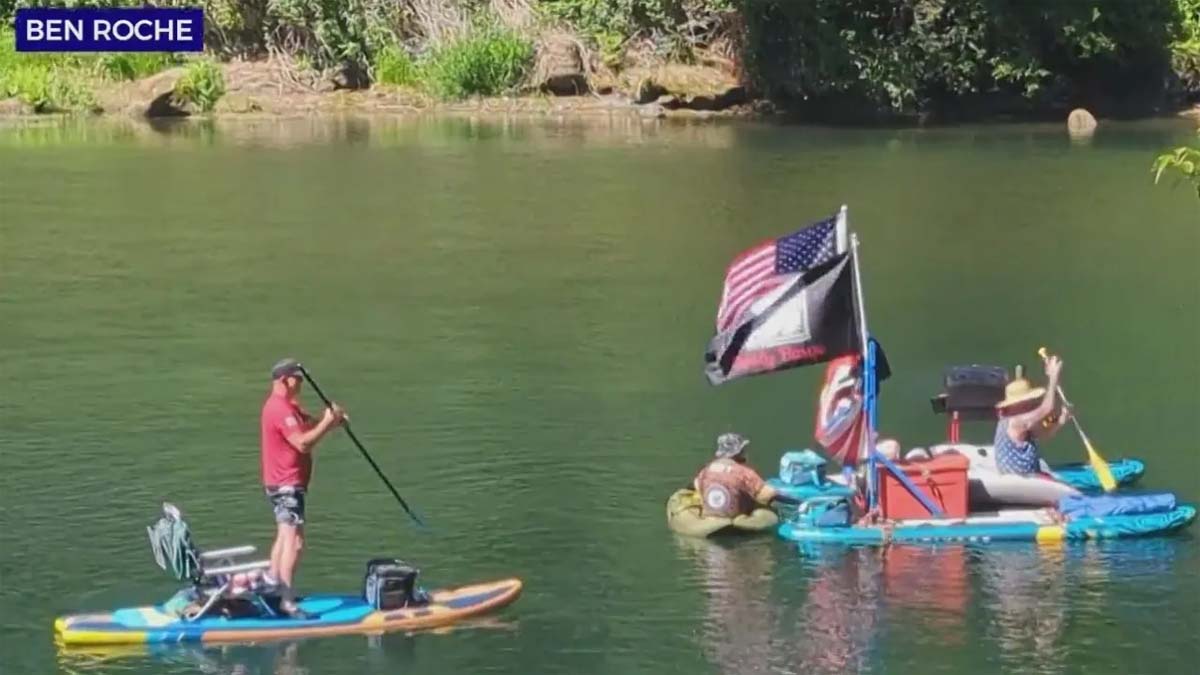
There are certain things Oregonians expect to bring along for a summer afternoon on the water.
Sunscreen.
A life jacket.
A paddle.
A dry bag containing three granola bars, a warm bottle of water, and a phone that will somehow still end up wet.
What many people apparently do not know they are supposed to bring is proof that they paid the State of Oregon for permission to stand on a floating piece of plastic and move slowly across a lake using a stick.
Welcome to paddling in Oregon in 2026.

A new state requirement now says virtually everyone age 14 and older operating a kayak, canoe, raft, stand-up paddleboard, or other nonmotorized boat must carry a Waterway Access Permit while using Oregon waters.
That includes small paddleboards and kayaks under 10 feet long, which were previously outside the permit requirement.
It includes inflatable versions.
It includes visitors.
It includes the paddleboard you bought at Costco because you had a brief moment of optimism about becoming an outdoorsy person.
And according to recent interviews conducted at Riverbend Park in Bend, quite a few people currently enjoying Oregon’s waterways had no idea any of this was happening.
Meanwhile, a citizens group trying to repeal the expanded requirement appears likely to miss the deadline for placing the issue before Oregon voters in November.
The group, Let Us Paddle, has reportedly gathered around 36,000 signatures. It needs approximately 117,000 valid signatures by July 2.
That leaves the campaign roughly 80,000 signatures short with about a week remaining.
Technically, anything is possible.
Realistically, collecting 80,000 valid signatures in a week would require a minor civic miracle, several warehouses full of clipboards, and every person leaving an Oregon Costco to stop signing up for solar estimates long enough to sign a ballot petition.
Organizers acknowledge the outlook is grim.
So the repeal effort is sinking, the permit remains in force, and many of the people affected by it are apparently floating around Oregon with no clue that the government has paperwork for them.
It is a remarkably Oregon situation.
Oregon Sunshine Now Comes With Administrative Requirements
To understand how we got here, we need to go back a few years.
Oregon’s Waterway Access Permit is not entirely new. Beginning in 2020, the state required permits for many nonmotorized boats measuring 10 feet or longer.
That meant a large number of canoes, kayaks, drift boats, rafts, and stand-up paddleboards already fell under the program.
Plenty of paddleboards are longer than 10 feet, so state officials correctly point out that many paddleboard owners have technically needed permits for years.
The big change arrived through House Bill 2982, approved by the Oregon Legislature and signed into law in 2025.
Beginning January 1, 2026, the old exemption for most nonmotorized boats under 10 feet disappeared. The permit system expanded to nearly all paddlecraft regardless of length.
That sounds like a fairly small change when written in legislative language.
Remove a length exemption. Adjust several fees. Add some wording. Send it through the Capitol.
Out in the real world, however, it pulled a much larger group of casual recreationists into a permit system they may never have encountered before.
These are not necessarily seasoned boaters with trailers, registrations, motors, bilge pumps, navigation lights, and an intimate understanding of Oregon marine regulations.
Many are people who keep an inflatable paddleboard folded in their garage next to the Christmas decorations.
They may use it twice a year.
They may toss it into the back of a Subaru, drive to a lake, spend 20 minutes operating an air pump, and then spend another 15 minutes wondering why the board still feels soft.
They do not necessarily identify as “boaters.”
Oregon law does.
That distinction matters because the state now expects those people to know they are operating a regulated nonmotorized boat and must have the proper permit ready to show a marine law enforcement officer.
Judging by the response at Riverbend Park, the message has not exactly reached every corner of Paddleboard Oregon.
The official That Oregon Life store
The Oregon you bring home.
Start the day with Oregon-roasted coffee, then find original gear inspired by the places, stories, and oddities that make this state ours.
Shop Oregon gear

Many Paddlers Apparently Never Received The Memo
Central Oregon Daily News spoke with paddleboarders at Riverbend Park on Wednesday, and most of those interviewed reportedly did not know about the expanded permit requirement.
They also did not know a petition was underway to repeal it.
To be fair, this was not a scientific statewide survey. Nobody should look at a handful of interviews in one Bend park and conclude that precisely 73.4 percent of Oregon paddleboarders are living in permit darkness.
Still, it tells us something important.
The law is now in effect during the first full summer season under the expanded requirements, and people actively standing beside paddleboards at a popular Oregon river access point were unaware that the permit existed.
These were not people being interviewed in the plumbing aisle at Home Depot.
They were paddleboarders at the water.
If the people currently holding paddles do not know about the paddle permit, there may be a communication problem.
The State Marine Board has information online. The rules are publicly available. Permit instructions have been posted. News organizations have covered the change.
But Oregon is a large state filled with lakes, rivers, reservoirs, coastal inlets, and people who do not regularly browse the Oregon State Marine Board website for recreational reading.
Most people do not wake up on a sunny Saturday morning and ask, “I wonder whether the Legislature recently amended ORS 830.624?”
They check the weather.
They find the paddle.
They load the cooler.
They argue about who forgot the towels.
Then they head for the water under the old-fashioned assumption that quietly paddling around on a lake is one of the few human activities that does not require a state-issued document.
That assumption is now incorrect.
The Permit Is Not Terribly Expensive Until You Start Multiplying
The official base prices are:
- $6 for a seven-day permit
- $20 for a one-year permit
- $35 for a two-year permit
Additional transaction charges apply depending on where the permit is purchased. The Boat Oregon Store adds a portal fee, while permits purchased through Oregon Department of Fish and Wildlife systems include a separate transaction charge.
On its own, $20 is not an enormous amount of money.
That is part of the state’s defense.
Twenty dollars for a year of access to Oregon’s remarkable rivers and lakes sounds manageable for many people. Plenty of us have spent more than that at a food cart while waiting for someone to put brisket, pickled onions, and an experimental aioli into a burrito.
But the permit applies per boat while the boat is being used.
The permit can be transferred from one paddlecraft to another, which is helpful for someone who owns multiple boats but only uses one at a time.
It does not solve the problem for a family using several boats simultaneously.
A family of six heading out in six kayaks would need six permits. At the base annual price, that is $120.
Now add gas, parking, food, equipment, life jackets, replacement paddles, campground charges, day-use fees, and the mysterious financial vortex that opens whenever a family leaves the house.
Suddenly the supposedly small permit begins feeling less small.
Let Us Paddle co-chief petitioner Kari Goodheart argues that this cumulative burden can discourage families from getting outside.
That concern deserves more than a dismissive shrug.
Oregon leaders regularly talk about public health, youth activity, mental wellness, outdoor access, and connecting people with nature. Those are popular goals right up until a family tries to connect with nature and discovers that nature has a checkout screen.
A $20 annual charge will not prevent everyone from paddling.
For some households, however, another fee really is another obstacle.
That is especially true for families who only paddle occasionally and may already be stretching their budgets to purchase used kayaks, borrow equipment, or plan a low-cost afternoon outdoors.
Paddling has traditionally been one of the simpler ways to enjoy Oregon.
You do not need a boat ramp capable of handling a pickup and trailer.
You do not need fuel.
You do not need a marina slip.
You do not need to spend $87 at a gas station because your boat consumes petroleum like an offshore drilling operation.
You need a small craft, a paddle, proper safety equipment, and access to water.
The simplicity is part of the appeal.
Opponents believe Oregon is slowly sanding away that simplicity, one permit and processing fee at a time.
The State Says The Money Goes Back Into Oregon’s Waterways
The Oregon State Marine Board is not claiming the money disappears into a mysterious Salem vault where government employees swim through piles of paddleboard cash.
The agency says Waterway Access Permit revenue supports two primary purposes.
One part pays for projects improving nonmotorized access to Oregon waterways.
That can include launch areas, docks, parking, restrooms, sanitation, staging areas, storage racks, boat-in camping facilities, and other infrastructure designed for paddlers and small-watercraft users.
State officials point to places such as Miller’s Landing in Bend as an example. The popular Deschutes River access site received substantial funding through the Waterway Access Grant program, with the Marine Board reportedly covering nearly half the cost of a recently completed project there.
The Marine Board says more than $4.6 million in Waterway Access Permit revenue has been awarded through grants since 2021.
That is real money funding real improvements.
Anyone who has tried to launch a kayak from a steep, muddy bank while sliding backward in sandals can understand why better access matters.
Anyone who has arrived at a crowded launch and found trucks, trailers, paddleboards, inflatable flamingos, wet dogs, and seven families attempting to occupy the same 12 square feet can also appreciate infrastructure designed specifically for nonmotorized users.
The second purpose involves aquatic invasive species prevention.
Oregon officials are particularly concerned about destructive species such as zebra mussels, quagga mussels, and golden mussels.
These invasive mussels can attach to boats and equipment, spread between waterways, damage infrastructure, disrupt ecosystems, and create enormous long-term costs.
Oregon has worked for years to keep them from gaining a foothold.
Money from permit sales helps support inspection stations, educational programs, targeted inspections, and rapid response efforts.
Protecting Oregon’s waterways from invasive species is not silly.
Nobody wants to watch a beloved lake become an ecological disaster because something hitched a ride across state lines.
The frustration comes from who is being asked to pay, how broadly the rule is written, and whether the state has done enough to show that small human-powered craft present a risk proportionate to the new requirement.
A Paddleboard Is Not Exactly A Motorboat With A Ballast Tank
Let Us Paddle argues that the expanded system places too much of the financial burden on low-risk users.
A simple paddleboard does not have a motor, live well, bilge system, or ballast tank.
It generally does not contain the hidden compartments and water-holding systems that make larger boats more difficult to inspect and clean.
A paddleboard is basically a long floating plank with a fin.
An inflatable paddleboard is a long floating plank that begins its day inside a backpack.
That does not mean paddlecraft can never transport unwanted organisms. Mud, plants, standing water, and aquatic material can cling to all kinds of gear.
Responsible paddlers should inspect, drain, clean, and dry equipment before moving between waterways.
But opponents question whether charging every casual paddleboarder is a sensible response to threats most often associated with more complicated boats traveling between regions.
The campaign says it found no documented Oregon case in which a nonmotorized watercraft was responsible for introducing or spreading an invasive species.
That is the campaign’s position, and it is central to its argument that the policy is poorly targeted.
The Marine Board takes a broader view.
From the agency’s perspective, all boaters benefit from clean waterways and usable access sites. Therefore, all boaters should contribute.
That creates the heart of the dispute.
Is the permit a modest user fee that helps paddlers maintain the places they enjoy?
Or is it another pay-to-play barrier imposed on people using the simplest and most environmentally friendly craft on the water?
Oregonians will answer that question differently.
What is harder to defend is having a rule that many affected people apparently do not know exists.
Oregon Has Managed To Make The Definition Of Floating Complicated
The permit requirement becomes even more entertaining when you begin exploring what does and does not count.
A stand-up paddleboard is treated as a boat and needs a permit.
A surfboard does not.
A kiteboard does not.
A sailboard does not.
A kayak does.
A canoe does.
An inflatable kayak does.
A raft generally does.
Certain small whitewater boats may qualify for an exemption, but only when used for defined whitewater activities on waterways the Marine Board has specifically identified.
So your under-10-foot kayak may need a permit on one body of water but could qualify for an exemption while engaged in whitewater recreation on another approved stretch.
Perfectly simple.
Just consult the rules, study the map layers, confirm your craft type, determine the designated waterway status, consider the nature of your activity, and try not to drift into a different regulatory category while floating downstream.
Children 13 and younger do not need a permit.
People 14 and older generally do.
A permit can move between your paddlecraft, but you need one permit for every boat currently being operated.
The permit is not a registration sticker.
You may carry a printed copy or display it electronically.
This means a person enjoying a relaxing escape from phones and technology may need to bring a phone onto the water to prove they purchased permission to enjoy a relaxing escape from phones and technology.
The state recommends saving the permit to your device ahead of time.
That is smart advice because many of Oregon’s best lakes are located precisely where your phone decides it has never heard of the internet.
Ocean paddlers are not automatically outside the rule either. Oregon waters extend from the coastline to three miles offshore.
The broader point is not that every exemption is unreasonable.
Laws often need definitions.
The point is that Oregon took one of the most basic recreational activities imaginable and surrounded it with enough details to make a person miss the days when their biggest concern was falling into the water in front of strangers.
The Petition Began With Anger And Plenty Of Early Energy
Let Us Paddle formed after lawmakers approved HB 2982.
The volunteer group launched Initiative Petition 2026-053 in an effort to reverse the expanded permit requirements.
Organizers framed the issue around personal liberty, affordable recreation, environmental responsibility, and public access to Oregon’s waterways.
They argued that paddleboards, kayaks, and canoes provide healthy, low-impact ways for families to enjoy public resources.
They also accused lawmakers of creating an unnecessary financial barrier without adequately considering how it would affect everyday Oregonians.
Early in the campaign, petition circulators reported encouraging interest.
Some people recognized the group’s materials and approached volunteers eager to sign.
The frustration was clearly real.
Oregon residents have become increasingly sensitive to fees, taxes, permits, surcharges, service charges, and the general sensation that someone in Salem is waiting behind every tree with a card reader.
For paddlers who already believed the state had crossed a line, the petition offered a path toward a public vote.
But ballot initiatives are brutal.
A successful campaign needs organization, money, volunteers, statewide reach, legally valid petition sheets, properly completed signatures, and enough additional names to survive the validation process.
Gathering tens of thousands of signatures is difficult even for well-funded political operations.
For a volunteer-driven group trying to reach outdoor enthusiasts scattered across Oregon, the challenge is enormous.
By late June, the campaign had gathered about 36,000 signatures.
That would be an impressive number for a petition asking the city to repair a pothole.
It is nowhere near enough for a statewide ballot measure requiring approximately 117,000 valid signatures.
With the July 2 deadline approaching, organizers said they did not expect to make it.
The repeal attempt is not mathematically dead until the deadline passes.
It is, however, floating face down and making everyone nervous.
The Cruel Irony Is That The People Most Affected May Not Know About The Fight
The campaign’s predicament contains a frustrating contradiction.
Let Us Paddle needs support from paddlers.
Many paddlers apparently do not know there is a permit.
If people do not know the law changed, they are unlikely to know someone is collecting signatures to undo it.
The same lack of awareness that may eventually expose boaters to a fine also makes organizing opposition more difficult.
A person cannot become outraged about a regulation they have never heard of.
They cannot sign a petition they do not know exists.
They cannot contact lawmakers about a rule they discover only when an officer asks to see proof on the water.
This may be the most revealing part of the entire story.
The state can point to websites, announcements, news stories, social media posts, agency pages, and frequently asked questions.
The campaign can point to events, volunteers, petition locations, interviews, and online outreach.
Still, most paddleboarders approached by reporters at one of Bend’s busiest river parks reportedly knew nothing about either side.
There is a difference between making information publicly available and successfully informing the public.
Government agencies sometimes confuse the two.
Posting something on a website is not the same as reaching the weekend recreationist who bought an inflatable kayak three summers ago and has never visited a marine regulation page.
Passing a law is the easy part.
Getting millions of residents and visitors to understand it is harder.
When the penalty for misunderstanding is a $115 fine, the state should be doing more than hoping people stumble across the correct FAQ before leaving home.
Missing The Ballot Does Not Make The Permit Disappear
Unless something extraordinary happens before the deadline, Oregonians will not vote on the repeal in November.
That does not mean the disagreement is finished.
Organizers say they intend to continue fighting for unrestricted access to Oregon waters.
Future legislative proposals could attempt to narrow the requirement, restore length exemptions, change the definition of a covered boat, adjust the fee structure, or create new exceptions.
A lawmaker already floated the idea of rolling back requirements for smaller craft before the expanded system fully took effect.
Public frustration could lead to another bill.
It could lead to a future initiative.
It could lead to louder demands for the state to demonstrate exactly how much revenue is collected, where every dollar goes, and why small paddlecraft should be included.
For now, however, the permit remains the law.
Failing to show it when asked by marine law enforcement is a Class D violation carrying a $115 fine.
That is worth emphasizing.
This is not merely a voluntary donation to the Nice Boat Ramp Fund.
It is a legal requirement.
A paddleboarder who has no idea the rule exists can still be cited for violating it.
“I didn’t know Oregon had invented a paddleboard permit” may be an understandable reaction.
It is unlikely to function as a durable legal strategy.
What Oregon Paddlers Need To Know Before Heading Out
Until lawmakers or voters change the system, here is the practical reality for Oregon paddlers.
Most people age 14 and older operating a nonmotorized boat on Oregon waters need a Waterway Access Permit.
Covered craft include:
- Stand-up paddleboards
- Kayaks
- Canoes
- Rafts
- Drift boats
- Inflatable versions of paddlecraft
- Other nonmotorized boats
The requirement applies regardless of length, except for specific exemptions.
The base permit prices are $6 for seven days, $20 for one calendar year, or $35 for two calendar years.
Transaction fees may increase the final cost slightly.
You need one permit for each nonmotorized boat being used at that moment.
You can transfer a permit between your own paddlecraft when they are not being operated at the same time.
You can carry a printed permit or save a digital version on your phone.
Children 13 and younger are exempt.
Surfboards, kiteboards, and sailboards are exempt.
Certain short whitewater boats may be exempt when used for eligible activities on specifically designated waterways.
Free boating days may also be available on dates designated by the state.
Failure to show the permit can result in a $115 fine.
Nonmotorized boats are not being titled or registered under this program. The permit belongs with the operator and may be transferred between qualifying craft.
Paddlers should also remember that the access permit does not replace normal safety responsibilities. Life jacket requirements, sound-producing devices, cold-water precautions, weather awareness, and other boating rules still apply.
Oregon water can remain dangerously cold even when the air temperature is warm enough to convince everyone in the parking lot that summer has defeated nature.
It has not.
There Is A Reason This Issue Struck A Nerve
This debate is not really about whether $20 will financially destroy the average paddleboard owner.
It will not.
The anger comes from accumulation.
Oregonians pay to park at some recreation sites.
They pay campground fees.
They buy fishing licenses, hunting licenses, Sno-Park permits, Northwest Forest Passes, state park passes, federal recreation passes, boat registrations, guide permits, and various local access permits.
They pay gas taxes to drive to public land and then sometimes pay again to park after arriving.
They pay service charges for the privilege of paying the original charge.
One more fee can sound harmless when considered alone.
People do not experience fees alone.
They experience them as a stack.
The Waterway Access Permit landed on top of that stack and reached a group of people who often see their activity as the opposite of regulated boating.
A person paddling quietly across a lake is not creating a wake, burning fuel, producing engine noise, or requiring a large launch ramp.
They may have purchased a used kayak for $150 precisely because it offered an inexpensive way to get outside.
Telling that person the fee is small misses the emotional point.
They are asking why the fee exists at all.
The state has an answer.
Infrastructure and invasive species prevention cost money, and paddlers benefit from both.
Opponents have a response.
Charge the people and equipment creating the greatest risk, use existing revenue more efficiently, or fund statewide environmental protection through a broader source rather than placing another barrier between families and public water.
That is a legitimate policy disagreement.
It is the kind of disagreement voters might have settled if the initiative had reached the ballot.
At the moment, it probably will not.
Oregon Needs Clean Water And Rules People Actually Understand
There is room here for two ideas to be true.
Oregon’s rivers and lakes need protection.
The state should take invasive species seriously.
Public access sites cost money to build and maintain.
Safe launches, parking areas, docks, sanitation, and paddler-friendly facilities do not magically emerge from the ferns.
At the same time, Oregon should be extremely cautious about placing fees and permits on basic outdoor recreation.
The outdoors are not merely an industry here.
They are part of Oregon life.
Families go to the river because it is one of the few places where entertainment does not have to involve an admission gate, a subscription, or a snack counter charging $8 for lemonade.
People paddle because it is peaceful.
They paddle to exercise.
They paddle to escape work.
They paddle to spend time with their children.
They paddle because Oregon is beautiful and being on the water provides a perspective no roadside viewpoint can match.
Any law affecting that experience should be necessary, carefully targeted, easy to understand, and communicated clearly.
A rule that catches active paddleboarders by surprise has failed at least one of those tests.
Whether someone supports the permit or wants it repealed, nobody should be pleased that people may receive a $115 lesson about a law they never knew existed.
For Now, The Permit Floats On
The Let Us Paddle campaign appears unlikely to gather the remaining signatures before July 2.
Its volunteers may continue working until the final hour, but overcoming an approximately 80,000-signature deficit in a week would be an astonishing turnaround.
Barring that miracle, the expanded Waterway Access Permit will not face a repeal vote this November.
Oregon paddlers will remain responsible for obtaining permits.
The state will continue collecting revenue for access projects and invasive species programs.
Organizers will likely continue pushing back.
And somewhere this weekend, an Oregonian will load a paddleboard into a vehicle, drive to a lake, inflate it, launch it, and learn for the first time that peaceful floating now comes with administrative requirements.
So before you head for the Deschutes, the Willamette, the McKenzie, the Rogue, Detroit Lake, Waldo Lake, the Columbia, or your favorite quiet corner of Oregon water, check your equipment.
Bring the life jacket.
Bring the whistle.
Bring the sunscreen.
Bring enough water.
And apparently, bring your papers.
Because Oregon still wants you to go outside.
It would just like you to complete the transaction first.
Follow Let Us Paddle on Facebook to get the latest updates and where to sign, as well as their website as letuspaddle.com.