

In case you missed it, Oregon politics delivered another masterclass this week in how things definitely don’t look questionable at all.
On Monday, during a work session of the House Judiciary Committee, an amendment tied to House Bill 4145, legislation dealing with implementation of voter-approved Measure 114, appeared to be on its way to failure.
The official That Oregon Life store
The Oregon you bring home.
Start the day with Oregon-roasted coffee, then find original gear inspired by the places, stories, and oddities that make this state ours.
Shop Oregon gear


Then something happened.
And by “something,” we mean the committee chair abruptly paused the meeting after one key “no” vote. Nearly 20 minutes later, the committee reconvened. A re-vote was called. The lawmaker who had voted “no” voted “yes.”
And just like that it passed.
Totally routine.
Rep. Jason Kropf, a Democrat from Bend and chair of the House Judiciary Committee, is a chief sponsor of HB 4145. The bill outlines how Measure 114, Oregon’s controversial gun control measure passed in 2022 and stalled in court, would be implemented.
During the committee session, Rep. Thủy Trần, a Democrat from Portland, voted “no” on a key amendment. Legislative video shows Kropf audibly inhaling and then abruptly pausing the meeting before all members had finished voting.
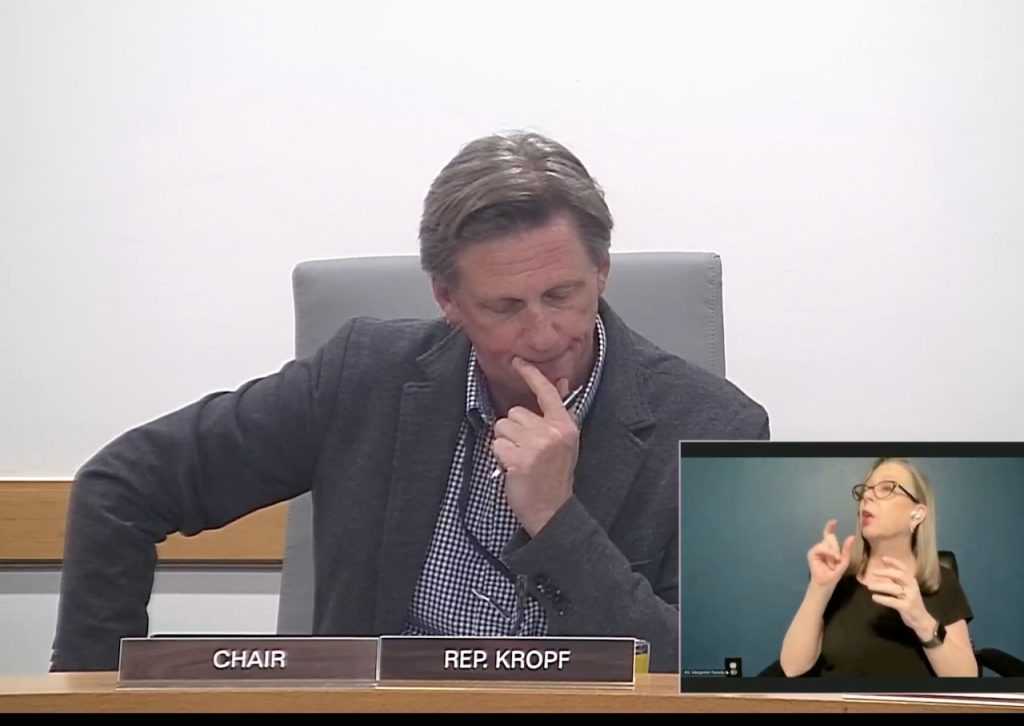
Without Trần’s support, the amendment would not have advanced.
So the meeting stopped.
According to a complaint later filed with the Legislative Equity Office by gun rights advocate Derek LeBlanc, Kropf and Trần stepped outside the room. The complaint alleges Trần was left visibly shaken and in tears after the interaction. It also claims Kropf threatened her and refused to accept her initial “no.”
Kropf has denied wrongdoing and said he holds deep respect for Trần, declining to comment further because of the open complaint.
Of course.
A clock in the committee room shows roughly 20 minutes passed before the meeting resumed.
Then came the re-vote.
Trần appeared confused, asking, “Didn’t we just vote on it already?”
Kropf replied that he had asked for a recall of the vote.
Again.
After several pauses and visible hesitation, Trần switched her vote to “yes.” She later voted “yes” on the overall bill.
The amendment passed.
Funny how that works.
Republican Rep. Alek Skarlatos addressed the situation on the House floor without naming names, but the target seemed obvious.
“We’ve almost gotten physical on a few occasions,” Skarlatos said of heated debates among Republicans. “But one of the things we would never do is pull a member out of a committee or off the floor and ask them to change their vote.”
He called such behavior inappropriate and warned that it goes against our principles as a republic.
Those are strong words in a building where strong words are often carefully avoided.
It is worth noting that both Kropf and Trần sit on the House Conduct Committee, the very body that would review complaints like this. Kropf would need to recuse himself. Trần is also a member.
No conflicts there, right?
Critics say this episode fits a broader pattern of high pressure political maneuvering in Salem. Last year, a Democrat senator resigned as committee co-chair after being accused of aggressively confronting a Republican colleague during a tense meeting.
Now we have a gun bill amendment that appeared to fail until a closed door conversation and a re-vote produced a different result.
Sure, legislative recalls happen. Yes, emotions run high. But when a “no” becomes a “yes” after a private exchange and a 20 minute pause, people are going to ask questions.
And when the result conveniently benefits the committee chair’s own legislation, that only raises more eyebrows.
Maybe everything here was perfectly above board. Maybe it was just tense politics. Maybe it was a misunderstanding blown out of proportion.
Or maybe voters just witnessed exactly why so many people have lost trust in the system.
When lawmakers appear to pressure colleagues behind closed doors, when votes are paused midstream, when dissent disappears after a private conversation, that is not a good look in any republic.
Measure 114 has already divided the state and tied up the courts. The last thing Oregon needs is more questions about how the sausage gets made.
Because when the public starts wondering whether votes are truly voluntary, that is not a partisan issue.
That is a credibility issue.
Nothing to see here, Oregon.
Move along.
HB 4145 goes far beyond what voters were originally told they were approving. This does not read like simple implementation. It reads like expansion by bureaucratic design.
The bill doubles the time the state has to issue a firearm purchase permit from 30 days to 60. That gives government agencies more room to delay a constitutional right.
It more than doubles the cost of that permit, jumping from $65 to $150. That is not a minor adjustment. That is a financial barrier. Lawful gun ownership becomes harder not because of crime, but because of cost.
The bill also exempts both on-duty and off-duty law enforcement from permit requirements and magazine limits. In other words, two classes of citizens under the same law.
It shifts implementation timelines and creates a government-maintained registry of firearm owners, including personal data and fingerprints shared with the FBI.
Supporters call it administration. Critics call it what it looks like.
Regulatory overreach layered on top of an already controversial law, expanding state control while tightening restrictions on ordinary Oregonians.