
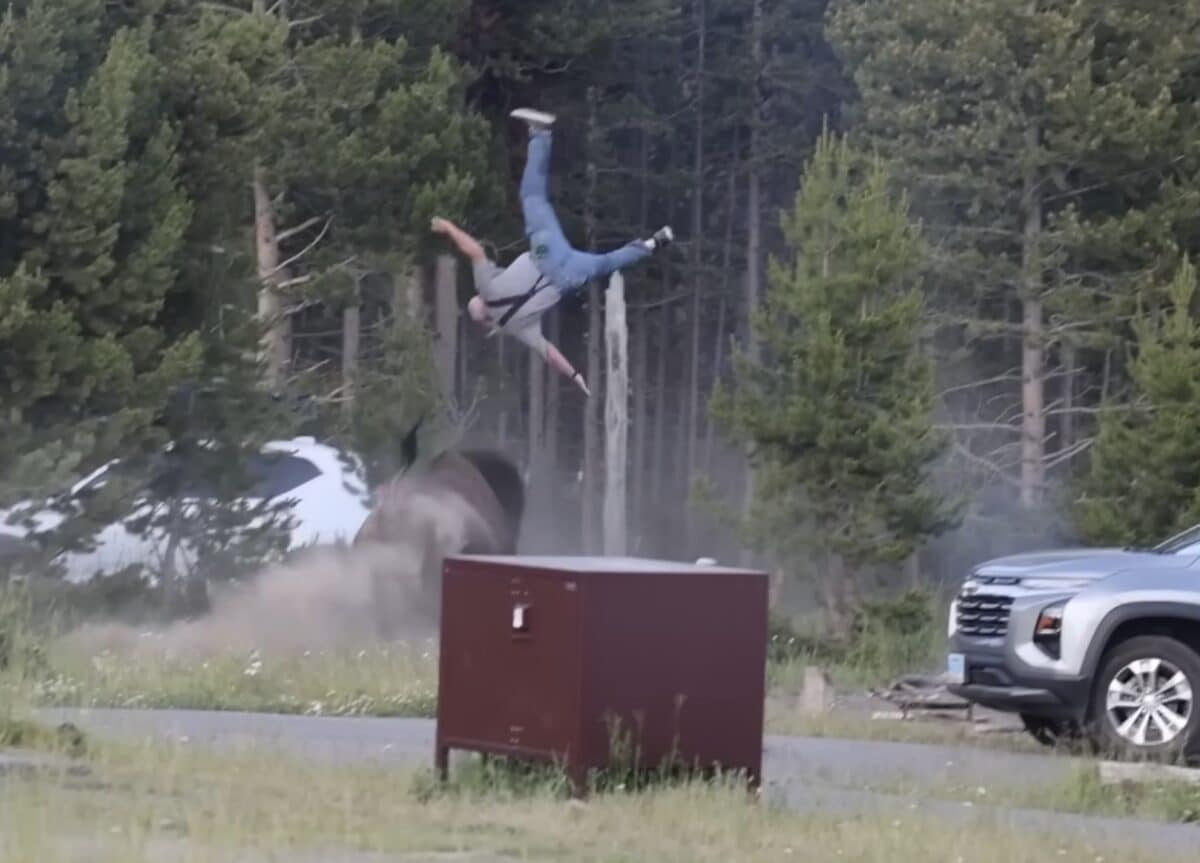
A peaceful summer evening at Yellowstone National Park turned into a frightening emergency when a massive bull bison charged an older man walking with his grandson, struck him with its horn, and hurled him several feet into the air.
The attack happened Friday, July 10, near Bridge Bay Campground, a popular camping area on the western shore of Yellowstone Lake. Video recorded by a witness shows the enormous animal moving through the campground before suddenly racing toward the grandfather and grandson. The younger man managed to escape without being struck, but the older man could not get out of the bison’s path in time.
The bison caught the grandfather near the hip and launched him into the air. He landed hard on the ground while the animal remained nearby, shaking its head and standing over him. Witnesses feared the bull might attack a second time, prompting several bystanders to yell and move toward the animal in an effort to draw its attention away from the injured man.
A tourist was seriously injured after a bison tossed them about 8 feet into the air in Yellowstone National Park
by u/eternviking in whoathatsinteresting
Their intervention worked. The bison eventually moved off, allowing people to reach the victim and call emergency services. The older man reportedly suffered serious injuries and was in considerable pain following the violent encounter.
Yellowstone National Park had not released the man’s name, age, hometown, or a detailed medical update at the time of publication. Witnesses said there did not appear to be a major external wound, but the force of the strike and fall left him in serious condition.
The incident is a stark reminder that Yellowstone’s familiar wildlife remains completely wild. Bison may spend hours grazing quietly beside a road or moving slowly through a meadow, but they are capable of explosive speed and unpredictable behavior. Even visitors who appear to be giving the animals plenty of room can find themselves in danger if a bison becomes agitated and decides to charge.
In this case, witnesses said the grandfather and grandson were not attempting to touch the animal, pose beside it, or crowd it for a photograph. They were reportedly a substantial distance away when the encounter began. The bison had already shown signs of aggression before the two entered the area, and they may not have known what had happened moments earlier.
That detail makes the attack especially unsettling. Yellowstone visitors are frequently warned about approaching bison too closely, and many injuries have involved people stepping inside the park’s required safety boundary. This encounter appears to have unfolded differently. The grandfather and grandson were reportedly trying to move away when the animal turned its attention toward them.
The Bison Had Already Charged A Group Of Children
Photographer Mike MacLeod was staying at Bridge Bay Campground with his wife when he noticed the bull bison moving through the developed area. Wildlife wandering through a Yellowstone campground is not unusual, particularly in sections of the park near open meadows, water, and well-traveled animal routes.
Bison routinely cross Yellowstone roads, enter parking areas, walk beside boardwalks, and pass between campsites. For visitors, seeing one near a campground can feel like an extraordinary stroke of luck. A bull may appear calm, slow, and almost indifferent as people watch from nearby vehicles or tents.
The bull at Bridge Bay, however, was behaving unusually.
Before the grandfather and grandson appeared, the bison reportedly charged toward a group of children. The children ran and avoided being struck, but the encounter seemed to leave the animal highly agitated.
After rushing toward the children, the bison dropped into a patch of loose soil and began wallowing. It rolled its enormous body in the dirt, kicked its legs, and sent a cloud of dust rising around it.
Wallowing is a common and natural behavior among bison. The animals may roll in dirt to discourage insects, remove loose hair, spread scent, or display themselves during the summer breeding season. At Yellowstone, visitors often see circular patches of exposed soil where generations of bison have repeatedly rolled.
The behavior can appear harmless or even playful to someone watching from a distance. A bison lies down, rolls onto its back, throws dust across its fur, and eventually climbs back to its feet.
In this case, the wallow appeared to calm the bull for a brief period. The animal stopped charging and remained in the dirt, creating the impression that the immediate danger had passed.
It had not.
The Grandfather And Grandson Walked Into The Area
The grandfather and grandson came into view while walking along a road through Bridge Bay Campground. They apparently had no idea that the bison had already rushed toward a group of children.
Nothing in the video suggests the pair was attempting to approach the animal. Witnesses said they were watching from a considerable distance, with some estimates placing them several hundred feet away.
That would have put them far beyond Yellowstone National Park’s required minimum distance of 25 yards from bison.
As the bull began to rise from the dirt, the grandfather and grandson started moving away. They headed toward a cluster of trees, apparently hoping to place more distance and natural barriers between themselves and the animal.
At nearly the same time, a white pickup truck drove through the campground.
The vehicle appeared to trigger another burst of aggression. The bison turned and charged toward the truck, but the driver continued moving and escaped the animal’s path.
The bull then redirected its attention toward the grandfather and grandson.
What had been a large but distant animal suddenly became an immediate threat. The bison lowered its head and began running across the campground toward the two men.
Despite their heavy appearance, bison can reach speeds of roughly 35 mph. They can run several times faster than an average person, change direction quickly, navigate rough terrain, swim, and jump obstacles that might seem large enough to provide protection.
A person standing 25 yards from a charging bison may have only a few seconds to react.
The grandson managed to move out of the bull’s path. The grandfather, however, could not get away quickly enough.
The video shows the older man attempting to escape through the trees while the animal continues its pursuit. A small tree briefly appears to interrupt the charge, but the bison quickly recovers and closes the remaining distance.
Moments later, it strikes.
The Impact Sent The Man Flying
The bison lowered its head as it reached the grandfather and caught him near the hip with one of its horns. The force lifted the man completely off the ground and sent him tumbling through the air.
Witnesses estimated that he rose roughly eight feet before falling back to the ground. His body appeared to rise above the bison’s back before crashing down several feet away.
A mature bull bison can weigh close to 2,000 pounds. Its heavy head is supported by an enormous concentration of muscle around the shoulders and upper body. Those muscles allow the animal to sweep snow aside during the winter, battle rival bulls, push through obstacles, and deliver devastating force with a quick upward movement of its head.
Even without a direct goring, the impact alone can cause severe injuries. A person struck by an animal of that size may suffer broken bones, internal injuries, joint damage, head trauma, or deep bruising. Being thrown through the air adds the danger of a hard fall onto rocks, trees, pavement, or uneven ground.
After the grandfather landed, the bison remained close.
The bull stood over him and shook its massive head while the injured man lay on the ground. Witnesses feared the animal might strike him again or trample him before he could move.
At that point, several bystanders took action.
The man recording the encounter stopped filming and began yelling at the bison. Other people joined him, shouting and moving toward the bull in an effort to redirect its attention.
Running toward a bison is normally the opposite of accepted wildlife safety advice. In this situation, however, witnesses believed the grandfather faced an immediate risk of being attacked again. Their goal was not to confront the animal but to pull its focus away from the person lying helplessly beneath it.
The commotion eventually worked. The bison turned away from the victim and left the immediate area.
Once the bull moved off, bystanders rushed to the grandfather and called for help. A 911 call was placed, and emergency medical personnel arrived at the campground.
Witnesses said the man was conscious but in severe pain. Although they did not see an obvious puncture wound, he was reportedly struggling with significant pain around his hip and leg. He was later described as seriously injured.
His grandson escaped without physical injury but witnessed the entire attack at close range.
The Pair Had Reportedly Been Keeping Their Distance
Many Yellowstone bison encounters make national headlines because a visitor ignored obvious warnings.
Online videos regularly show tourists walking toward bison with phones raised, posing only a few feet from resting animals, or attempting to pass directly through a herd. Some people have tried to touch bison or place children near them for photographs.
Those incidents often end with a charge, a toss, or a visitor scrambling behind a vehicle after discovering that the animal is much faster than expected.
The Bridge Bay attack does not appear to fit that pattern.
Witnesses repeatedly said the grandfather and grandson had been standing far away. They were not inside the park’s 25-yard boundary, and they appeared to be moving farther from the animal as soon as it stood up.
The bison crossed the distance between them.
There were reportedly other campers closer to the bull, but the animal focused on the grandfather and grandson after charging the passing pickup. Why the bison selected them is not clear.
Wild animals do not always respond in ways people can understand. A bison may react to movement, noise, perceived crowding, a blocked route, another animal, or something that happened before a visitor arrived.
The grandfather and grandson may have seen only a bison rolling in the dirt. They may not have known it had already charged children, and they could not have anticipated how it would react to the truck passing through the campground.
By the time the bull turned toward them, the distance that had seemed safe disappeared quickly.
The attack demonstrates why Yellowstone’s distance rules should be treated as minimum boundaries rather than guarantees. Remaining 25 yards from a bison dramatically reduces the risk of a dangerous encounter, but it does not create an invisible wall the animal cannot cross.
When a bison is already agitated, acting erratically, or moving through a crowded area, visitors should create far more distance than the minimum requires.
Yellowstone’s Bison Are Powerful And Unpredictable
Bison are among Yellowstone National Park’s most recognizable residents. Visitors see them grazing in Hayden Valley, crossing the roads of Lamar Valley, walking near Old Faithful, and resting in open areas around Yellowstone Lake.
Their presence is one of the great wildlife success stories of the American West. Yellowstone is home to one of the oldest and most important free-ranging bison populations in the country, and the animals remain deeply connected to the park’s identity.
That familiarity can also create dangerous misunderstandings.
A bison grazing calmly beside a road may look similar to livestock in a pasture. Its slow movements and heavy body can make it seem less threatening than a bear, wolf, or mountain lion.
In reality, bison are extremely athletic wild animals.
A large bull may weigh close to a ton. Both males and females have horns, and the animals can pivot, sprint, jump, and maneuver through difficult terrain with surprising ease. Their thick skulls, powerful necks, and muscular shoulders are built to withstand the violent collisions that occur when bulls fight during the breeding season.
A human being has virtually no physical defense against that combination of speed, size, and strength.
Yellowstone officials have repeatedly warned that bison injure more visitors in the park than any other animal. That statistic often surprises travelers who arrive mainly concerned about grizzly bears.
Most people understand that approaching a bear is dangerous. They instinctively give a grizzly room and remain inside a vehicle when one appears near a road.
Bison do not always receive the same respect.
Visitors frequently stand outside their cars as bison move nearby. They walk toward them for photographs, gather around them on boardwalks, and assume the animals will remain calm because they were calm moments earlier.
The Bridge Bay attack shows how dangerous that assumption can become.
The Encounter Happened During The Bison Rut
The July attack occurred during the bison rut, the annual breeding season when mature bulls compete for access to females.
The rut generally begins during the summer and may continue into early fall. During this period, bulls become more active and often display dramatic behavior. They follow cows, challenge rival males, bellow across valleys, roll in dust wallows, and engage in powerful head-to-head clashes.
The sound of two large bulls colliding can carry across an open valley. They slam their heads together, lock horns, and push against one another with tremendous force.
Not every bull becomes aggressive toward people during the rut, and wallowing alone does not mean an animal is preparing to charge. Still, breeding season can make mature males more unpredictable, particularly when they feel crowded, challenged, startled, or blocked.
The bull involved in the Bridge Bay attack had already provided several indications that something was wrong. It reportedly charged children, wallowed in the dirt, rushed toward a pickup, and then pursued the grandfather and grandson.
The pair may not have witnessed all of those warning signs. They arrived after the earlier encounter and saw an animal that appeared to be settling down.
This is why visitors should pay attention to more than the animal itself. People running away, vehicles backing up, crowds suddenly dispersing, or rangers attempting to clear an area may signal that an animal has already behaved aggressively.
When a bison appears unsettled, the safest response is to leave the area rather than wait to see whether it calms down.
Visitors Must Stay At Least 25 Yards Away
Yellowstone National Park requires visitors to remain at least 25 yards from bison, elk, deer, moose, and most other large animals.
For bears, wolves, and cougars, the required minimum distance is 100 yards.
The park often describes 25 yards as the approximate length of two full-size buses. That comparison helps visitors understand how much space should remain between themselves and an animal.
The rule applies everywhere inside Yellowstone, including campgrounds, trails, parking lots, roadsides, boardwalks, and developed visitor areas.
A bison does not become domesticated when it enters a campground. An elk standing beside a visitor center is still a wild animal. A bear walking across a paved road remains just as dangerous as one encountered deep in the backcountry.
When an animal moves closer, visitors are responsible for backing away and restoring the required distance.
That may mean turning around on a trail, returning to a vehicle, waiting inside a building, or abandoning a campsite temporarily. Visitors should never try to squeeze past a bison simply because it is standing on the route they want to use.
The animal has the right of way.
Yellowstone also warns visitors to watch for signs of agitation. A bison that begins bobbing its head, pawing the ground, snorting, bellowing, raising its tail, or making short rushes may be warning people to leave.
Those behaviors should not be treated as entertainment.
They are signs that a charge may be coming.
Do Not Stand Your Ground If A Bison Charges
People often hear that they should not run from certain wild animals, leading some visitors to believe they must stand still when a bison approaches.
Yellowstone’s guidance for bison is different.
Visitors should not stand their ground. They should immediately move away, walking or running as necessary, and place a substantial barrier between themselves and the animal whenever possible.
A vehicle or building may provide protection. Large trees may help a person move out of the bison’s direct path, although a small tree is not guaranteed to stop a charging animal weighing nearly 2,000 pounds.
The grandfather in the Bridge Bay video attempted to use trees as cover. The bison briefly encountered an obstacle but continued pursuing him.
Bear spray may also be used while retreating if a bison continues following. As with bear encounters, the spray needs to be carried in a place where it can be reached immediately. A canister buried beneath clothing and food in a backpack will be of little use during a sudden charge.
The safest response begins before the animal runs.
Visitors should watch its direction of travel and make sure they are not blocking the route it appears to want. If a bison begins walking toward them, they should continue moving away rather than waiting for it to cross the official 25-yard boundary.
Photography can make these situations more dangerous. Looking through a phone or camera narrows a person’s awareness. The animal may appear farther away through the screen, and the photographer may miss changes in posture or direction.
Binoculars and telephoto lenses allow visitors to enjoy Yellowstone’s wildlife without needing to step closer.
A photograph taken from a safe distance is always better than a close-up that ends with an ambulance ride.
A Campground Is Still Wild Habitat
Bridge Bay Campground lies close to Yellowstone Lake, surrounded by lodgepole pine forest and within easy driving distance of Fishing Bridge, Lake Village, and Hayden Valley.
It is a popular base for families exploring the eastern and central sections of Yellowstone. Campers return in the evening after watching wildlife, visiting thermal features, hiking, fishing, or spending time along the shore of Yellowstone Lake.
At first glance, the campground may feel like any other summer camping destination. There are picnic tables, tents, trailers, coolers, camp chairs, bicycles, and families preparing meals beneath the trees.
The difference is that Bridge Bay sits in the middle of an active wildlife corridor.
Bison do not recognize numbered campsites or campground roads as human property. They may walk between tents, cross behind recreational vehicles, or move through picnic areas because the campground occupies habitat they have used for generations.
Visitors must adjust their behavior to the animals rather than expecting the animals to avoid developed areas.
When a bison enters a campground, people should not gather around it. A crowd can surround the animal, block its path, and increase its stress.
Parents should bring children close and move them toward a vehicle or building. Dogs should remain secured, since barking and sudden movement may agitate wildlife.
Campers should also pay attention to possible escape routes and nearby shelter. A sturdy vehicle offers far more protection than an open area. Visitors should never assume a picnic table, tent, or narrow tree will stop a charging bull.
A campground may have bathrooms, paved loops, and designated sites, but it remains part of Yellowstone’s wild landscape.
The Attack Is A Warning For Summer Travelers
Yellowstone National Park is one of the most extraordinary places in the American West. Seeing a herd of bison move through Hayden Valley at sunrise can become one of the defining memories of a family road trip.
The park’s wildlife is not a separate attraction placed inside the landscape. It is part of the landscape itself.
That is what makes Yellowstone so remarkable, and it is also what demands caution.
Families from Oregon and across the Pacific Northwest frequently make the long summer trip to Yellowstone. Some cross the high desert through eastern Oregon and Idaho before continuing toward Wyoming. Others combine Yellowstone with Grand Teton National Park, Montana, and other destinations across the northern Rockies.
The drive leads to a place filled with experiences unlike anything found closer to home. Visitors may watch geysers erupt, hear elk calling through the trees, see bears in distant meadows, or find themselves sitting in traffic while hundreds of bison cross a road.
Those experiences should be enjoyed with the understanding that Yellowstone is not controlled like a zoo or theme park.
Oregonians are familiar with beautiful places that demand respect. Sneaker waves can reach far beyond the wet sand on the coast. Cascade weather can change rapidly. Rivers that look calm may conceal dangerous currents. Wildfire conditions can transform an ordinary summer afternoon.
Yellowstone follows the same rule.
Beauty does not erase risk.
A bison resting quietly beside a campground may become agitated. An elk near a lodge may charge during calving or breeding season. A bear may enter a developed area in search of food. Thermal ground may look solid while hiding dangerously thin crust.
Visitors do not need to fear the park, but they do need to pay attention.
A Calm Evening Changed In Seconds
The grandfather and grandson at Bridge Bay appear to have understood the importance of keeping their distance.
They were reportedly hundreds of feet away. They began moving as the bison stood, and they attempted to use trees to place barriers between themselves and the animal.
What they could not know was that the bull had already charged children and remained highly agitated. They could not predict that a passing pickup would trigger another charge or that the animal would suddenly turn toward them.
The bison covered the distance in seconds.
The grandson escaped. The grandfather was struck, lifted into the air, and thrown violently to the ground.
Then strangers stepped forward.
They yelled, distracted the animal, reached the injured man, and called for emergency help. Their response may have prevented the bull from striking again.
The grandfather now faces what could be a difficult recovery. His identity and the complete nature of his injuries had not been publicly released, but reports consistently described his condition as serious.
The video offers a frightening example of how quickly an encounter with Yellowstone wildlife can change. An animal that appears calm is still capable of sudden movement. A distance that looks generous may disappear far faster than expected.
Visitors should always give bison more room than they think is necessary. When an animal appears agitated, leave the area rather than continuing to watch. Keep children close, remain near solid shelter, and never assume a bison has calmed down simply because it stopped moving.
Yellowstone’s bison are magnificent because they remain wild. They move through the park according to their own instincts, not according to the expectations of the people watching them.
We are the visitors in their home, and the safest way to appreciate them is from a distance.
The official That Oregon Life store
The Oregon you bring home.
Start the day with Oregon-roasted coffee, then find original gear inspired by the places, stories, and oddities that make this state ours.
Shop Oregon gear